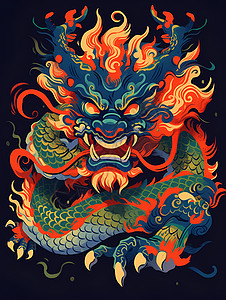
A Thousand Miles of Red
Far north of where any human lives, beyond the Yanmen Pass, on the lower slopes of a mountain that has no warmth — there lies Zhulong. The Torch Dragon. Or Torch Shade, depending on which ancient text you're reading, because the Chinese name works both ways. Zhulong illuminates, and Zhulong obscures. That duality is the whole point.
The Classic of Mountains and Seas describes a creature with a human face and a snake's body, a thousand li long and scarlet red from head to tail. A thousand li. That's roughly five hundred kilometers of dragon, coiled in the darkness of the extreme north where the sun never reaches. When Zhulong opens his eyes, it becomes day. When he closes them, night falls. When he breathes out, winter comes. When he breathes in, summer arrives.
He doesn't eat. He doesn't drink. He doesn't sleep. He just lies there, keeping time for the entire world, because in the deep north there is no sun to do the job.
The Shan Hai Jing Account
The Classic of Regions Beyond the Seas: The North gives us the most detailed description. The god of Mount Zhong is named Torch Shade. Eyes open: daylight. Eyes shut: night. Exhale: winter. Inhale: summer. He doesn't breathe in the normal sense, but when he does, it creates gales that scour the land. His body is scarlet. His form is a snake with a human face.
Guo Pu, the Jin dynasty scholar who annotated the Classic of Mountains and Seas, added: "The Enlightener is a dragon; he enlightens the nine darknesses" — meaning the nine points of the compass on the dark side of the flat-earth cosmos. Zhulong doesn't just make day and night for fun. He's holding back the dark at the edges of the known world.
A Solar God in Dragon Skin
Several scholars have noted that Zhulong reads like a solar deity who got demoted. The eye-opening/closing = day/night motif is sun mythology 101. The red coloring, the association with light and heat — these are sun god attributes wrapped in a reptilian package. But Zhulong isn't the sun. He's what replaces the sun in places where the sun can't go.
There's a theory, proposed by multiple mythologists, that Zhulong represents the aurora borealis — the northern lights. To ancient Chinese observers in the central plains, the aurora would have appeared as a vast, serpentine glow writhing across the northern sky. Red. Undulating. Sometimes bright enough to read by, sometimes gone entirely. If you'd never heard of charged particles and magnetic fields, you might describe it as a giant red dragon whose eyes controlled the light.
It's a compelling theory. The aurora does appear in the north, does vary in brightness, and ancient Chinese did call the northern lights "red spirit." But the myth works either way. Whether Zhulong is a personified aurora or a primordial solar deity, what he represents is the human need to explain why the world keeps turning even when we can't see the machinery.
What Makes Zhulong Different
Most Chinese dragons are rainmakers. They live in oceans and rivers, control the weather, and answer prayers for good harvests. Zhulong does none of this. He doesn't interact with humans at all. He doesn't grant wishes or punish the wicked. He just exists, impossibly vast, keeping the cosmic clock running through sheer presence.
In that sense, Zhulong feels older than the rest of the Chinese dragon pantheon. He belongs to a stratum of mythology where gods aren't characters in stories but forces of nature. You don't pray to Zhulong any more than you pray to gravity. He's not a deity to worship. He's a deity to acknowledge — the immense, indifferent engine that makes day follow night follow day, all the way at the edge of the world where nobody is watching.