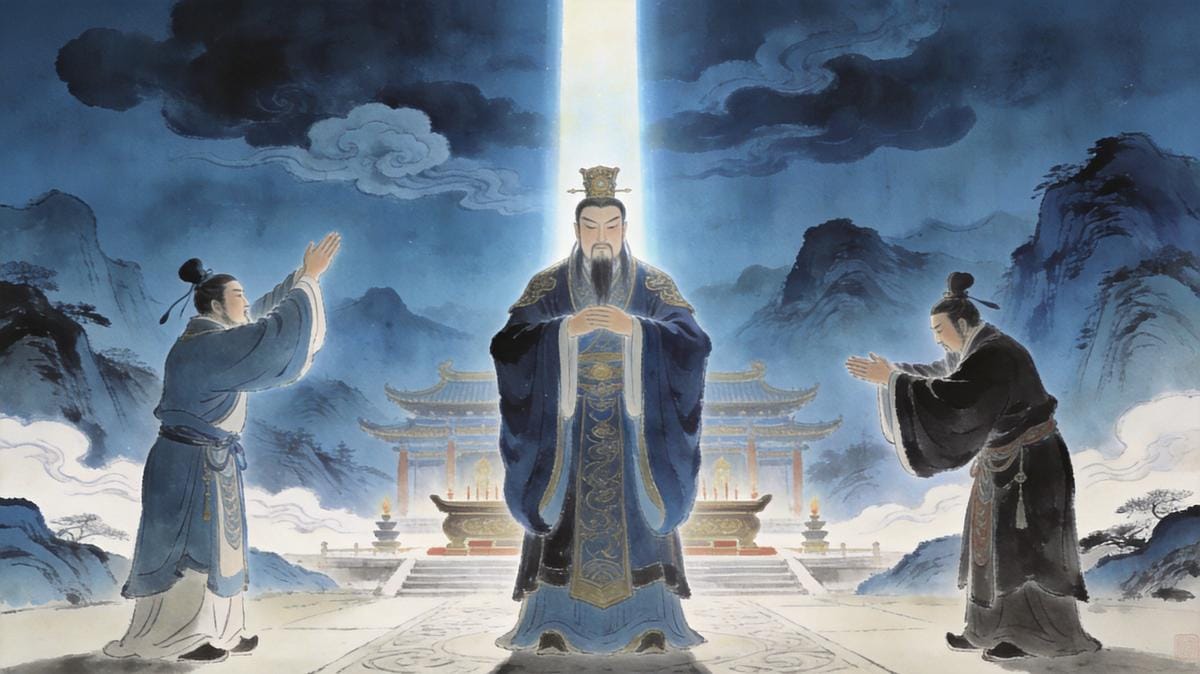
The Great Separation
Before Zhuanxu (颛顼), heaven and earth were connected. Gods walked among humans. Spirits commingled with mortals. The boundaries between the divine and the mundane were as thin as rice paper — and just as fragile. People could climb to heaven on ladders and trees. Shamans could invoke spirits at will. The dead could return without invitation. The cosmic order was, to put it gently, a mess.
Zhuanxu fixed it. He ordered the Severing of Heaven and Earth (jue di tian tong 绝地天通) — a radical act that shut the door between the two realms and established, once and for all, that gods belong in heaven and humans belong on earth. It was the mythological equivalent of a constitutional amendment: a structural change so fundamental that everything after it operated under different rules.
This makes Zhuanxu unique among the Five Emperors. Where the Yellow Emperor won wars and invented things, where Yao and Shun are remembered for their moral virtue, Zhuanxu is remembered for a single, irreversible administrative decision that reorganized reality itself.
Who Was Zhuanxu?
The Shiji provides a genealogy: Zhuanxu was the grandson of the Yellow Emperor. His father was Changyi (昌意), the Yellow Emperor's son, who was demoted to live among the common people in the Ruo River region. Zhuanxu's mother was a woman named Nüshu (女枢), and the Diwang Shiji claims that before his birth, a star of the Yao constellation appeared like a rainbow and flowed into her womb — a celestial conception to match his cosmic vocation.
The name Zhuanxu is composed of two characters: zhuan (颛, meaning "upright" or "earnest") and xu (顼, meaning "deep" or "profound"). His personal name was Gaoyang (高阳), and the Shiji notes that he was quiet and self-possessed from a young age, with a talent for strategy and a deep sense of purpose — personality traits that would define his reign.
Chaos Before the Cut
The Shu Jing (Book of Documents), in the "Lü Xing" (吕刑) chapter, describes the situation that prompted Zhuanxu's reform: "The people of Miao did not have the virtue of the spirits. They were contemptuous of the gods and neglected their duties. They used divination without sincerity and made sacrifices without reverence."
The Guoyu (国语, Discourses of the States) provides more context. In the age before Zhuanxu, "spirits and humans dwelt together without distinction. Every household had its shaman, and every shaman claimed direct access to the divine. There was no order in sacrifice, no regulation in worship, and no authority to distinguish true revelation from false." The result was spiritual anarchy — too many people claiming to speak for the gods, too many contradictory oracles, too much confusion about who actually had the ear of heaven.
This is the background against which Zhuanxu acted. The Severing of Heaven and Earth was not a philosophical gesture. It was a governance reform, targeted at a very specific problem: the democratization of divine authority was destabilizing the social order.
The Act: Jue Di Tian Tong
Zhuanxu appointed two officials to carry out the separation. The Guoyu names them: Nan Zheng (南正) Chong was given authority over heavenly affairs — all matters relating to the gods, spirits, and celestial rituals. Huo Zheng (火正) Li was given authority over earthly affairs — all matters relating to humans, administration, and civil governance.
Chong was ordered to "manage heaven and arrange the spirits." Li was ordered to "manage earth and arrange the people." The channels between the two realms were closed. No longer could any shaman or common person claim unmediated access to the divine. Communication with heaven became the exclusive domain of the state — specifically, of state-appointed religious officials.
This was, in effect, the nationalization of religion. Before Zhuanxu, spirituality was a free market — anyone could set up as a medium. After Zhuanxu, it was a regulated monopoly, controlled by the throne. The political implications were enormous. If only the state could talk to heaven, then only the state could claim divine legitimacy.
The Cosmic Geography of Zhuanxu
The Shan Hai Jing places Zhuanxu at the center of a mythological landscape that is eerily precise. He is associated with the north — his capital was at Diqiu (帝丘), modern Puyang in Henan — and the Shan Hai Jing locates his burial place on the Difu Mountain (务隅之山), where the Yellow River meets the sea. The same text describes a tree called the jianmu (建木) at the center of the world, which once served as the ladder between heaven and earth before Zhuanxu cut it down.
The Huainanzi elaborates: "In the center was the jianmu tree. In the east was the sang tree where the ten suns rested. In the west was the ruomu tree. All of these once connected heaven and earth. After Zhuanxu's reform, only the spirits of the properly ordained could ascend and descend."
The War with Gonggong
Zhuanxu's reign was not entirely peaceful. The Huainanzi records that the water god Gonggong (共工) rebelled against Zhuanxu's authority. The battle was catastrophic. When Gonggong was defeated, he smashed his head against the Buzhou Mountain (不周山) — one of the eight pillars holding up the sky. The pillar broke. The sky tilted northwest, and the earth shifted southeast. This is why, the text explains, rivers in China flow eastward and the sun, moon, and stars move toward the northwest.
Some versions attribute the Gonggong revolt to the reign of Nuwa instead, but the Zhuanxu version is widely attested. The thematic link is clear: Zhuanxu, the emperor who imposed cosmic order by severing heaven and earth, faced a backlash from the forces of chaos. Gonggong's assault on the cosmic pillar was a direct attack on the separation Zhuanxu had enacted. The pillar broke, but the separation held. Heaven and earth remained apart. The order survived, though the sky was permanently tilted.
The Religious Reformer
Zhuanxu's legacy in Chinese religious history is profound. The jue di tian tong reform established the principle that there is a proper order to the cosmos — that the sacred and the profane occupy different spheres, and that crossing between them requires authorization. This principle underlies virtually every subsequent development in Chinese ritual practice, from the Zhou dynasty's elaborate state sacrifices to the Confucian insistence that only the Son of Heaven may offer the suburban sacrifice to Heaven.
It also created the category of the "unauthorized shaman" — the folk practitioner who claimed spiritual authority without state sanction. This figure would be persecuted repeatedly throughout Chinese history, from the Han dynasty's suppression of shamanic cults to the Qing dynasty's prohibition of "heterodox teachings." All of these campaigns trace their ideological lineage back to Zhuanxu.
A Legacy of Boundaries
Zhuanxu's story is, at its heart, about the power of drawing lines. Before him, everything bled into everything else — gods and humans, sacred and secular, order and chaos. By severing heaven from earth, he created the space in which human civilization could function without constant divine interference. But he also created the space in which divine authority could be monopolized by those who controlled the official channels of communication with heaven.
The tension between these two outcomes — the liberation of the human sphere and the concentration of religious power — runs through all of Chinese history. Every time a dynasty claimed the Mandate of Heaven, it was leaning on the infrastructure Zhuanxu built. Every time a folk religion was condemned as "heterodox," it was being exiled to the wrong side of the line Zhuanxu drew.
He is worshipped as one of the Five Emperors, honored at temples in his ancestral lands. But his real monument is invisible: the space between heaven and earth, which he created and which has never closed.