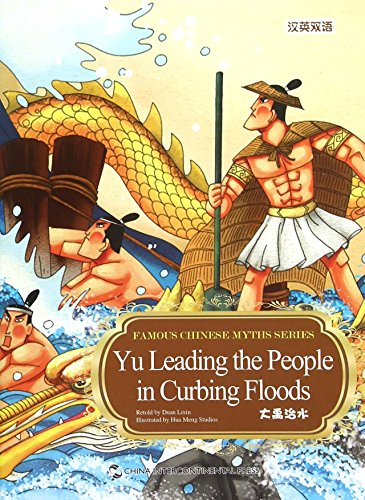
The Great Flood
In the time of Emperor Yao, a catastrophe of unimaginable scale struck the land. The waters rose — from the rivers, from the seas, from the sky itself — and covered the earth. Mountains were submerged, valleys became lakes, and the people were driven from their homes to seek refuge on the highest peaks. Crops were destroyed, villages were swept away, and famine stalked the land. The Great Flood was not merely a natural disaster but an existential threat to civilization itself, and it seemed that no human power could stand against it. The waters continued to rise year after year, and the people despaired of ever seeing dry land again.
Emperor Yao, desperate to find a solution, appointed a man named Gun to control the floods. Gun's approach was to build massive dikes and embankments to contain the waters, fighting the flood with sheer force and massive construction. For nine years, Gun labored to hold back the waters, but his strategy of containment was ultimately doomed to fail. The waters were too powerful, the floods too vast, and the dikes too fragile. Again and again, the waters broke through the barriers, and each breach brought fresh devastation. When Gun died in disgrace, his son Yu vowed to succeed where his father had failed — not by fighting the water, but by understanding it.
A New Approach
Yu's genius lay not in brute force but in a fundamentally different philosophy of flood control. Where his father had tried to contain the waters with dikes and dams, Yu proposed to guide them — to channel the flood waters along natural pathways to the sea, working with the water rather than against it. This was a revolutionary concept that reflected the Daoist principle of wu wei, or non-coercive action: instead of opposing the natural flow of water, Yu would direct it, giving it a path of least resistance and allowing it to drain harmlessly into the ocean.
Yu's plan was ambitious in the extreme. He would dredge river channels to increase their capacity, dig new canals to redirect flood waters, and create a vast network of waterways that would carry excess water away from populated areas. He would also repair the damage caused by his father's failed dikes, removing the barriers that had actually worsened the flooding by trapping water behind them. This was not merely an engineering project but a complete reimagining of the relationship between human civilization and the natural world — a vision of harmony rather than domination.
Thirteen Years of Labor
For thirteen years, Yu labored without rest. He traveled the length and breadth of the land, personally supervising the dredging of rivers and the digging of canals. He worked alongside the common laborers, carrying earth and stone, wading through mud and water, and enduring the same hardships they faced. The legends say that he wore away the nails on his hands and feet, that his skin was shriveled and calloused, and that he developed a limp from the constant strain of walking through water and mud. He carried his tools wherever he went, and his clothing was always wet and caked with earth.
The most famous legend about Yu's dedication tells of the three times he passed the door of his own home without going inside. Each time, he could hear his family inside — his wife, his children — but he refused to pause his work even for a moment, knowing that the floods could not wait and that every day of delay meant more suffering for the people. This story of self-sacrifice, known as "Three Passes Without Entering," became one of the most celebrated moral exemplars in Chinese culture, a symbol of the willingness to put the welfare of the people above personal comfort and family obligations. It established Yu as the model of the virtuous public servant, a standard that would influence Chinese political philosophy for millennia.
Divine Assistance
According to some versions of the myth, Yu did not work alone. The Yellow River, the most powerful and dangerous of all Chinese rivers, presented a challenge that even Yu's ingenuity could not overcome through engineering alone. When Yu reached the Yellow River, he was visited by a divine horse that emerged from the water and presented him with a map of the river's course, showing him the best places to dig channels and redirect the flow. This map, known as the Hetu or Yellow River Map, became one of the most sacred objects in Chinese cosmology, a symbol of the cosmic order that could be discerned through careful observation of nature.
In other versions, Yu received help from Yinglong, a winged dragon who used its tail to carve channels through the mountains, creating pathways for the flood waters to reach the sea. The collaboration between Yu and the dragon symbolizes the partnership between human ingenuity and natural forces — the idea that the greatest achievements come not from conquering nature but from working in harmony with it. This theme, which runs throughout the Yu myth, has taken on new relevance in an age of environmental crisis, when the failures of the "conquer nature" approach have become painfully apparent.
Founder of a Dynasty
Yu's success in taming the Great Flood brought him unparalleled prestige and respect. When Emperor Shun, Yao's successor, grew old, he chose Yu as his heir, bypassing his own son in recognition of Yu's extraordinary merit. Yu thus became the founder of the Xia Dynasty, traditionally regarded as the first dynasty in Chinese history. Under Yu's rule, the land that had been devastated by floods was restored to productivity, and the people who had been scattered by the disaster were reunited in stable communities. Yu divided the realm into nine provinces, established systems of taxation and governance, and laid the foundations for Chinese civilization as we know it. His legacy as both a hero and a ruler made him the ideal model of the sage-king, a leader who earned his authority through service and sacrifice rather than birthright or conquest.