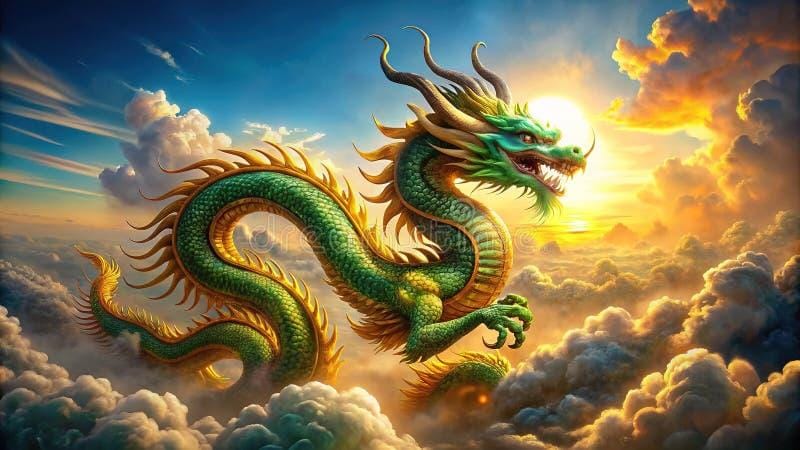
The Only Dragon With Wings
Almost every Chinese dragon you've seen in art slithers through the clouds on serpentine coils — no wings necessary. Yinglong is the exception. In the mythological record, he's described as the only Chinese dragon with actual wings. Not tiny decorative ones, either. Big, functional wings that carried him across battlefields and through the sky.
Yinglong's name means "Responsive Dragon" or "Answering Dragon," because when people prayed for rain, Yinglong answered. But before he was a rain god, he was a war god — and his first and greatest war was at the side of the Yellow Emperor.
The Battle of Zhuolu
The Yellow Emperor was fighting Chiyou, the monstrous warlord with a bronze head and four eyes who could summon fog and wind. It was the war that would decide who ruled the central plains. Chiyou had magic — thick, blinding fog that trapped the Yellow Emperor's army. The Yellow Emperor had technology — the south-pointing chariot, an early compass that kept his troops oriented. But it was Yinglong who provided the decisive strike.
The Yellow Emperor sent Yinglong to attack Chiyou. Yinglong gathered the waters, hoarding them in the upper reaches to create devastating floods. Chiyou responded by sending the gods of wind and rain to unleash a storm so fierce it nearly drowned the Yellow Emperor's army. That's when the Yellow Emperor called on his daughter Ba — the Drought Demon — whose presence drove away all rain and left the land parched and cracked.
Together, Yinglong and Ba broke Chiyou's storm. The warlord was killed, and the Yellow Emperor claimed the central plains. But the victory came at a cost. Yinglong, who had killed Chiyou, could not return to heaven. He was condemned to stay on earth, forever wandering the south.
Why the South Gets All the Rain
The Classic of Mountains and Seas explains the weather pattern of ancient China through Yinglong's exile. Because the winged dragon settled in the southern regions after the war, that's where the rain falls most abundantly. He answers prayers for water, responding from his home in the deep south. The north, by contrast, is where Ba — the Drought Demon — resides, which is why it's dry.
It's mythology functioning as climate science. The ancient Chinese noticed that southern China gets more rain than the north, and they built a story to explain it. Yinglong brings rain because that's what he does. He's in the south because that's where exile put him. The ecology and the narrative reinforce each other.
Yinglong vs. Kuafu
In a separate myth, Yinglong killed the giant Kuafu — the fool who tried to race the sun. Kuafu, dying of thirst after his chase, was finished off by Yinglong, who had been hoarding water in the region. Some versions say Yinglong killed Kuafu on purpose as part of a divine plan. Others say Kuafu simply got caught in the crossfire of Yinglong's water-hoarding strategy. Either way, the result was the same: another mythological giant fell to the winged dragon.
The Wingless Aftermath
Some later texts suggest Yinglong lost his wings as punishment for killing Chiyou. The logic goes: a dragon who sheds blood can't keep the gift of flight. This reading adds tragedy to Yinglong's story. He was the mightiest of dragons, the only one who could fly under his own power, and his service in the great war cost him the very thing that made him unique.
But even without wings, Yinglong retained his power over rain. People still prayed to him, and he still answered. The name "Responsive Dragon" took on a new meaning: he couldn't soar anymore, but he could still show up when it mattered. That's a very Chinese kind of heroism — not the glory of flight, but the reliability of the response.