The War That Made China
Every civilization has a founding war. Rome has Romulus killing Remus. Greece has the Trojan War. China has the Battle of Zhuolu — a clash between the Yellow Emperor (Huangdi, 黄帝) and the monstrous Chiyou (蚩尤) that decided not just who would rule, but what kind of civilization would emerge from the mythological age.
Huangdi is the central figure of the Five Emperors period, and arguably the most important single character in all of Chinese mythology. He is not the oldest — Suiren came before him, as did Fuxi and Shennong. But he is the one who turned a collection of tribes into something resembling a state, and the one who absorbed the innovations of his predecessors into a unified system of governance, technology, and cosmology.
The Shiji by Sima Qian, China's first systematic history, opens with Huangdi. Not with Pangu. Not with Nuwa. With Huangdi. Sima Qian chose to begin his narrative at the moment when myth crystallizes into history — and that moment belongs to the Yellow Emperor.
Birth of a Sovereign
The Shiji gives Huangdi a matter-of-fact genealogy: he was the son of Shaodian and his wife Fubao. But other sources dress the birth in supernatural detail. The Diwang Shiji records that Fubao saw a flash of lightning circling the Big Dipper and became pregnant. The Huangdi Neijing tradition claims he was born able to speak, and that he was named Xuanyuan (轩辕) after the hill where he was raised.
The name "Yellow Emperor" comes from his association with the element of earth, which in the Five Elements system corresponds to the color yellow, the center direction, and the season of late summer. He is the axis around which everything else revolves.
The Battle of Banquan: Brother Against Brother
Before Zhuolu, there was Banquan. The Shiji describes how Huangdi's half-brother (or predecessor), the Yan Emperor (Shennong's descendant or possibly Shennong himself), had lost the ability to control the feudal lords. "The feudal lords invaded each other and harassed the common people, while the Yan Emperor could not punish them." So Huangdi gathered his forces, trained his soldiers in the use of weapons, and went to war.
The two armies met at Banquan. The Shiji is terse: "Huangdi fought the Yan Emperor at Banquan. After three battles, he achieved his desire." The Yan Emperor was not killed — he was subordinated. His people were absorbed into Huangdi's coalition. This merger of the "Yan" and "Huang" peoples is the origin of the term "Yan Huang Zisun" (炎黄子孙, "Descendants of Yan and Huang"), which Chinese people still use to describe themselves.
The Battle of Zhuolu: Monster vs. Sovereign
Chiyou was not a rival king. He was something worse. The Shan Hai Jing (山海经, Classic of Mountains and Seas) describes him as having a human body but the hooves of an ox, six arms, four eyes, and a head made of iron. He ate sand, stones, and metal. The Guang Bowuzhi adds that Chiyou had seventy-two (or eighty-one) brothers, all with iron foreheads and bronze bodies, who consumed iron and copper for food.
Chiyou had already defeated the Yan Emperor and seized his territory. The Yan Emperor fled to Huangdi and asked for help. What followed was the most spectacular battle in Chinese mythology.
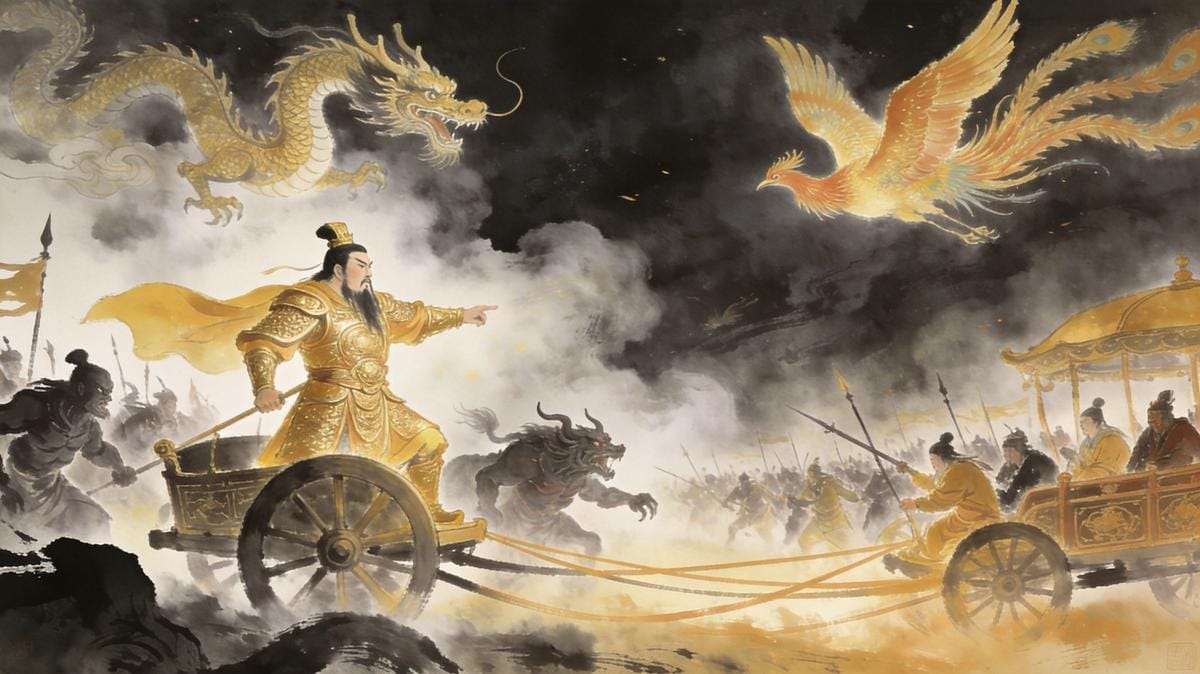
The Shi Ji records that Chiyou created a thick fog that blanketed the battlefield for three days, making it impossible for Huangdi's army to find the enemy. Huangdi responded by inventing the zhinan che (指南车, the South-Pointing Chariot) — a mechanical device with a figure that always pointed south, regardless of which direction the chariot was turned. With this navigational tool, his army cut through the fog.
The Shan Hai Jing adds further details. Huangdi sent down the yinglong (应龙, winged dragon) to attack Chiyou with torrents of water. Chiyou countered by summoning the fengbo (风伯, Wind Earl) and yushi (雨师, Rain Master) to create a devastating storm. Huangdi then called upon his daughter banü (魃, the Drought Demon), whose presence dried up all the rain. The skies cleared. Chiyou's advantage was gone.
The final blow came from the kui (夔) ox. The Shan Hai Jing describes the kui as a one-legged ox whose skin, when made into a drum, could be heard for five hundred li. Huangdi had the kui hunted, its skin made into a war drum, and its bones used as drumsticks. When the drum sounded, Huangdi's soldiers found their courage renewed while Chiyou's forces lost their nerve. Chiyou was captured and killed.
The Price of Victory
Victory at Zhuolu came at a cost. The Drought Demon, having descended from heaven to help her father, could not return. Wherever she walked, no rain fell. The Shan Hai Jing says: "Huangdi had no choice but to banish her to the north of the Red River. She is never to be invoked again." She became the spirit of drought — a reminder that even the weapons of the gods leave scars.
The yinglong also could not return to heaven after using its rain powers on earth. It went to live in the south, and the Shan Hai Jing says that wherever the yinglong dwells, there is abundant rain — which is why the south of China gets so much precipitation, according to mythological geography.
The Inventor Sovereign
After the wars, Huangdi became the most prolific inventor in Chinese mythology. His attributed creations include: the calendar, the chariot, the boat, the bow and arrow, housing, clothing (specifically robes and caps), the ding (鼎, ritual cauldron), the well, the counting board, the lu (律, musical pitch pipes), the system of weights and measures, and the institution of government with appointed officials.
Most of these attributions are retrospective — later generations projecting their inventions backward onto the culture hero. But they reveal a core truth about how the Chinese understood Huangdi: he was not just a warrior. He was an organizer. A system-builder. The person who looked at the chaos of post-war society and imposed order on every level — temporal (calendar), spatial (architecture), economic (weights and measures), social (government offices), and spiritual (ritual cauldrons, music).
The Yellow Emperor's Inner Canon
The Huangdi Neijing (黄帝内经, Yellow Emperor's Inner Canon) is the foundational text of traditional Chinese medicine. It is structured as a dialogue between Huangdi and his minister Qi Bo (岐伯), discussing the principles of yin-yang, the five elements, the meridian system, and the diagnosis and treatment of disease.
The text was compiled in the Han dynasty, roughly two thousand years after the mythological Huangdi would have lived. But the choice of Huangdi as the dialogue partner is significant. By placing the origins of medicine in the mouth of the civilization-builder, the authors were making a claim: medicine is not a separate domain. It is part of the same civilizing project as agriculture, governance, and warfare. The same mind that organized the state can organize the body.
Ascension to Heaven
The Shiji and the Fengsu Tongyi both record that Huangdi did not die. Instead, a dragon descended from heaven, and Huangdi rode it upward, along with seventy of his ministers and concubines. The common people grabbed at his clothing and bow, but could not hold on. They buried his clothes and weapons at a tomb in Qiaoshan (桥山), modern-day Huangling County, Shaanxi Province — the Mausoleum of the Yellow Emperor, which remains a national shrine visited by millions.
The dragon-ascension story is crucial. It separates Huangdi from every other figure in Chinese mythology. Suiren and Shennong died. Fuxi's fate is ambiguous. But Huangdi ascended — a distinction usually reserved for Daoist immortals. He did not merely rule the earth. He transcended it.
The Axis of Chinese Identity
More than any other mythological figure, Huangdi represents the Chinese nation itself. He is the "ancestor of Chinese civilization" in a way that no other figure quite matches. When Sun Yat-sen wanted to unite the Chinese people against the Qing dynasty, he invoked "the descendants of Yan and Huang." When the People's Republic holds ceremonies at the Yellow Emperor's Mausoleum on Qingming Festival, it is performing a ritual of civilizational continuity that stretches back, through Sima Qian, through the Han dynasty, through the Zhou, all the way to the mythic warrior-king who defeated a monster and built a state from the ruins.
Huangdi's story is, at its core, about the relationship between violence and civilization. He did not build a peaceful utopia. He killed his enemies and subordinated his allies. But from that violence, he constructed a world where calendars tracked time, where officials administered justice, where doctors understood disease, and where music gave shape to ritual. Every ordered thing in Chinese culture, the myth suggests, was born from a battlefield.