Before the Beginning
In ancient Chinese cosmology, before the existence of heaven and earth, there was only Hun Dun — a state of primordial chaos that contained all possibilities within itself. This was not the chaos of disorder and destruction found in some Western traditions, but rather a state of perfect potential, where all things existed in an undifferentiated unity. Nothing had yet taken form, nothing had yet been named, and the distinctions that would later define the world — light and dark, hot and cold, above and below — had not yet come into being.
This concept of primordial chaos was visualized as a cosmic egg, round and complete, containing the yin and yang in perfect balance. The egg shape itself was deeply symbolic in Chinese thought, representing wholeness, fertility, and the infinite potential of the unformed. Within this egg, the forces that would eventually create the universe existed in a state of dynamic tension, waiting for the moment of transformation that would set creation in motion.
The Symbolism of the Egg
The cosmic egg is one of the most widespread creation symbols in world mythology, and the Chinese version shares remarkable similarities with traditions from India, Greece, and elsewhere. In Chinese tradition, however, the egg carries particular significance because of its connection to the philosophical concept of Taiji — the Supreme Ultimate from which all duality emerges. The egg represents the state of unity before yin and yang separated, before heaven and earth were distinguished, before the multiplicity of the world came into being.
The yolk and the white of the egg were sometimes interpreted as representing yin and yang respectively — the heavy, dark yolk sinking to become the earth, and the light, pure white rising to become the sky. This natural imagery made the cosmic egg a powerful and accessible metaphor for the creation of the world, one that could be understood by anyone who had ever cracked open an egg and seen its dual nature revealed. The shell itself represented the boundary between the formless potential of chaos and the structured reality of the created world.
From Chaos to Order
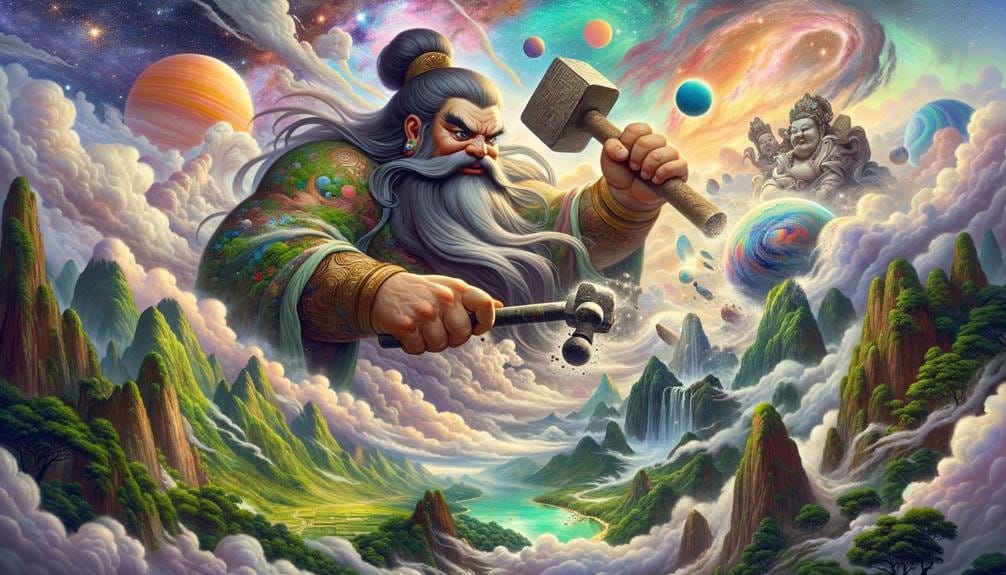
The transformation from chaos to order is the central drama of the Chinese creation myth. When Pangu broke open the cosmic egg, he did not simply destroy the shell — he initiated the process by which the undifferentiated potential of chaos became the structured reality of the world. This transition from chaos to order mirrors the philosophical journey from Wuji (the Limitless) through Taiji (the Supreme Ultimate) to the ten thousand things of manifested reality. It is a process that continues in every moment of creation and transformation.
The ancient Chinese saw this pattern repeating throughout nature — in the cycle of the seasons, in the growth of a seed into a tree, in the development of an embryo into a living being. Each of these processes begins with a state of undifferentiated potential that gradually takes form and structure through the interaction of yin and yang. The cosmic egg myth thus served as a master narrative that explained not only the origin of the world but the fundamental pattern by which all things come into being.
Hun Dun: The Spirit of Chaos
In some versions of the myth, the cosmic egg is personified as Hun Dun, a being without face or features, who represents the state of primordial chaos. In the Zhuangzi, one of the foundational texts of Daoist philosophy, Hun Dun appears as the ruler of the central region, treated kindly by the rulers of the northern and southern regions. These two rulers, wishing to repay Hun Dun's kindness, decide to bore holes in him like a human has — seven holes for seven days. On the seventh day, Hun Dun dies, and from his death, the ordered world is born.
This parable is often interpreted as a warning against imposing artificial order on natural chaos, a key theme in Daoist thought. The death of Hun Dun represents the necessary but tragic transformation from the formless potential of chaos to the fixed structures of the created world. It suggests that creation always involves a kind of destruction, and that the ordered world we inhabit came at the cost of the boundless possibilities that existed before. This philosophical depth distinguishes the Chinese creation myth from simpler narratives and reveals the sophisticated cosmological thinking of ancient Chinese civilization.
The Enduring Power of the Myth
The cosmic egg myth continues to resonate in modern Chinese culture, appearing in literature, film, and popular media as a symbol of origins and transformation. The concept of a formless potential from which all things emerge remains a powerful metaphor for creativity, innovation, and the possibility of new beginnings. In a world that often seems chaotic and uncertain, the ancient Chinese understanding of chaos as a source of creative potential offers a perspective that is both reassuring and profoundly wise. The cosmic egg reminds us that order emerges from chaos not through destruction, but through the natural unfolding of possibilities that were always present from the beginning.