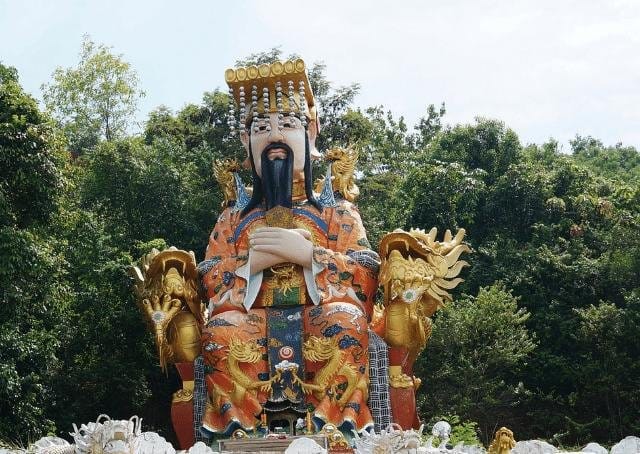
Origin of the Jade Emperor
The Jade Emperor, known in Chinese as Yuhuang Dadi, is the supreme deity of the Chinese celestial pantheon, ruling over heaven, earth, and the underworld from his magnificent palace in the highest reaches of heaven. According to tradition, the Jade Emperor was originally a prince of the kingdom of Guangyan Miaole, who renounced his throne to pursue the Dao. After cultivating his spiritual practice for one thousand seven hundred and fifty kalpas — each kalpa lasting 129,600 years — he achieved perfect enlightenment and was appointed by the primordial gods as the ruler of all creation.
This origin story is significant because it establishes that the Jade Emperor's authority is not arbitrary but earned through immense spiritual cultivation and dedication. Unlike the gods of some other traditions who rule by birthright or force, the Jade Emperor rules by virtue of his wisdom, compassion, and understanding of the Dao. He is not merely powerful — he is worthy of power, having proven himself through countless lifetimes of selfless practice. This concept of merit-based authority resonated deeply with the Chinese imperial system, where the ideal emperor ruled not through force alone but through virtue and moral example.
The Celestial Bureaucracy
One of the most distinctive features of the Jade Emperor's domain is its bureaucratic structure, which closely mirrors the imperial government of ancient China. Heaven is organized into ministries and departments, each headed by a deity with specific responsibilities. The Ministry of Thunder controls storms and weather. The Ministry of Fire governs hearths and volcanoes. The Ministry of Water oversees rivers, lakes, and oceans. The Ministry of Wealth manages fortune and prosperity. Each department functions according to strict rules and protocols, with reports filed, promotions granted, and punishments administered according to a celestial code of law.
This heavenly bureaucracy was not simply a reflection of earthly government — it was also a justification for it. By suggesting that the structure of heaven mirrored the structure of the imperial court, the myth implied that the earthly government was a reflection of divine order, and that obedience to imperial authority was tantamount to obedience to the gods themselves. The Jade Emperor, like the human emperor, appointed officials, received reports, issued decrees, and maintained order through a combination of benevolence and authority. This parallel between celestial and terrestrial government was one of the most powerful ideological tools of the Chinese imperial system.
The Zodiac Race
One of the most famous stories involving the Jade Emperor is the tale of how he created the Chinese zodiac. According to legend, the Jade Emperor decided to create a calendar system and invited all the animals of the world to participate in a race. The first twelve animals to cross a river would be honored with a year named after them, in the order they finished. The clever rat rode on the back of the ox and jumped ahead at the last moment to claim first place. The ox, steady and reliable, took second. The tiger, powerful but slowed by the current, came third, followed by the rabbit, who crossed on floating logs.
The dragon, despite being the most powerful of all the creatures, came in fifth because he had stopped to make rain for a village in need. The snake hid on the horse's hoof and startled it at the finish, taking sixth place while the horse came seventh. The goat, monkey, and rooster worked together to cross on a raft, finishing eighth, ninth, and tenth. The dog, who had stopped to play in the water, came eleventh, and the pig, who had stopped for a meal and a nap, came last. This story reveals the Jade Emperor's character — he values not only strength and speed but also cleverness, cooperation, and compassion, as shown by the dragon's selfless delay.
Judge of Souls
Beyond his role as cosmic administrator, the Jade Emperor also serves as the ultimate judge of human souls. When a person dies, their soul travels to the underworld, where it is examined by the ten courts of judgment. Each court reviews different aspects of the person's life — their deeds, their words, their thoughts, their intentions. After passing through all ten courts, the soul is brought before the Jade Emperor himself, who makes the final determination about the soul's next incarnation. Those who have lived virtuous lives are rewarded with rebirth into favorable circumstances, while those who have committed great evil face punishment before being reincarnated.
This judicial function gives the Jade Emperor a profoundly moral dimension. He is not merely a distant administrator but the ultimate arbiter of justice, the one who ensures that good is rewarded and evil is punished. This belief provided a powerful incentive for moral behavior in traditional Chinese society, where the fear of celestial judgment was a real and present concern. Even the emperor himself was said to be subject to the Jade Emperor's judgment, a belief that served as a check on earthly power and reinforced the idea that no one was above the moral law.
Worship and Modern Significance
The Jade Emperor remains one of the most widely worshipped deities in Chinese religion today. His birthday, celebrated on the ninth day of the first lunar month, is a major festival in many Chinese communities, with elaborate ceremonies, incense offerings, and communal feasts. Temples dedicated to the Jade Emperor can be found throughout China, Taiwan, Southeast Asia, and wherever Chinese communities have established themselves. In Daoist practice, the Jade Emperor is venerated as the embodiment of cosmic order and the representative of the ultimate, unknowable Dao. His continued prominence in Chinese religious life testifies to the enduring power of the ideal he represents — a just and ordered cosmos governed by wisdom and virtue.