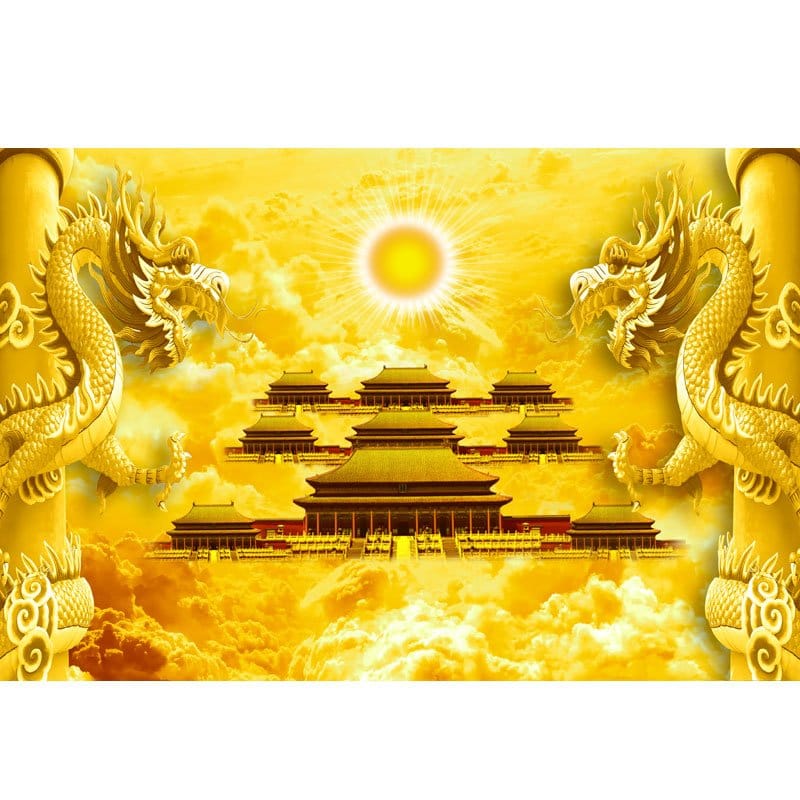
A Mirror of Empire
The Chinese heavenly court is one of the most elaborate and sophisticated mythological systems ever devised, a celestial government that mirrors the imperial bureaucracy of earthly China in remarkable detail. At its head sits the Jade Emperor, surrounded by ministers, generals, and advisors, each with specific duties and territories. Below him are the Three Pure Ones, the highest divinities of Daoism, who represent the ultimate principles of the universe. Together, these deities govern every aspect of existence, from the movements of the stars to the fate of individual humans.
The heavenly court is not a place of idle leisure but of active governance. Deities hold court, issue decrees, investigate complaints, and enforce the laws of heaven with the same diligence — and sometimes the same red tape — that characterized the earthly imperial administration. Petitions from mortals are received and processed through official channels. Reports from local deities are reviewed and filed. Promotions and demotions within the celestial hierarchy are decided based on merit and performance. This bureaucratic vision of heaven reflects a fundamentally Chinese understanding of the cosmos: that order, not chaos, is the natural state of the universe, and that this order must be actively maintained through proper governance.
The Dragon Kings of the Four Seas
Among the most important members of the heavenly court are the Dragon Kings, who rule over the four seas that surround the world. Ao Guang rules the East Sea, Ao Qin the South Sea, Ao Shun the North Sea, and Ao Run the West Sea. Each Dragon King resides in a magnificent underwater palace and commands the forces of weather, water, and marine life within his domain. They can take human form when visiting the heavenly court, and they are responsible for distributing rain to the earth according to the Jade Emperor's decrees. Their power over rainfall makes them among the most practically important deities in the Chinese pantheon, as the agricultural economy of ancient China depended entirely on timely and sufficient rain.
The Dragon Kings also serve as judges in their own right, hearing cases involving disputes over water rights, fishing territories, and maritime matters. Their courts operate according to the same principles of justice and procedure as the Jade Emperor's court, reinforcing the idea that law and order extend throughout the entire cosmos. In the famous novel Journey to the West, the Dragon King Ao Guang plays a significant role, initially opposing the Monkey King before eventually becoming his reluctant ally. This portrayal captures the complex relationship between the Dragon Kings and other celestial beings — powerful and proud, but ultimately subject to the authority of the Jade Emperor.
The Star Gods
The heavenly court also includes a host of stellar deities, each governing a particular constellation or celestial phenomenon. The most important of these is the Big Dipper, known in Chinese as Beidou, which is associated with the Northern Dipper Sovereign, a deity who controls the destinies of all living beings. According to tradition, the Big Dipper determines the length of each person's life, and prayers to the Northern Dipper Sovereign can extend one's lifespan. The Southern Dipper, Nandou, is associated with immortality and is often paired with the Northern Dipper in religious practice.
Other important stellar deities include the Weaving Girl and the Cowherd, two star-crossed lovers represented by the stars Vega and Altair, who are permitted to meet only once a year on the seventh day of the seventh lunar month, crossing the Milky Way on a bridge of magpies. Their story, celebrated during the Qixi Festival, is one of the most beloved tales in Chinese mythology and highlights the emotional dimension of the celestial court. Even the gods are subject to rules and restrictions, and even they must suffer the pain of separation from those they love. This humanization of the celestial bureaucracy made it relatable and meaningful to ordinary people, who saw in the loves and losses of the gods a reflection of their own experiences.
City Gods and Local Deities
Below the celestial court in the divine hierarchy are the local deities who govern specific cities, mountains, rivers, and communities. Every Chinese city has its own City God, or Chenghuang, who serves as both protector and judge of the community. The City God's temple is typically one of the most important religious sites in any Chinese city, and the deity is responsible for maintaining order, protecting against disasters, and judging the souls of the local dead before they proceed to the higher courts of the underworld. In many cases, historical figures known for their virtue and public service were deified as City Gods after their deaths, creating a direct link between earthly merit and celestial authority.
The Earth God, or Tudi Gong, is an even more local deity, with shrines found in virtually every village and neighborhood throughout China. The Earth God is responsible for the welfare of the land and its inhabitants, and he serves as a kind of celestial neighborhood watch, reporting the activities of mortals to the higher gods. This network of local deities, each with specific territorial responsibilities, creates a comprehensive system of divine surveillance and governance that extends to every corner of the inhabited world. No place is beyond the reach of heaven's authority, and no person is beyond the notice of the gods.
The Cosmic Order
The Chinese heavenly court represents one of the most comprehensive attempts in human history to imagine a rationally ordered cosmos. Unlike mythological systems that rely on the whims of capricious gods, the Chinese celestial bureaucracy operates according to fixed laws and established procedures. Rain falls according to schedule, souls are judged according to consistent standards, and the movements of the heavens follow predictable patterns. This vision of cosmic order reflects the fundamental Chinese philosophical conviction that the universe is not chaotic but rational, not arbitrary but lawful, and that human beings can understand and align themselves with this order through proper conduct and correct ritual practice.