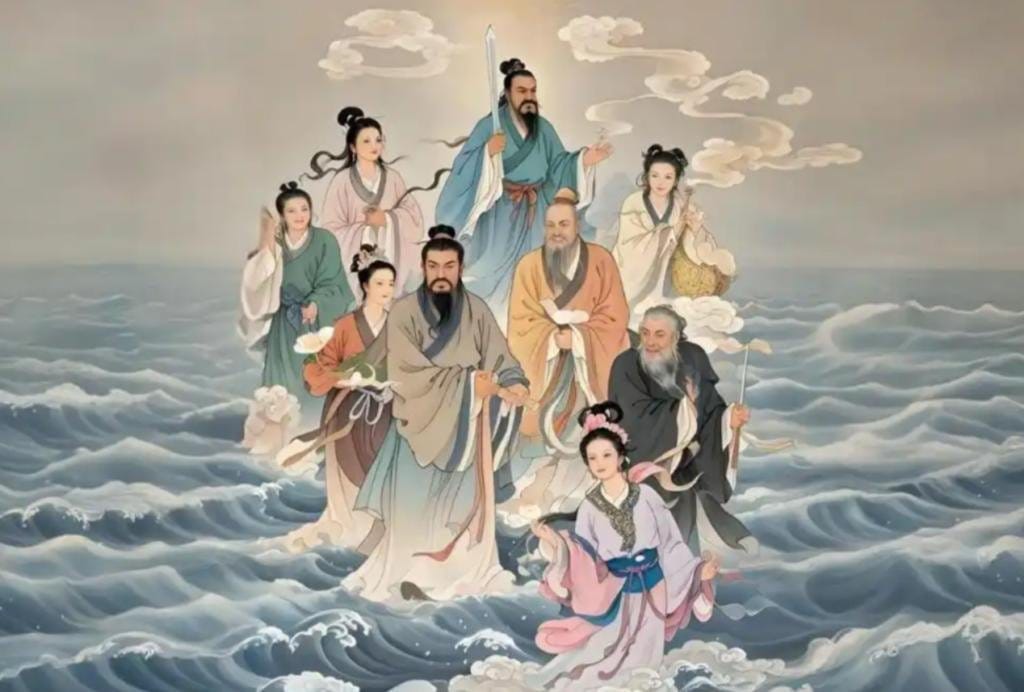
Who Are the Eight Immortals?
The Eight Immortals, known in Chinese as Baxian, are perhaps the most beloved and widely depicted figures in all of Chinese mythology. Unlike the distant and awesome deities of the celestial court, the Eight Immortals are approachable, eccentric, and thoroughly human in their personalities and foibles. They consist of six men and two women from wildly different backgrounds — a prince, a beggar, a scholar, a soldier, a young woman, an old woman, a wealthy patron, and an eccentric hermit. Together, they represent the Daoist ideal that enlightenment and immortality are available to anyone, regardless of social status, age, or gender.
The Eight Immortals are not merely individual heroes but a collective symbol of diversity and inclusion. Their very composition — spanning the full spectrum of Chinese society — sends a powerful message that the Dao does not discriminate. The path to immortality is not reserved for the wealthy, the powerful, or the educated. It is open to all who are sincere in their practice and dedicated to their spiritual development. This egalitarian message has made the Eight Immortals enormously popular among ordinary people throughout Chinese history, and their images can be found in temples, homes, and businesses across the Chinese-speaking world.
Li Tieguai: The Iron-Crutch Immortal
Li Tieguai is perhaps the most visually striking of the Eight Immortals, typically depicted as a crippled beggar with an iron crutch and a gourd of medicine. According to legend, Li was originally a handsome scholar named Li Xuan who practiced Daoist meditation. One day, he decided to leave his body and travel to the heavens in spirit to meet with Laozi. He instructed his disciple to watch over his physical body and burn it after seven days if his spirit had not returned. On the sixth day, the disciple received news that his mother was dying, and he cremated Li's body so he could visit her. When Li's spirit returned on the seventh day, he found his body destroyed and was forced to inhabit the corpse of a recently deceased beggar.
This transformation from handsome scholar to crippled beggar is rich with symbolic meaning. It suggests that true spiritual attainment has nothing to do with physical appearance or social status, and that the highest wisdom may reside in the most humble and unexpected vessels. Li Tieguai's gourd of medicine also connects him to the healing arts, and he is often invoked as a patron of pharmacists and doctors. His iron crutch symbolizes perseverance and the ability to overcome physical limitations through spiritual strength. In art, he is often shown leaning on his crutch with a cheerful expression, embodying the Daoist ideal of finding joy and freedom despite life's apparent limitations.
He Xiangu and Lan Caihe: The Gender Transcenders
He Xiangu is the only unambiguously female member of the Eight Immortals, typically depicted as a beautiful young woman carrying a lotus flower. According to tradition, she was a Tang Dynasty maiden who refused to marry, choosing instead to pursue spiritual cultivation. She survived on powdered mother-of-pearl and jade and eventually achieved immortality after eating a miraculous peach. Her lotus flower symbolizes spiritual purity and the ability to rise above worldly concerns, while her rejection of marriage represents the Daoist ideal of freedom from social obligations and attachments.
Lan Caihe is perhaps the most gender-ambiguous figure in the Chinese pantheon, sometimes depicted as male, sometimes as female, and sometimes as androgynous. Lan Caihe is typically portrayed as a street performer who wears one shoe and goes barefoot on the other foot, carrying a basket of flowers and singing songs that mock worldly conventions. This fluidity of gender identity is remarkable for a tradition that is often stereotyped as rigidly patriarchal, and it suggests that the Dao transcends all binary distinctions, including those of gender. Lan Caihe's songs, which celebrated the impermanence of all things and the folly of worldly ambition, were said to bring comfort to the poor and trouble to the powerful.
Zhongli Quan and Lu Dongbin: The Masters
Zhongli Quan, also known as Han Zhongli, is the leader and teacher of the Eight Immortals, typically depicted as a stout, bare-chested man with a fan that can revive the dead. According to legend, he was a general during the Han Dynasty who abandoned his military career after encountering a Daoist master who taught him the secrets of immortality. His fan, which he uses to magically transform stones into gold and to bring the dead back to life, symbolizes the transformative power of Daoist practice. Zhongli Quan is also credited with discovering the Elixir of Life, and he is the master who initiated Lu Dongbin into the secrets of immortality.
Lu Dongbin is the most famous and most widely worshipped of the Eight Immortals, a scholar-warrior who carries a fly-whisk and a magical sword that can slay demons and cut through ignorance. His story is the most extensively developed of all the Eight Immortals, with numerous tales of his adventures, his encounters with temptation, and his efforts to help humanity. In one famous episode, he spent ten years in a dream in which he experienced an entire lifetime — achieving worldly success, suffering devastating loss, and finally awakening to the emptiness of worldly ambition. This dream, inspired by the story of the Yellow Millet Dream, convinced him to devote himself fully to the pursuit of immortality.
Cao Guojiu, Zhang Guolao, and Han Xiangzi
The remaining three Immortals round out this diverse group. Cao Guojiu, the Royal Uncle, is the most aristocratic of the Eight, typically shown wearing official robes and carrying castanets. Despite his high birth, he chose the path of spiritual cultivation over worldly power, symbolizing the rejection of material success in favor of inner development. Zhang Guolao is an eccentric old man who rides a white donkey backwards and carries a bamboo drum, representing the value of experience and the wisdom of age. Han Xiangzi, the nephew of the famous Tang Dynasty poet Han Yu, is a young musician who plays a jade flute that can make flowers bloom and wither at will, embodying the transformative power of art and beauty. Together, these eight remarkable beings represent the full spectrum of human experience and the universal possibility of transcendence.