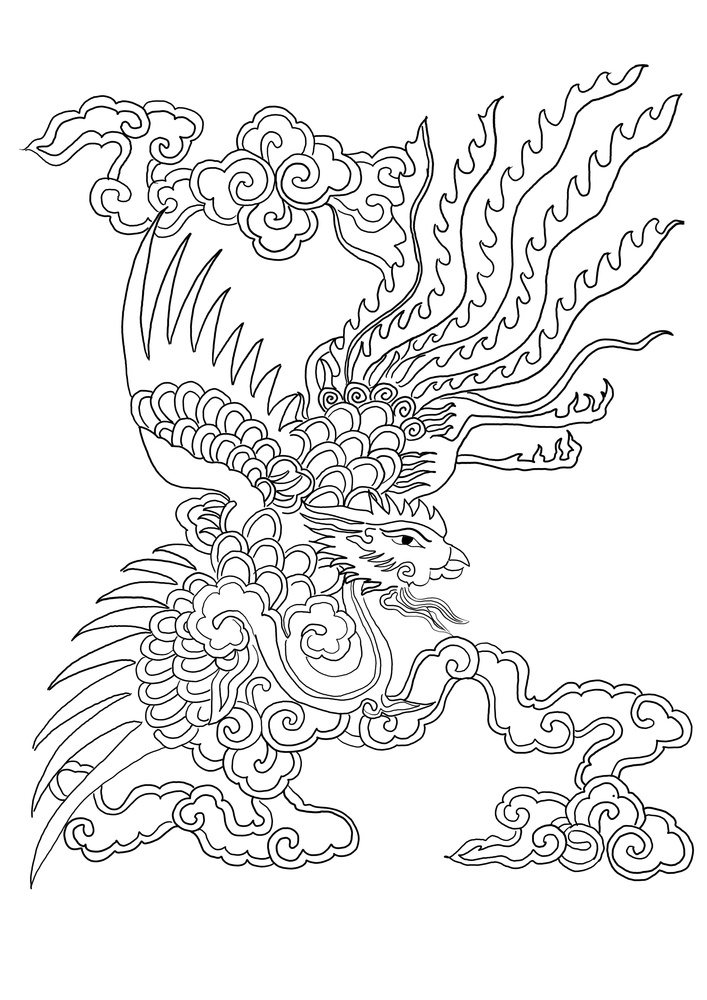
Not the Western Phoenix
The Chinese phoenix, or fenghuang, is one of the most frequently misunderstood creatures in Chinese mythology, largely because it shares a name with the phoenix of Western tradition. But the fenghuang is a fundamentally different creature with a fundamentally different symbolism. The Western phoenix is a bird that dies in flames and is reborn from its own ashes, a symbol of resurrection and immortality through destruction. The Chinese fenghuang, by contrast, is a creature of eternal grace and virtue that never dies and is never reborn — it simply exists as a living embodiment of moral perfection and cosmic harmony. Conflating these two creatures obscures the unique and profound significance of the fenghuang in Chinese culture.
The name fenghuang itself reveals important aspects of the creature's nature. Originally, feng referred to the male bird and huang to the female, and together they represented the perfect union of yin and yang, masculine and feminine, in harmonious balance. Over time, however, the fenghuang became increasingly associated with the feminine principle, particularly as it was paired with the dragon, which represented the masculine. In the imperial period, the dragon symbolized the emperor and the fenghuang symbolized the empress, and this pairing became one of the most common motifs in Chinese art and decoration. The fenghuang thus represents not only individual virtue but the ideal of complementary balance between opposing forces.
The Anatomy of Perfection
Like the dragon, the fenghuang is a composite creature, combining features from multiple animals into a single, perfect form. According to traditional descriptions, the fenghuang has the head of a pheasant, the beak of a swallow, the throat of a snake, the neck of a tortoise, the legs of a crane, the tail of a peacock, and the wings of a mandarin duck. Its plumage contains the five fundamental colors — black, white, red, yellow, and green — each corresponding to one of the five Confucian virtues: benevolence, righteousness, propriety, wisdom, and sincerity. Every aspect of the fenghuang's appearance is thus imbued with moral significance, making it not merely a beautiful creature but a living representation of ethical perfection.
The fenghuang's song is said to contain the five musical notes of the Chinese scale, and its appearance is always accompanied by beautiful music and sweet fragrances. It perches only on the finest trees, eats only the most precious seeds, and drinks only from the purest springs. In every aspect of its existence, the fenghuang demonstrates a commitment to quality, purity, and excellence that serves as a model for human behavior. This association with refinement and moral cultivation made the fenghuang a particularly important symbol for the Chinese literati, who saw in its perfection an ideal toward which they could aspire in their own lives and scholarship.
The Bird of Auspicious Omen
In Chinese tradition, the appearance of the fenghuang is considered the most auspicious of all omens, signifying that a just and virtuous ruler sits upon the throne and that peace and prosperity prevail throughout the land. According to legend, the fenghuang appeared during the reigns of the greatest sage-kings — Yao, Shun, and Yu — and its presence was taken as confirmation that these rulers governed with wisdom and benevolence. Conversely, the disappearance of the fenghuang was seen as a sign that a dynasty had lost the Mandate of Heaven and that chaos and suffering would follow.
The most famous story of the fenghuang's appearance involves the legendary Emperor Shun, who was said to have been so virtuous that the fenghuang came to dance in his courtyard and sing songs of praise. This story established the fenghuang as the ultimate validator of political legitimacy — a ruler who could attract the fenghuang was, by definition, a ruler who governed justly and wisely. This belief gave the fenghuang enormous political significance, and rulers throughout Chinese history sought to associate themselves with the bird through art, architecture, and ceremonial practice. Even the suggestion that a fenghuang had been sighted could bolster a ruler's legitimacy and strengthen public confidence in the government.
The Fenghuang and the Empress
During the Ming and Qing dynasties, the fenghuang became the exclusive symbol of the empress, just as the dragon became the exclusive symbol of the emperor. The empress's headdress was called the fengguan, or "phoenix crown," and was adorned with images of the fenghuang in gold, pearls, and precious gems. The empress's robe was embroidered with fenghuang motifs, and her personal quarters were decorated with fenghuang imagery. This association was not merely decorative but carried deep symbolic meaning — the empress, like the fenghuang, was expected to embody the virtues of grace, wisdom, and moral refinement, and to serve as the complementary partner to the emperor's strength and authority.
The pairing of dragon and fenghuang in imperial art and architecture represented the ideal of yin-yang harmony in governance. The dragon brought power and protection, while the fenghuang brought grace and wisdom. Together, they symbolized the perfect balance of masculine and feminine energies that was necessary for just and effective rule. This symbolism extended beyond the imperial court into the broader culture, where the dragon-phoenix pair became a common wedding motif, representing the ideal of marital harmony and mutual respect. Even today, dragon and phoenix imagery is standard at Chinese weddings, a wish for the newlyweds to enjoy the same balance of strength and grace that these ancient symbols represent.
The Fenghuang in Modern Culture
The fenghuang continues to be an important cultural symbol in modern China, appearing in art, fashion, architecture, and popular media. The city of Fenghuang in Hunan Province, named after the mythical bird, is one of China's most popular tourist destinations, attracting visitors with its beautifully preserved ancient architecture and its atmospheric riverfront setting. The fenghuang also appears in contemporary Chinese literature and film, where it is often used as a symbol of female empowerment and moral integrity. In a culture that is rapidly modernizing and changing, the fenghuang serves as a reminder that the highest values — virtue, grace, and harmony — are timeless, and that the pursuit of moral perfection remains as relevant today as it was in the age of the sage-kings.