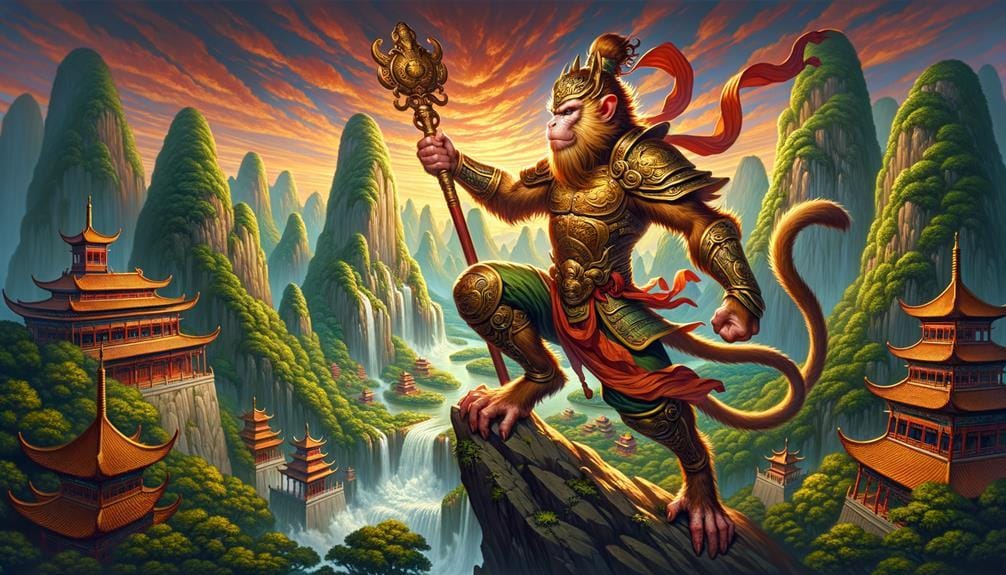
Born From Stone
Before he was the Great Sage Equal to Heaven, before he wore the golden headband or carried the Ruyi Jingu Bang, Sun Wukong was just a rock on the Mountain of Flowers and Fruit. Not even a special rock — just one that happened to sit in the right spot, soaking up the essence of heaven and earth for who knows how many centuries. When the stone finally cracked open, out tumbled a monkey with golden eyes that shot beams of light all the way to the Jade Emperor's palace.
That first light show put heaven on notice. The Jade Emperor looked down, saw the beams, and basically shrugged. "It's just a monkey," he told his ministers. "Let it be." That turned out to be one of the worst managerial decisions in all of Chinese mythology.
The Daoist Dropout Who Learned Too Much
Wukong wasn't content to be an ordinary monkey. He watched his fellow apes grow old and die, and the fear of mortality gnawed at him. So he built a raft and sailed across the ocean to find a teacher. He found Subhuti, a Daoist immortal, who gave him a name — Sun Wukong, "Monkey Awakened to Emptiness" — and taught him the 72 transformations, cloud-somersaulting (one flip covered 108,000 li), and a bunch of other tricks that no mortal should probably have.
Here's the thing about Wukong: he was brilliant. Annoyingly, terrifyingly brilliant. He mastered in years what other immortals took centuries to learn. And the moment he had power, he started using it with the subtlety of a hurricane.
Why He Wrecked the Peach Banquet
The trouble really started when the Jade Emperor, trying to keep Wukong busy, gave him a title — "Keeper of the Heavenly Horses." Wukong was insulted. It was a job with no rank. He wanted respect, not a stable-cleaning gig. So he rebelled, declared himself the Great Sage Equal to Heaven, and the Jade Emperor, hoping to placate him, gave him a better title but still no real authority.
Then came the Peach Banquet. Every few hundred years, heaven threw a party, serving peaches of immortality, heavenly wine, and Laozi's golden pills of longevity. Wukong wasn't invited. He found out by accident, crashed the preparations, ate the peaches, drained the wine, and swallowed Laozi's pills like candy. When the guests arrived, there was nothing left.
Was it petty? Absolutely. But there's something deeply human about it. Wukong wasn't trying to destroy heaven — he just wanted a seat at the table. The establishment refused, so he flipped the table over.
The Battle Nobody Won
Heaven threw everything at him. The Hundred Thousand Celestial Soldiers. The Four Heavenly Kings. Nezha with his six arms. Erlang Shen with his truth-seeing third eye. Wukong fought them all, sometimes turning into a giant, sometimes shrinking to the size of a bug, sometimes just whacking them with his staff.
Laozi finally captured him by dropping his diamond snare from above. They tried to execute Wukong — but his body was diamond-hard from all those golden pills. They tried to burn him; he came out with fiery golden eyes. They locked him in Laozi's furnace for 49 days, hoping the samadhi fire would reduce him to ash. Instead, he kicked the furnace open, stronger and angrier than before.
The Price of the Headband
Buddha stepped in. Not to fight — that would have been beneath him. He made Wukong a bet: if the monkey could jump out of Buddha's palm, he'd get to rule heaven. Wukong, confident in his cloud-somersault, leaped to the edge of the universe, where he saw five massive pillars. He wrote his name on them as proof and jumped back. But the "pillars" were Buddha's fingers. Wukong had never left his palm.
He was trapped under Five Elements Mountain for five hundred years. Then a monk named Xuanzang freed him — on one condition. Guanyin placed a golden headband on Wukong's crown. If he disobeyed the monk, Xuanzang would recite a sutra, and the band would tighten until Wukong's skull felt like it was cracking open.
That headband is the whole story in miniature. Wukong had limitless power and zero discipline. The headband forced him to learn something harder than any martial art: patience. Loyalty. Trust in someone weaker than himself.
What Makes Wukong Endure
Sun Wukong is not a hero in the Western mold. He doesn't stand for justice or truth. He stands for the refusal to accept your place. He's the working-class kid who looks at the old boys' club and says, "Why not me?" Sometimes that makes him destructive. Sometimes it makes him brave. Most of the time, it makes him both.
Every generation in China has remade Wukong in its own image. The 1964 animated film turned him into a revolutionary. The 2015 game made him a tragic figure. On the internet, he's a meme about workplace frustration. The character endures because the question he asks never gets old: who gets to decide where I belong?