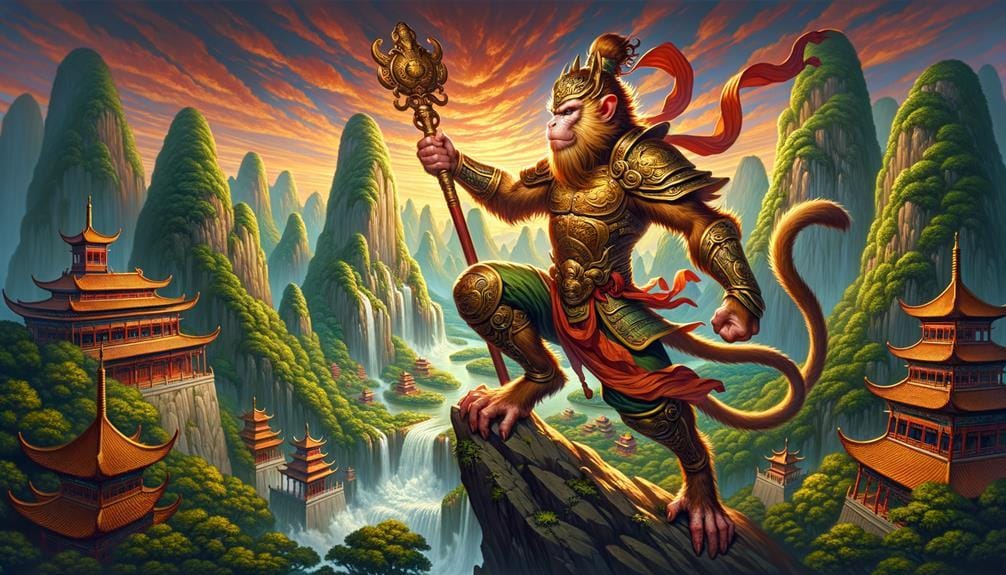
A Game That Made the World Care About Chinese Mythology
When Black Myth: Wukong dropped in August 2024, it didn't just break sales records — it introduced millions of people worldwide to a mythology they'd never encountered before. The game sold 10 million copies in its first three days. Players who couldn't tell you the difference between Nuwa and Nüwa were suddenly obsessed with yaoguai, celestial bureaucracy, and a monkey who punched his way through heaven.
And here's the thing that makes this game special for mythology nerds like us: it didn't just use Chinese mythology as window dressing. The developers at Game Science clearly loved this material. They didn't simplify it for Western audiences or sand down the weird edges. They leaned into the strangeness, the complexity, and the sheer storytelling ambition of Journey to the West and the broader mythological universe it lives in.
The result is a game that works on two levels. For newcomers, it's a stunning action game with a monkey hero and cool monsters. For people who know the mythology, it's a deep, reverent, sometimes provocative reimagining that asks "what if the story didn't end the way we were told?"
The Premise: What Happens After the Journey?
In the original Journey to the West, Sun Wukong completes his 14-year pilgrimage with the monk Tang Sanzang, defeats the demons, protects his master, and is rewarded with Buddhahood. He becomes the "Victorious Fighting Buddha" (斗战胜佛). Happy ending, right?
Black Myth: Wukong says: what if that ending was a lie?
The game opens with Wukong seemingly defeated — or maybe he just stopped fighting. The celestial powers that be have imprisoned him, stripped him of his powers, and the world has moved on. You play as the "Destined One" (天命人), a small macaque who might be Wukong's successor, setting out on a journey to recover Wukong's six senses (the relics of his scattered power).
This is not a retelling of Journey to the West. It's a sequel. And that's what makes it fascinating from a mythological perspective. The game asks questions that the original text never answered. What does it mean for a rebel to become part of the establishment? Can you truly achieve enlightenment if you're forced into it? Is heaven's authority legitimate, or just another form of oppression?
These aren't questions Western games typically ask. They come directly from Chinese philosophical traditions — specifically the tension between Daoist individualism and Buddhist submission, between the mandate of heaven and the right to rebel. The game doesn't answer them neatly. It lets you sit with the discomfort.
The Yaoguai: Monsters With Backstories That Break Your Heart
In Journey to the West, the demons Wukong fights are mostly obstacles — they exist to be defeated so the pilgrims can continue. The novel gives some of them sympathetic backstories (like the White Bone Spirit, who just wants to eat the monk's flesh to become human), but for the most part, they're villains of the week.
Black Myth: Wukong flips this completely. Almost every boss you fight has a tragic, humanizing story. Many of them are former celestial beings who were cast out of heaven for petty reasons. Some are animals who gained sentience through centuries of spiritual cultivation, only to be persecuted by the heavenly bureaucracy. A few are genuinely trying to do good in a world that's abandoned them.
This mirrors a broader theme in Chinese mythology that doesn't get enough attention: the line between "god" and "demon" is paper thin. The same celestial system that elevated Wukong to Buddhahood also condemned countless beings to yaoguai status for the crime of existing outside the established order. The game makes you feel this tension in every boss fight. You're not slaying monsters — you're putting down beings who might have been your allies in a fairer world.
Take the Black Bear Spirit (黑熊精), one of the earliest bosses. In the original novel, he's a straightforward villain — a bear demon who steals Tang Sanzang's cassock. In the game, he's a guardian of a burning mountain, someone who tried to protect his forest and was corrupted by the celestial fire meant to punish him. You feel bad defeating him. That's deliberate.
Or consider the White Clad Noble (白衣秀士), a snake demon who appears as a refined scholar. In Chinese folklore, snakes that cultivate for centuries can transform into human form, and many are portrayed as longing for the human experience. The game captures this beautifully — he's elegant, melancholic, and fighting you because he has no choice. The celestial order won't accept him, and the mortal world fears him. He's stuck between two worlds, which is exactly where Chinese mythology puts so many of its most interesting characters.
The Celestial Bureaucracy: Heaven as Corporate Hell
Chinese mythology features one of the most elaborate bureaucratic systems ever imagined. The Heavenly Court has departments, ranks, memorials, and performance reviews. The Jade Emperor doesn't rule through divine right alone — he manages a sprawling administrative apparatus. Think the DMV, but with immortality benefits.
Black Myth: Wukong captures this brilliantly. The celestial beings you encounter are not wise, benevolent deities. They're middle managers. They follow rules they don't understand, enforce hierarchies they didn't create, and punish anyone who questions the system. Sound familiar?
This reading of Chinese mythology isn't new — scholars have noted the satirical subtext in Journey to the West for centuries. The novel was written during the Ming Dynasty, a period notorious for bureaucratic corruption, and many readers have interpreted Wukong's rebellion against heaven as a veiled critique of Ming governance. The game just makes the subtext text. When a celestial official tells you that "order must be maintained" while standing over a village his soldiers just destroyed, the parallel to real-world power structures is impossible to miss.
The game also draws on a Daoist tradition of anti-authoritarian storytelling. In Daoism, the natural world is inherently just — it's human (and celestial) institutions that create injustice. Wukong, as a being born from nature itself, represents the Daoist ideal of spontaneous, unmediated power. The Heavenly Court represents the Confucian obsession with order and hierarchy. The conflict between them isn't just a fight — it's a philosophical debate expressed through combat.
Visual Mythology: Bringing Ancient Art to Life
One of the game's most remarkable achievements is how it translates Chinese visual art traditions into a modern medium. The boss designs draw from temple sculptures, scroll paintings, and folk art that most Western players have never seen. The Tiger Vanguard isn't just a tiger-man — he's modeled after the guardian tiger statues that sit outside Chinese temples, reimagined at night when no one's watching.
The environments tell mythological stories too. The ancient temple you explore isn't just a level — it's a recreation of the kind of Buddhist cave temples found in Dunhuang and Longmen, complete with murals depicting scenes from Buddhist mythology. The misty mountains echo the landscape paintings of the Song Dynasty. Even the fog isn't just fog — it's the qi (气) that Chinese philosophers believed permeated all living things.
The attention to detail borders on obsessive. The armor designs reference actual Ming Dynasty military equipment. The temple layouts follow feng shui principles. The calligraphy on scrolls and tablets uses historically accurate scripts. Game Science reportedly consulted with historians, Buddhist scholars, and traditional artisans during development. This is why the game feels authentic in a way that most "mythology-themed" games don't — it was built by people who understand the material at a scholarly level.
Game Science didn't just make a game that looks like Chinese mythology. They made a game that thinks like Chinese mythology. And that's a much harder trick to pull off.
Why This Matters Beyond Gaming
Black Myth: Wukong matters because it proves that Chinese mythology can be a global cultural force. For too long, Greek and Norse mythology have dominated Western pop culture. Every superhero movie draws from Zeus and Thor. Every fantasy game features elves and dwarves. Meanwhile, the mythology of a quarter of humanity has been treated as a niche interest.
This game changed that. Millions of people who never would have picked up a copy of Journey to the West are now deeply invested in its characters and themes. They're learning about yaoguai, about the Eight Immortals, about the complicated relationship between Buddhist and Daoist cosmology in Chinese thought. They're Googling "what is the Heavenly Court" and falling down rabbit holes that lead them to sites like this one.
And the game respects them enough to not dumb things down. That's rare and valuable. The mythology isn't simplified into "good vs. evil" — it's presented as the morally complex, philosophically rich tradition it actually is. If you played Black Myth: Wukong and want to understand the mythology behind it, you're in the right place. Welcome to the deep end.