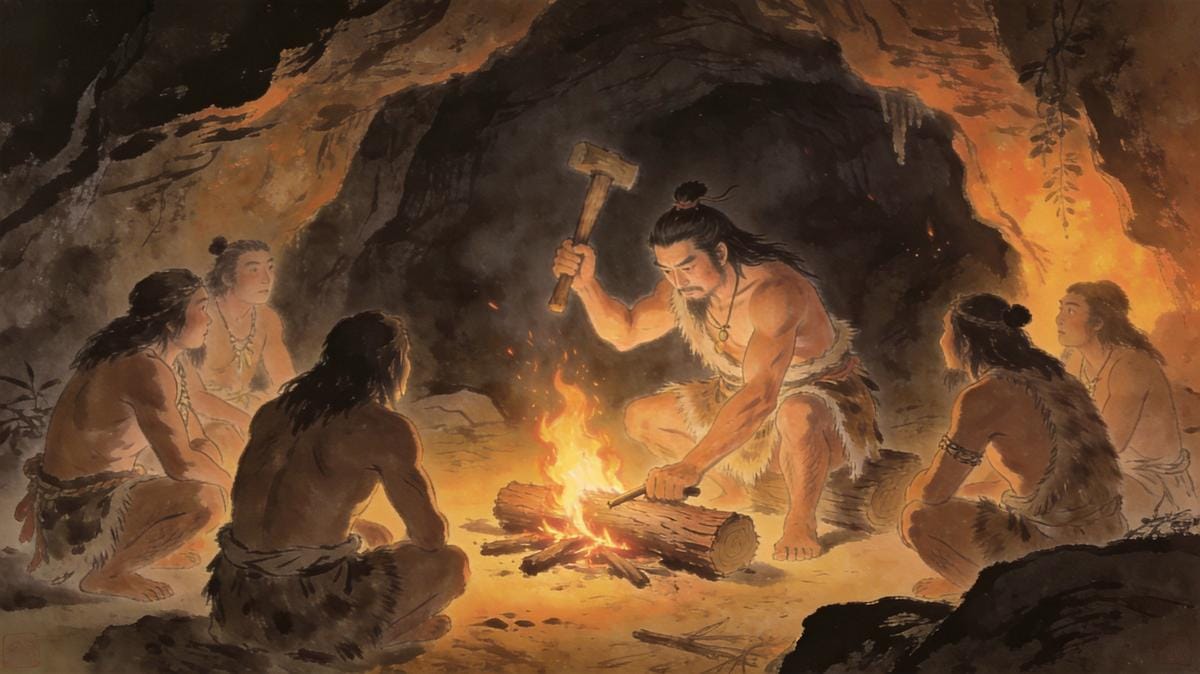
Before the Flame
Picture this: a world without fire. No warmth when the sun disappears. No cooked food. No light to push back the thing with glowing eyes that circles your camp every night. You huddle closer to the others, shivering, stomach churning from another meal of raw meat. Your teeth ache. Your gut is a war zone. You live maybe thirty years if nothing eats you first.
This was the world before Suiren (燧人). The "Flint Man." The person who, according to Chinese mythology, cracked the secret of fire and dragged humanity out of the raw, cold dark into something resembling civilization.
The name says it all. Sui (燧) means "fire-starter" — not just flint, but any tool or method for creating fire. The Liji (Book of Rites) breaks it down further: musui (木燧) for wood-based fire drills, and yangsui (阳燧) for bronze mirrors that concentrate sunlight. Ren (人) simply means "person." So his name literally translates to "Fire-Starting Person" — a title, not a birth name, which tells you everything about how he was remembered.
The Legend of the Sui Wood
The most famous version of Suiren's story comes from the Shi Ji (拾遗记, not to be confused with Sima Qian's Shiji). It paints a scene straight out of a fever dream.
There was a place called Suiming (燧明国), a country shrouded in perpetual darkness. No sun. No moon. No seasons. The people there were said to be immortal — when they grew tired of living, they simply ascended to heaven. In the heart of this shadowed land grew a tree called the Sui Wood (燧木), its roots and canopy stretching across ten thousand qing of land, clouds and mist swirling between its branches.
According to the Taiping Yulan, which quotes the lost Shi Ji by Wang Jia, a sage traveled to this remote country and rested beneath the enormous tree. He noticed birds — some say owls — pecking at the trunk. Each peck produced a flash of fire. The sage watched, and something clicked. He broke off a branch, pressed it against another piece of wood, and spun it. Smoke. Then flame.
He had done it. He had made fire from nothing but wood and persistence.
He brought this knowledge back to his people, and they never lived in cold or darkness again. They named him Suiren — the one who brought the fire.
What the Classics Actually Say
Suiren appears in ten books from the Han dynasty or earlier. Five of them specifically credit him with inventing the wood drill for fire. These include three Confucian works — the Bai Hu Tong (白虎通), the Zhong Lun (中论), and the Fengsu Tongyi (风俗通义) — plus the Legalist Han Feizi (韩非子) and the historical textbook Gu San Fen (古三坟).
The Han Feizi, written around the 3rd century BCE, puts it bluntly: "In the age of antiquity, the people ate raw meat and drank blood... A sage appeared who drilled wood to make fire and eliminated the rank and foul smells. The people rejoiced and made him ruler of the world, calling him Suiren." No mythology, no magic birds — just a person who solved a problem and got promoted for it.
The Shangshu Dazhuan (尚书大传) ranks him highest among the Three Sovereigns: "Suiren is the Sovereign of Heaven (燧皇). He ruled through fire, for fire represents the sun. The sun is yang, and yang is supreme. Therefore Suiren represents Heaven and stands first among the Three Sovereigns."
More Than Just Fire
Later traditions expanded Suiren's resume considerably. The Lushi (路史) by Luo Mi credits him with observing the heavens and establishing the concept of tiandao (天道), the Way of Heaven. He supposedly gave names to mountains, rivers, and all things — establishing didao (地道), the Way of Earth. And he recognized that human survival depends on following both, which became rendao (人道), the Way of Man.
The same text claims he established the first surnames and marriage rules, preventing the chaos of uninhibited unions. He also created jiesheng jishi (结绳记事) — recording events by tying knots in rope, a system that preceded writing.
Are these later embellishments? Almost certainly. But they reveal how Chinese culture understood the significance of fire: it wasn't just about warmth. Fire was the first domino. Cooked food meant better nutrition, which meant bigger brains and longer lives. Fire meant you could work after dark. Fire meant protection from predators. Fire meant you could smelt metal, bake pottery, clear land for farming. Every subsequent invention in Chinese mythology — from Fuxi's nets to Shennong's plow to the Yellow Emperor's chariots — depends on someone first taming fire.
The Father of Fuxi?
Some traditions, particularly later ones, claim Suiren was the father of both Fuxi and Nüwa. This genealogical detail is interesting but not widely attested in the earliest sources. It does, however, reinforce a narrative logic: the person who gave humanity fire comes first, and the person who gave humanity civilization (Fuxi) comes next. The fire precedes the structures built upon it.
A Different Kind of Hero
What makes Suiren unusual among the Three Sovereigns is how grounded his story feels. Compare him to Fuxi, who invented the eight trigrams and received revelations from a dragon-horse. Or Shennong, who had a transparent body and tasted a hundred herbs in a day. Suiren just... watched a bird peck a tree and figured out friction.
That is the most plausible origin story in all of Chinese mythology. Archaeological evidence shows that humans were using fire at least 400,000 years ago in China — long before any mythological timeline. The specific technique of drilling wood to create fire is well-documented across ancient cultures worldwide. Suiren's legend isn't about gods intervening in human affairs. It's about a person paying attention and being clever.
Even his traditional reign length — 110 years — has a practical quality to it. Not 10,000 years like the cosmic sovereigns, not even 197 years like Fuxi. Just a long human lifetime spent doing useful work.
Suiren's Legacy
Suiren is worshipped as Suihuang (燧皇), the Flint Emperor, and honored as the huozu (火祖), the Ancestor of Fire. His burial mound, the Suihuangling (燧皇陵), still stands in Shangqiu, Henan Province — the same area identified as the ancient Suiming kingdom. Archaeological finds in the region support the idea that it was an early center of fire-making technology.
Today, Suiren remains the most humble of the Three Sovereigns. He didn't create the universe like Pangu. He didn't mold humans from clay like Nüwa. He didn't decode the cosmos like Fuxi. He just gave people fire — and in doing so, gave them everything that followed.
Sometimes the most important innovation isn't the flashiest. Sometimes it's just figuring out how to stay warm.