The Body That Could See Itself
Of all the figures in Chinese mythology, Shennong (神农) is the one who suffered most — and did it on purpose. His legend is not about conquest or cosmic creation. It is about one man systematically poisoning himself, over and over, for the benefit of everyone else.
Shennong, the "Divine Farmer," is the third of the Three Sovereigns in the tradition that lists Suiren, Fuxi, and Shennong. His personal name is sometimes given as Jiang Shennong (姜神农), and he is also known as the Yan Emperor (炎帝, Yandi) — though whether Shennong and Yandi were originally the same figure or were later conflated is one of the messier debates in Chinese mythography.
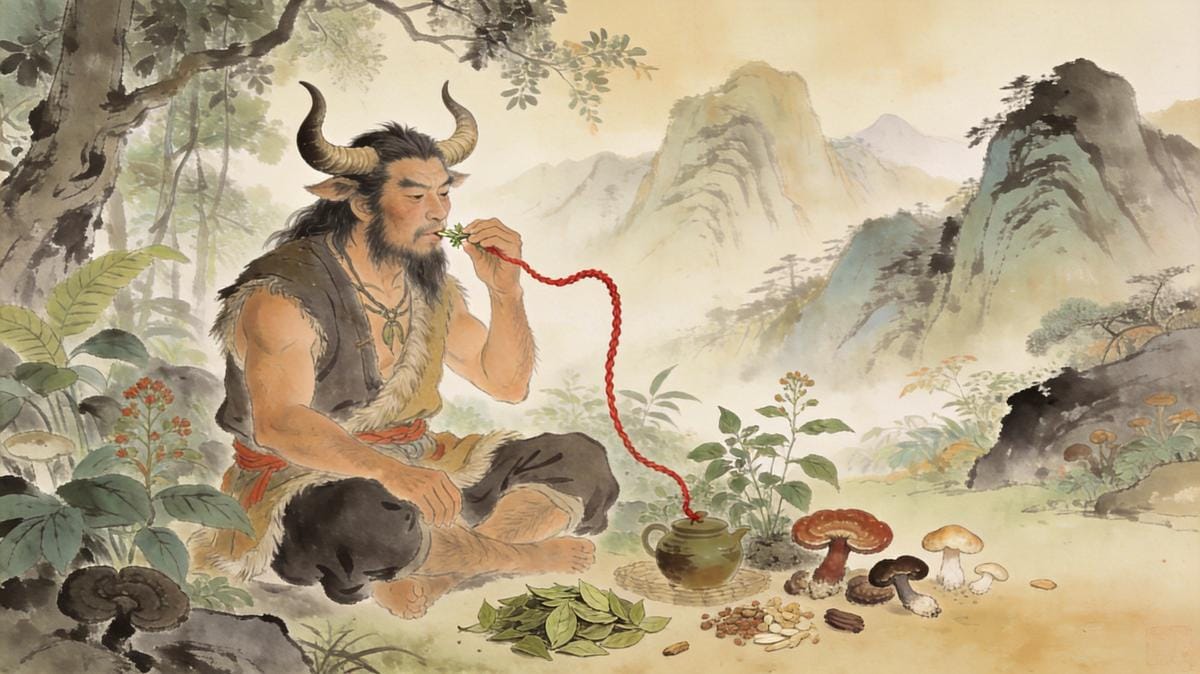
The Huainanzi describes his physical form: a human head and torso, but with the body of an ox below. More specifically, the Diwang Shiji claims he had a transparent jade-like abdomen. When he ate a plant, he could watch it travel through his body and observe exactly which organs it affected. This was not a metaphor. In the logic of the myth, Shennong's body was a living pharmacological laboratory — a walking, breathing clinical trial.
Seventy Poisons a Day
The core of Shennong's legend is the tasting of herbs. The Huainanzi states: "In ancient times, Shennong tasted a hundred herbs and encountered seventy poisons in a single day." The Shi Ji by Sima Qian echoes this: "Shennong tasted the hundred herbs and began the practice of medicine."
Seventy poisons. In one day. The math is brutal. If he tasted a hundred substances and seventy of them were toxic — some violently so — then Shennong spent most of his working hours in agony. The legend says he used tea (cha 茶) as an antidote, chewing tea leaves to neutralize the toxins. This is why tea is considered one of Shennong's gifts to humanity — not just a beverage, but a lifeline.
The Shennong Bencao Jing (神农本草经, Divine Farmer's Materia Medica) is the text traditionally attributed to him. It classifies 365 substances into three grades: superior herbs that nourish life and can be taken long-term, middle herbs that treat illness and maintain vitality, and inferior herbs that cure disease but are toxic and should be used only briefly. This three-tier system remained the backbone of Chinese pharmacology for over two thousand years.
Scholars date the Bencao Jing to the Han dynasty or later — Shennong did not actually write it. But the system it describes probably does reflect genuine Neolithic experimentation with medicinal plants, accumulated over generations and mythologized into the story of one man's heroic self-experimentation.
The Invention of Agriculture
Before Shennong taught farming, the Bai Hu Tong tells us, people ate raw meat and wild plants. "They did not know the use of grain." Shennong observed the patterns of nature — which seeds sprouted, which soil was fertile, which seasons brought rain — and invented the wooden plow (lei 耒) and the wooden hoe (si 耜).
The Yijing Xici records: "Shennong carved wood to make the plowshare and bent wood to make the handle, and taught the people of the world to use them." This is presented not as a divine gift but as a technological transfer — Shennong as teacher, not as god. The people were students, not supplicants.
He also established the first markets. The Yijing Xici continues: "At midday, he caused the people of the world to gather and exchange their goods, each returning home satisfied." This is one of the earliest descriptions of commerce in Chinese literature. Shennong didn't just teach people to grow food — he taught them to trade it, creating the economic infrastructure that makes settled civilization possible.
The Yan Emperor Question
Here is where the mythological record gets complicated. The name "Yan Emperor" (炎帝) appears in sources that seem to describe a different figure — a powerful tribal leader who fought and lost to the Yellow Emperor at the Battle of Banquan. The Shiji describes this conflict: the Yellow Emperor defeated Yandi at Banquan, then went on to face Chiyou at Zhuolu.
By the Han dynasty, the two figures had merged. The Shi Ji commentary by Sima Zhen explicitly identifies Shennong with Yandi, and this conflation became standard in later historiography. But earlier sources suggest they may have been distinct: Shennong as the culture hero who invented agriculture, and Yandi as the tribal chieftain who warred with the Yellow Emperor.
The merger made narrative sense. If Shennong represented the agricultural, settled way of life, and the Yellow Emperor represented the military, organizational way of life, then Shennong's defeat at Banquan becomes a mythological encoding of a real transition: the moment when the warrior-organizer surpassed the farmer-healer as the model of leadership. The Yellow Emperor did not destroy Shennong's legacy — he built on top of it. Agriculture continued. Medicine continued. But power shifted.
The Whip That Knew All Herbs
A later but vivid tradition gives Shennong a magical tool: the shenbian (神鞭), the Divine Whip. According to the Sou Shen Ji (搜神记), Shennong used a red whip to strike plants, and the whip would reveal the plant's nature — whether it was cold or hot, poisonous or medicinal, sweet or bitter. The whip was essentially a diagnostic instrument, a mythological MRI for botanical chemistry.
This detail is probably a Han or later addition, but it reveals something about how the story was understood: the knowledge of herbs was not just empirical. It required a tool, a method, a technology — even if that technology was a magic whip. Shennong was not just a martyr who ate poisons. He was a systematic investigator who developed instruments to extend his senses.
Death by the Break-Intestine Herb
The most poignant version of Shennong's death comes from folk tradition and the Huainanzi commentaries. After tasting hundreds of herbs and surviving dozens of poisons, Shennong encountered a plant called duanchangcao (断肠草, "break-intestine herb") — likely a species of Gelsemium. His transparent body allowed him to watch the toxin destroy his intestines in real time. He had no antidote. The tea leaves could not save him. He died, quite literally, from the inside out.
Other versions say he survived the break-intestine herb but was killed by a different poison — the baimacao (百足草). The details vary. The point does not: Shennong died doing his work. The divine farmer who fed the world and healed its diseases was ultimately consumed by the very subject he dedicated his life to understanding.
Shennong's Living Legacy
Shennong is worshipped as the patron of agriculture, medicine, and tea. His cult is especially strong in Hubei Province, where the Shennongjia (神农架, "Shennong's Ladder") forest region is named after him — legend says he built a ladder there to climb the mountains and gather herbs. The Shennong Temple in Suizhou, Hubei, has been a pilgrimage site for over a thousand years.
Traditional Chinese medicine still references the Shennong Bencao Jing. Farmers still invoke his name at spring planting festivals. And every cup of tea sold in the world traces its origin story, however distantly, to a man who chewed leaves to keep himself alive while he tasted the world's poisons for the rest of us.
Shennong's myth is the oldest medical ethic in Chinese culture: the healer who suffers so the patient does not have to. That is not a metaphor either.