Every Character Has a Past That Goes Back Centuries
Black Myth: Wukong is packed with characters who seem original to the game but are actually drawn from a deep well of Chinese mythology, folklore, and literary tradition. Some are direct adaptations of figures from Journey to the West. Others are inspired by regional folk tales, Daoist cosmology, or Buddhist parables that never made it into the mainstream novel.
Let's break down the major characters and trace them back to their mythological roots. Fair warning: this gets nerdy, and I love it.
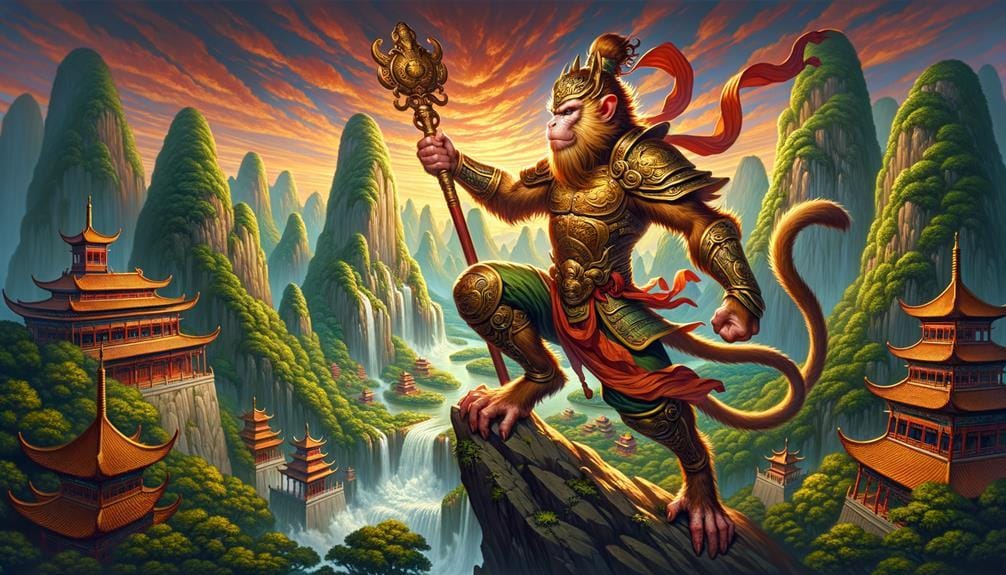
Sun Wukong: The Monkey Who Was Never Just a Monkey
Okay, let's get the big one out of the way. Sun Wukong is the most famous character in Chinese literature, but most Westerners only know the simplified version: monkey born from stone, gets powers, rebels against heaven, gets punished, goes on a journey, becomes a Buddha. That's accurate, but it misses about 90% of what makes Wukong fascinating.
In the original novel, Wukong's birth from a stone on the Mountain of Flowers and Fruit isn't random. That stone had been absorbing "the essence of heaven and earth" since the creation of the world. Wukong is, in a sense, the universe's child — born from the same primal energy that created everything. This is why he's so powerful and so impossible to categorize. He's not a god, not a demon, not a human. He's something the celestial bureaucracy has no form for.
The game picks up on this beautifully. Wukong's power doesn't come from the Buddhist scriptures or Daoist cultivation — it comes from his nature. He was born to break rules. The game's central tragedy is that the world won't let him be what he is.
Also, the "seventy-two transformations" that Wukong is famous for? In Daoist cosmology, the number seventy-two represents the number of earthly branches and seasonal transitions. It's not that Wukong can turn into exactly 72 things — it's that he can transform as fluidly as the seasons change. The number is symbolic, not literal. The game plays with this by giving you a limited set of transformations, each one a philosophical statement about identity and adaptation.
His staff, the Ruyi Jingu Bang (如意金箍棒), has its own mythology too. It was originally a pillar used by Yu the Great to measure the depths of the ocean during his flood control efforts. When Wukong takes it from the Dragon King of the East Sea, he's not just stealing a weapon — he's claiming a piece of cosmic infrastructure. The staff weighs 13,500 jin (about 7,960 kg) and can shrink to the size of a needle or grow to pierce the heavens. In the game, every swing carries that weight of history.
Erlang Shen: The Third-Eyed Warrior Who's More Complicated Than You Think
In the game, Erlang Shen (二郎神) is one of the major antagonists — the celestial warrior who hunts Wukong. In the original mythology, he's Wukong's most formidable opponent during the rebellion against heaven, the only celestial general who can fight him to a standstill.
But Erlang Shen's own backstory is wild. He's the nephew of the Jade Emperor — his mother is the Jade Emperor's sister, who was banished from heaven for falling in love with a mortal man. Erlang grew up as a half-celestial outcast. His signature third eye (天眼) is the gift (or curse) of his divine heritage. He hates the Jade Emperor for what happened to his mother but serves the Heavenly Court anyway, bound by duty and a complicated sense of honor.
In other words, Erlang is the anti-Wukong: someone who was born with one foot in heaven and one on earth, but who chose conformity over rebellion. The game positions them as mirrors of each other — two beings who could have been allies under different circumstances. When they fight, it's not just a boss battle. It's two people who understand each other fighting on opposite sides of a war neither of them started.
His dog, the Xiaotian Quan (哮天犬, "Howling Sky Dog"), is also from real mythology — a divine hunting hound that can track anything across any realm. Yes, the good boy is canon. In some versions of the myth, the dog is the one who actually bites Wukong during their battle, creating the opening for Erlang to capture him. In the game, the dog appears in the fight too, because Game Science respects the source material.
Nezha: The Boy God Who Defied His Father and Won
Nezha (哪吒) appears in the game as a celestial warrior, and his mythological backstory is one of the most dramatic in all of Chinese folklore. Born as a ball of flesh after a three-year pregnancy (his mother was not amused), Nezha was a prodigy who could walk and talk at birth. He gained immense power as a child — his weapons include a fire-tipped spear, a universe ring, and wind-and-fire wheels he stands on to fly.
Here's where it gets dark: Nezha accidentally killed the son of the Dragon King of the East Sea. In retaliation, the Dragon King threatened to destroy Nezha's entire city unless he was punished. Nezha's father, a mortal general, sided with the Dragon King against his own son. Nezha's response? He cut off his own flesh and bones — returning what he inherited from his parents — and his soul went to the Golden Light Cave, where his master Taiyi Zhenren rebuilt his body from lotus flowers.
The lotus-body resurrection is crucial. In Buddhist symbolism, the lotus rises from mud but remains pure — it represents rebirth and transcendence over worldly suffering. Nezha literally shed his family ties and was reborn as something new. The game references this through Nezha's design, which incorporates lotus motifs into his armor. When you fight him, you're fighting someone who already died for his principles once.
Zhu Bajie: More Than Comic Relief
Zhu Bajie (猪八戒), the pig-man, is one of Wukong's fellow pilgrims in Journey to the West. In the novel, he's played for laughs — lazy, gluttonous, lustful, always wanting to give up and go home. But his backstory reveals something darker.
Before his fall, Bajie was Tianpeng Yuanshuai (天蓬元帅), the Marshal of the Heavenly Canopy and commander of the 80,000 water navy of the Milky Way. He was one of the most powerful beings in the Heavenly Court. Then he got drunk at a banquet and flirted with Chang'e (the Moon Goddess). For this single transgression — a flirtation, not even an assault — he was banished to the mortal realm and forced to be reborn as a pig.
The punishment is wildly disproportionate, and that's the point. The Heavenly Court destroys lives over minor infractions while ignoring the corruption at its core. Bajie isn't a buffoon — he's a broken man (or broken pig) who copes with his trauma through food, sleep, and self-deprecation. The game doesn't feature Bajie prominently, but his ghost haunts the story as an example of what heaven does to those who step even slightly out of line.
The Bull Demon King: Wukong's Brother-in-Arms
Niu Mo Wang (牛魔王), the Bull Demon King, is one of the most important figures in Wukong's pre-heaven life. Before Wukong rebelled against the celestial order, he was part of a band of seven demon kings who swore brotherhood. The Bull Demon King was the eldest — Wukong's sworn brother.
Their falling out is one of the most painful moments in Journey to the West. When Wukong needs to pass through the Bull Demon King's territory during the journey, his former brother refuses to help. His wife, Princess Iron Fan (铁扇公主), holds a grudge because Wukong's son, Red Boy (红孩儿), was captured by Guanyin and forced into Buddhist service. From the Bull Demon King's perspective, Wukong destroyed his family to serve the very heaven that once tried to kill him.
In the game, the Bull Demon King appears as a tragic figure — a warrior who chose family over duty and was punished for it. His fight is one of the most emotionally charged in the game, because you're not fighting a villain. You're fighting someone who has every right to be angry.
Princess Iron Fan deserves her own mention. She wields the Banana Fan (芭蕉扇), one of the most powerful artifacts in Chinese mythology — it can extinguish any fire, including the flames of the Fiery Mountain. In some folk traditions, she's not just a demon's wife but a Daoist immortal in her own right, descended from the goddess of the wind. The game treats her with appropriate reverence.
White Bone Spirit: The Demon Who Just Wanted to Be Real
Baigujing (白骨精), the White Bone Spirit, is one of the most famous demons from Journey to the West. In the novel, she's a skeleton that gained sentience after absorbing yin energy for centuries. She disguises herself as a village girl, an old woman, and an old man to trick Tang Sanzang into letting his guard down. Wukong sees through each disguise and kills her, but Sanzang — who can't see through the illusions — punishes Wukong for murdering "innocent" people and banishes him from the group.
It's one of the most heartbreaking episodes in the novel, and it raises a question that the game explores deeply: who decides what's real and what's an illusion? The White Bone Spirit wasn't wrong that she existed — she was conscious, she had desires, she was trying to survive. But the Buddhist framework labels her as "unreal" because she wasn't born through conventional means. The game treats her with a dignity the novel never did, presenting her as a being caught between existence and non-existence, desperate to be seen as real.
The Deeper You Go, the More There Is
This is just scratching the surface. Every boss, every NPC, every item description in Black Myth: Wukong references real Chinese mythological sources. The game is a love letter to a storytelling tradition that spans thousands of years and thousands of texts. If you want to go deeper — and you should — start with Journey to the West itself. The Anthony C. Yu translation is the gold standard for English readers. After that, explore the folk tales about Erlang Shen, the Daoist texts about internal alchemy, and the Buddhist sutras that the novel constantly references and subverts.
Also worth reading: Investiture of the Gods (封神演义), another classic novel that tells the story of how the gods got their positions in the celestial bureaucracy. Many characters in that book — including Nezha and Erlang Shen — appear in Black Myth: Wukong with their backstories intact. The two novels together form a kind of shared mythological universe that's as rich and interconnected as anything Marvel or DC have built.
Chinese mythology isn't a museum piece. It's alive, it's evolving, and games like Black Myth: Wukong prove that it still has the power to surprise, move, and provoke. The myths didn't stop being told — they just found new ways to reach new audiences. And that's the most mythological thing of all.