Origins in Ancient Bronzes
The phoenix motif in Chinese art has a history that stretches back over three thousand years, making it one of the oldest continuous artistic traditions in the world. The earliest depictions of phoenix-like birds appear on the ritual bronze vessels of the Shang and Zhou dynasties, where they are rendered in the distinctive taotie style — abstract, symmetrical, and deeply symbolic. These early phoenix images were not merely decorative but served a religious function, connecting the ritual vessels to the celestial realm and invoking the blessings of the divine bird. The quality of the phoenix imagery on a bronze vessel was a measure of the vessel's sacredness and the status of its owner.
During the Zhou Dynasty, as Chinese society became more complex and the ritual system more elaborate, phoenix imagery became increasingly refined and naturalistic. The stylized, geometric birds of the Shang period gave way to more graceful, flowing forms that captured the fenghuang's essential qualities of elegance and movement. By the end of the Zhou period, the phoenix had become one of the most important motifs in Chinese decorative art, appearing on everything from bronze mirrors to jade pendants to silk textiles. The bird's association with virtue and good fortune made it a popular choice for personal adornment, as wearing phoenix imagery was believed to attract the blessings of the celestial bird.
Phoenix Motifs in Imperial Architecture
The phoenix reached its greatest artistic prominence during the imperial period, when it became one of the most important decorative motifs in palace architecture. In the Forbidden City, the world's largest palace complex and the seat of Chinese imperial power for nearly five hundred years, phoenix imagery is ubiquitous. The most spectacular example is the Fenghuang Hall, or Palace of Earthly Tranquility, which was the residence of the empress and is adorned with phoenix carvings, paintings, and sculptures throughout. The roof of the hall is decorated with phoenix figures positioned at the corners and along the ridge, their wings spread as if in flight, their plumage rendered in brilliant glazes of yellow, green, and blue.
The phoenix also appears extensively in the imperial garden architecture, where it is carved into stone balustrades, painted on ceiling panels, and woven into the designs of window lattices. In the Summer Palace outside Beijing, the famous Long Corridor is decorated with thousands of painted scenes from Chinese mythology and history, many of which feature the fenghuang in various contexts — dancing in the sage-king's courtyard, soaring above the mountains, or standing serenely beside the dragon in scenes of imperial harmony. These architectural applications of phoenix imagery served both decorative and symbolic functions, reinforcing the connection between the imperial family and the celestial order that the fenghuang represented.
Phoenix in Textile Art
Some of the most exquisite examples of phoenix imagery in Chinese art are found in textiles, particularly in the embroidered silk robes of the imperial court. The phoenix robe of the empress was a masterpiece of textile art, featuring the fenghuang rendered in gold and silver thread against a background of richly colored silk. The bird's plumage was created using a variety of embroidery stitches that produced different textures and sheens, giving the phoenix an almost three-dimensional quality. The five colors of the fenghuang's feathers were represented by different silk threads, each carefully selected for its hue and luster.
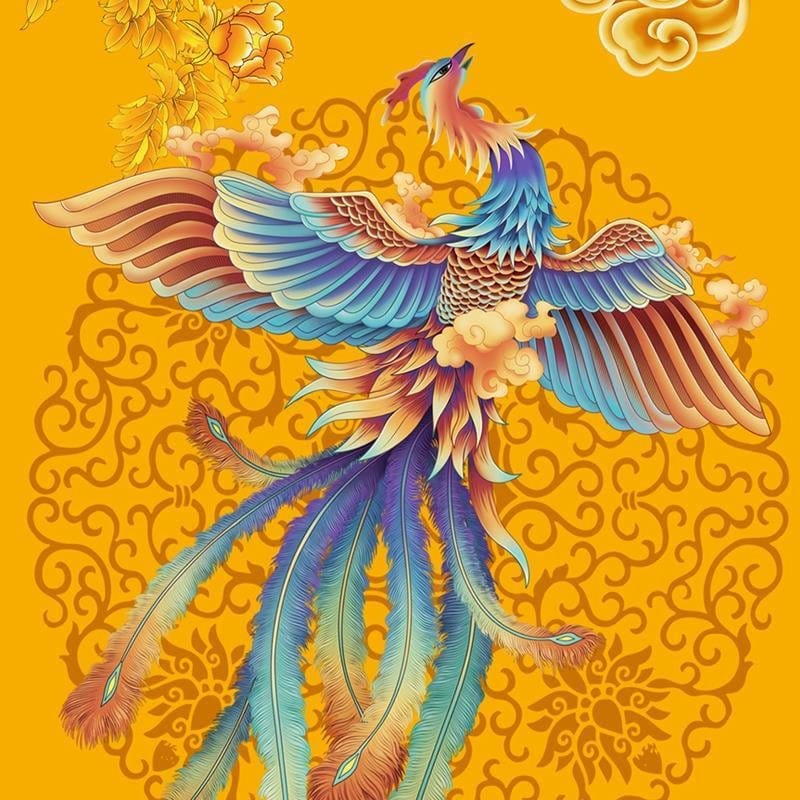
Phoenix imagery was not limited to imperial robes. In Chinese folk textiles, the fenghuang appears on wedding quilts, baby carriers, and ceremonial hangings, often paired with the dragon or the peony flower. These folk applications of the phoenix motif tend to be more colorful and less restrained than the imperial versions, reflecting the exuberance and optimism of popular culture. In the embroidery traditions of southern China, particularly in Suzhou and Hunan, the phoenix is often depicted in flight, its tail feathers streaming behind it in a cascade of color that showcases the embroiderer's skill and creativity. These textile traditions have been passed down through generations and continue to thrive today, both as living folk art and as inspiration for contemporary fashion designers.
Phoenix in Ceramics and Lacquerware
Chinese ceramics provide another rich tradition of phoenix imagery, spanning every dynasty and every major kiln center. During the Song Dynasty, the fenghuang appeared on celadon ware in subtle, monochromatic glazes that emphasized the bird's grace and elegance. During the Yuan and Ming dynasties, the phoenix became a prominent motif on blue-and-white porcelain, where it was typically depicted in flight or standing among peonies, the king of flowers. The combination of phoenix and peony was known as "fenghuang mudan" and symbolized wealth, honor, and beauty — a wish for prosperity and happiness that made these pieces popular as wedding gifts and household decorations.
In lacquerware, the phoenix was often carved in deep relief against a background of clouds or waves, creating a dramatic three-dimensional effect that highlighted the bird's dynamic form. The red lacquer of traditional Chinese lacquerware provided a striking contrast to the gold leaf that was sometimes applied to the phoenix's feathers, creating a dazzling interplay of color and light. These lacquered pieces were treasured possessions, handed down as heirlooms from generation to generation, and the phoenix imagery they carried was believed to bring the blessings of virtue and good fortune to every household that possessed them.
A Living Artistic Tradition
The phoenix continues to inspire Chinese artists and designers in the twenty-first century. In contemporary Chinese fashion, phoenix motifs appear on haute couture gowns, bridal wear, and accessories, often reimagined in modern materials and techniques while retaining the essential symbolism of the ancient motif. In graphic design and branding, the fenghuang is used by companies and institutions that wish to associate themselves with the values of excellence, integrity, and cultural heritage. In architecture, phoenix imagery adorns new buildings and public spaces, connecting modern construction to the ancient traditions of Chinese decorative art. The enduring popularity of the phoenix in Chinese art is a testament to the power of mythological imagery to convey meaning across centuries, adapting to new contexts while preserving the essential qualities that have made it resonant for generations.