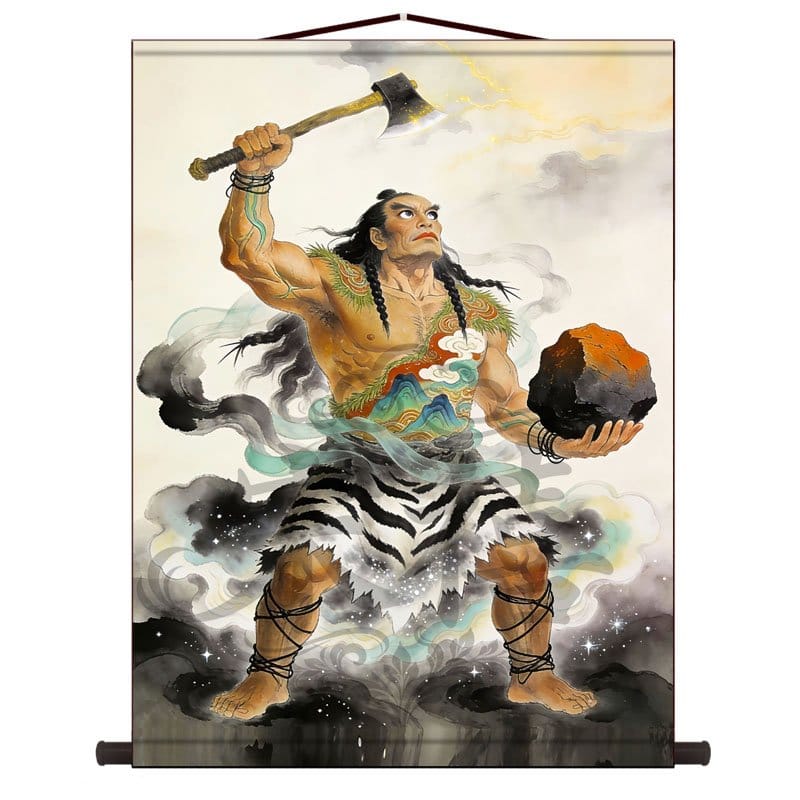
The Cosmic Egg
Before time began, the universe was nothing but a vast, formless chaos — a swirling mass of dark and light, hot and cold, heavy and light, all mixed together in a single cosmic egg. This egg contained within it the seed of all creation, waiting for the moment when the universe would be born. For eighteen thousand years, this primordial chaos existed in perfect stillness, neither growing nor changing, neither living nor dying.
Within this cosmic egg, Pangu slept and grew. He was the first being, a giant whose body contained the power of creation itself. For eighteen thousand years he rested inside the egg, gathering strength, until one day he awoke and found himself trapped in darkness. Frustrated by the confinement, Pangu seized a great axe that had formed beside him and struck the egg with all his might. The shell shattered with a thunderous crack, and the contents of the egg spilled forth into the void.
Separating Heaven and Earth
When the cosmic egg broke open, the light and pure elements rose upward to become the sky, while the heavy and impure elements sank downward to become the earth. But heaven and earth were still close together, and Pangu feared they might merge once more. So he stood between them, his head pushing against the sky and his feet planted firmly on the ground, and with each day the sky rose ten feet higher, the earth sank ten feet lower, and Pangu himself grew ten feet taller.
This labor continued for another eighteen thousand years. Day after day, year after year, Pangu held heaven and earth apart, his body growing ever larger, his strength tested to its absolute limits. The giant never rested, never wavered, never ceased his work of keeping the world separate and distinct. Finally, when the distance between heaven and earth was vast enough that they could never reunite, Pangu knew his task was complete.
The Giant Becomes the World
Exhausted from his monumental labor, Pangu lay down and died. But even in death, his body continued to give life to the world. His left eye became the sun, blazing across the daytime sky, and his right eye became the moon, casting its gentle light over the night. His breath became the wind and the clouds, his voice became the thunder that rolls across the heavens, and his blood became the rivers that carve their way across the land.
The giant's veins became the roads and pathways that would one day guide travelers, his flesh became the rich soil that would grow crops, his hair became the stars scattered across the night sky, and his teeth and bones became the metals and stones hidden within the earth. His sweat became the rain that nourishes all living things, and the parasites on his body, stirred by the wind, became the various peoples of the world. Thus Pangu gave his entire being to create the world we know — a supreme act of sacrifice that lies at the very heart of Chinese cosmology.
Legacy and Cultural Significance
The story of Pangu is one of the most fundamental creation myths in Chinese tradition, and its influence can be seen throughout Chinese culture. The tale embodies several key concepts that are central to Chinese philosophical thought: the unity of opposites (yin and yang emerging from chaos), the virtue of self-sacrifice for the greater good, and the interconnectedness of all things. Pangu does not merely create the world — he becomes the world, suggesting that the divine and the natural are not separate but are one and the same.
The Pangu myth is particularly associated with southern Chinese traditions and is believed to have originated among the Miao, Yao, and other ethnic minorities before being incorporated into the broader Chinese mythological canon. Temples dedicated to Pangu can still be found across southern China, particularly in Guangdong and Guangxi provinces. The Pangu Temple in Guangdong, dating back over a thousand years, continues to attract worshippers who honor the primordial giant as the father of all creation.
Pangu in Modern Culture
In contemporary Chinese culture, Pangu remains a powerful symbol of creation and transformation. The myth has been retold in countless books, films, television series, and video games, each adding new interpretations while preserving the core narrative. Pangu appears as a character in popular Chinese fantasy novels and online games, often depicted as a figure of immense power and cosmic significance. The story continues to resonate because it speaks to universal themes — the origin of existence, the sacrifice required to build something lasting, and the deep connection between humanity and the natural world.