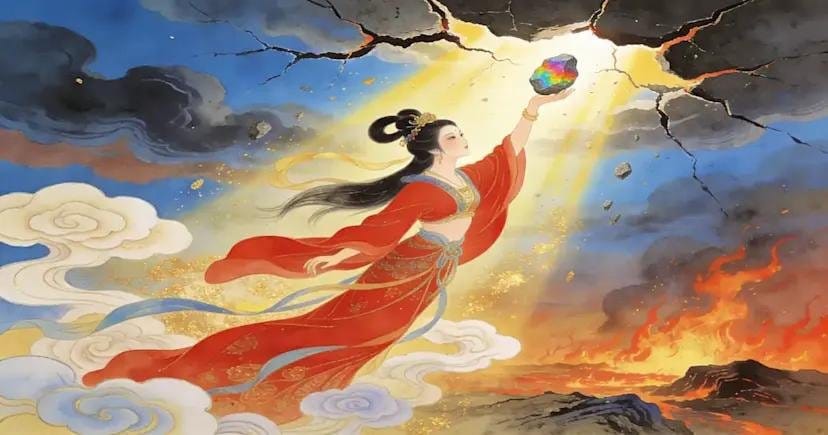
The Breaking of Heaven
In ancient times, a great catastrophe befell the world. Gonggong, the water god, had fought a terrible battle for supremacy with Zhuanxu, one of the legendary emperors. When Gonggong was defeated, he was consumed by shame and fury. In his rage, he smashed his head against Mount Buzhou, which was one of the pillars that held up the sky. The mountain shattered, and the pillar of heaven broke. The sky tore open in the northwest, creating a vast, gaping wound through which celestial fires rained down upon the earth. The earth itself cracked and tilted, sending floods pouring across the land.
The consequences were devastating. Forests burned, rivers overflowed their banks, and the sea surged inward, swallowing coastal lands. Fierce beasts emerged from the chaos — a black dragon devoured the people of Ji, while giant owls and predatory birds swooped down upon the helpless survivors. The world that Nuwa had so lovingly created was being torn apart before her eyes. The delicate balance between heaven and earth had been shattered, and without intervention, all of creation would be destroyed. It was in this moment of supreme crisis that Nuwa undertook her greatest and most heroic act.
Gathering the Five-Colored Stones
Nuwa knew that the only way to save the world was to repair the sky, but this was no ordinary task. The breach in heaven was enormous, and ordinary materials would never suffice to patch such a wound. Nuwa searched across the world and gathered five-colored stones — red, yellow, blue, white, and black — each representing one of the five elements and one of the five directions in Chinese cosmology. These stones contained the essence of creation itself, the primal forces from which the world had been formed, and only they possessed the power to heal the wounded sky.
The gathering of these stones was itself a heroic journey. Nuwa traveled to the farthest reaches of the world, braving fires and floods, crossing mountains and seas, to collect each precious stone. Red from the south, the color of fire and summer. Yellow from the center, the color of earth and transformation. Blue from the east, the color of wood and spring. White from the west, the color of metal and autumn. Black from the north, the color of water and winter. Together, these five colors represented the complete spectrum of cosmic energy, the full palette of creation.
Melting the Stones and Patching the Sky
Once she had gathered all five-colored stones, Nuwa built a great fire and placed the stones within it. She tended the fire for days and nights, using divine reeds as fuel, until the stones melted into a luminous, flowing substance that glowed with all the colors of creation. This molten essence of the five elements was the perfect material to repair the sky — it could flow into any crack, bond with the fabric of heaven, and restore the celestial vault to its original wholeness. With this miraculous substance, Nuwa climbed to the height of heaven and carefully, painstakingly, patched the great tear in the sky.
The repair was not merely functional but beautiful. Where the sky had been torn, Nuwa's patch created a stunning pattern of five-colored clouds that shimmered in the light. To this day, the five-colored clouds that sometimes appear at sunset are said to be the mark of Nuwa's repair, a reminder of the goddess who saved the world. After patching the sky, Nuwa also had to address the tilting of the earth. She cut the legs off a great cosmic turtle and used them as four new pillars to support the sky at the four corners of the world, restoring stability to creation.
Subduing the Forces of Chaos
With the sky repaired and the earth stabilized, Nuwa turned her attention to the remaining threats. She slew the black dragon that had been terrorizing the people of Ji, and by doing so, she put an end to the floodwaters that had been devastating the land. She drove away the fierce beasts and predatory birds, and she burned the reeds she had used to stop the flooding. Piece by piece, she restored order to the world, undoing the damage that Gonggong's rage had caused. It was a labor of restoration that matched her original labor of creation in both magnitude and significance.
The myth of Nuwa repairing the sky is often interpreted as an allegory for overcoming natural disasters, particularly floods, which have been a recurring threat throughout Chinese history. The Yellow River, where Nuwa is said to have created humanity, has also been the source of devastating floods that have killed millions. The story of a goddess who can repair the broken sky and calm the raging waters would have been deeply meaningful to people who lived in constant fear of nature's destructive power. It offered hope that even the most catastrophic events could be overcome through divine intervention and human resilience.
The Enduring Legacy
Nuwa's repair of the sky established her as not merely a creator but a savior — a goddess who would fight to protect her creation from destruction. This dual role made her one of the most beloved and widely worshipped deities in the Chinese pantheon. Temples dedicated to Nuwa can be found throughout China, and her festival is still celebrated in many regions. The five-colored stones she used to repair the sky have become a powerful symbol in Chinese culture, representing the harmony of the five elements and the possibility of restoring balance even in the face of overwhelming chaos. In an age of environmental crisis, Nuwa's story carries a particularly urgent message — that the damage we have done to our world can still be repaired, if only we have the will and the courage to act.