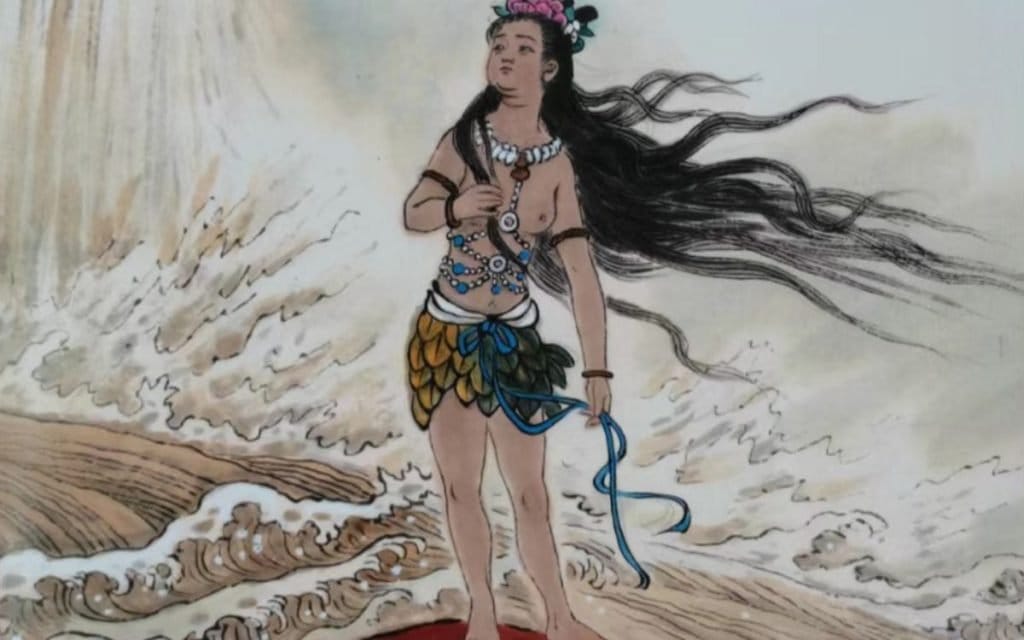
A World Without People
According to ancient Chinese mythology, after Pangu had separated heaven and earth and his body had transformed into the features of the world, the earth was a place of stunning beauty but profound emptiness. Mountains rose majestically toward the sky, rivers carved their way through verdant valleys, forests stretched to the horizon, and the sea sparkled under the sun. Birds sang in the trees, fish swam in the waters, and animals roamed the plains. Yet despite all this beauty and abundance, something was missing. There was no one to appreciate the wonder of creation, no one to tend the earth, no one to love and laugh and dream.
Nuwa, the goddess of creation, wandered this beautiful but lonely world and felt the weight of its silence. She was a being of immense power, often depicted with the body of a serpent and the head of a woman, a form that connected her to the deep, creative energies of the earth itself. As she walked along the banks of the Yellow River, she gazed into the water and saw her own reflection. In that moment, she had an idea that would change the world forever — she would create beings in her own image, creatures who could share in the joy and wonder of existence.
Molding the First Humans
Nuwa knelt by the riverbank and scooped up handfuls of yellow clay, the rich earth that had been formed from Pangu's flesh. With careful, loving hands, she began to shape the clay into small figures, each one crafted with meticulous attention to detail. She gave them heads and bodies, arms and legs, eyes to see, ears to hear, mouths to speak, and noses to breathe. She poured her creative spirit into each figure, breathing life into the clay until it stirred and blinked and looked up at her with wonder. These were the first human beings, born from the earth itself, animated by the divine breath of the goddess.
The process of creation was slow and painstaking. Each figure required careful shaping and the infusion of life-giving breath, and Nuwa labored with dedication and love. But the world was vast, and the number of humans she had created was small. Looking at the enormous task before her, Nuwa realized that if she continued to craft each person by hand, she would never finish before the world grew old. So she devised a faster method — she took a long rope, dipped it into the muddy clay, and swung it through the air. Wherever the drops of clay fell, they became human beings, springing to life in their thousands.
The Two Classes of Humanity
This dual method of creation gave rise to an important social myth in Chinese culture. The humans that Nuwa crafted carefully by hand were said to become the nobles and the wealthy, the scholars and the rulers — those who enjoyed privilege and power. The humans created from the flung drops of clay became the common people, the farmers and laborers who worked the land and built the civilization. This myth served as a divine justification for social hierarchy in ancient China, suggesting that the distinctions between rich and poor, powerful and humble, had existed since the very creation of humanity.
However, the myth also carries within it a profound message of equality at the most fundamental level. Whether crafted by hand or created from the flung rope, all humans share the same origin — they are all made from the same yellow clay, all animated by the same divine breath, all children of the same goddess. The differences between them are merely matters of method, not of essence. This subtle nuance has been interpreted by many scholars as suggesting that while social distinctions may be inevitable, they are not intrinsic to human nature — a remarkably progressive idea embedded within an ancient myth.
Nuwa as Mother Goddess
Nuwa's role as the creator of humanity established her as one of the most important goddesses in the Chinese pantheon. She was revered not merely as a distant creator but as a loving mother who remained connected to her children throughout their existence. In many traditions, she was also credited with establishing the institution of marriage, teaching humans how to live together in harmony and how to raise families. This connection to marriage and family made her a particularly important deity for women, who would pray to her for fertility, safe childbirth, and domestic harmony.
The worship of Nuwa predates written Chinese history, and archaeological evidence suggests that mother goddess worship was widespread in Neolithic China. The figure of Nuwa may represent the survival of these ancient beliefs in a later, more patriarchal mythological system. Despite the rise of male deities like the Jade Emperor, Nuwa never lost her significance — she remained a powerful and beloved figure throughout Chinese history, a testament to the enduring importance of the feminine creative principle in Chinese culture.
Modern Interpretations
In contemporary China, the story of Nuwa creating humanity from clay continues to be told and retold, finding new audiences through children's books, animated films, and cultural exhibitions. The myth has taken on new meanings in modern contexts — some see it as an early expression of the idea that humans are part of nature, literally made from the earth itself. Others interpret the dual creation method as a commentary on the tension between individuality and mass production, a remarkably prescient metaphor in the age of industrialization. Whatever interpretation one favors, the story of Nuwa remains one of the most beloved and enduring creation myths in all of world mythology.