Introduction: When the Dragon Becomes a Father
Of all the creatures in Chinese mythology, none captures the imagination quite like the dragon (龍, lóng). Majestic, powerful, and deeply woven into the fabric of Chinese civilization, the dragon has served as an imperial symbol, a rain-bringing deity, and the spiritual totem of an entire people. Yet one of the most enduring and culturally significant legends about the Chinese dragon has nothing to do with the dragon itself — it is about its children.
The phrase "lóng shēng jiǔ zǐ" (龍生九子), meaning "the dragon has nine sons," describes a set of mythological creatures, each with a distinct personality, appearance, and purpose. None of them grew up to become dragons. Instead, each son pursued his own passion — music, warfare, justice, literature, fire prevention — and found a permanent place in Chinese architecture, art, and daily life. The proverb "lóng shēng jiǔ zǐ, gè yǒu suǒ hǎo" (龍生九子,各有所好) — "the dragon has nine sons, each with his own preference" — has become a common Chinese idiom meaning that siblings may have very different temperaments and talents.
What makes this legend especially remarkable is its tangible presence. Unlike many myths that exist only in ancient texts, the nine sons of the dragon are physically embedded in Chinese culture. Visit any traditional Chinese temple, palace, or historic building, and you will find them — carved into roof ridges, cast onto bell handles, sculpted beneath stone monuments, and engraved on weapon hilts. They are not distant legends; they are architectural features you can touch.
The Historical Origins: An Emperor's Curiosity
The concept of the dragon having multiple offspring dates back at least to the Western Jin Dynasty (265–316 CE). The Xījīng Zájì (西京雜記, Miscellaneous Records of the Western Capital) records: "When the Huzi River breached its banks, a dragon followed by nine young emerged from the breach, swimming upstream." However, this early reference mentions no names or individual characteristics.
The legend as we know it today took shape during the Ming Dynasty (1368–1644). According to historical accounts, the Ming Emperor Xiaozong (r. 1487–1505) once asked his minister Li Dongyang (李東陽, 1447–1516), a renowned scholar: "I have heard that the dragon has nine sons. What are their names?" Li Dongyang could not immediately answer. He consulted several colleagues, pieced together fragments from various ancient texts, and finally compiled a list of nine creatures with their names and characteristics. He recorded this in his Huáilùtáng Jí (怀麓堂集).
However, there was never a single canonical list. At least four major versions circulated during the Ming Dynasty alone:
Li Dongyang's version (the most widely cited): Qiuniu, Yazi, Chaofeng, Pulao, Suanni, Bixi (Baxia), Bi'an, Fuxi, and Chiwen.
Yang Shen's version (the most commonly found in popular culture): Bixi, Chiwen, Pulao, Bi'an, Taotie, Baxia, Yazi, Suanni, and Jiaotu.
Lu Rong's version listed 14 creatures, while Fang Yizhi's version combined elements from the earlier lists.
It is important to understand that in Chinese culture, the number nine (九, jiǔ) is not always a literal count. It represents the supreme yang number, symbolizing abundance, extremity, and the highest honor. "Jiǔ" often means "many" rather than exactly nine. This is why some lists include more than nine creatures, and why other mythological beasts — such as Taotie (饕餮), Jiaotu (椒圖), and Baxia (蚣蝮) — are sometimes counted among the dragon's offspring.
This article follows Li Dongyang's version, which remains the most influential and widely recognized, supplemented by details from folk traditions and architectural evidence.
1. Qiuniu (囚牛) — The First Son, Lover of Music
Pinyin: qiú niú | Rank: Eldest | Parentage: Dragon and Water Buffalo
Of all the dragon's sons, Qiuniu is the most gentle. Where his brothers are fierce, combative, or imposing, Qiuniu is quiet, contemplative, and deeply sensitive to sound. He is said to have a yellow-scaled dragon body with small horns, and he spends his days perched on the heads of stringed instruments, listening intently to the music that humans play.
The character for his name, 囚 (qiú), means "imprisoned" or "confined," while 牛 (niú) means "ox" or "water buffalo." According to folk tradition, Qiuniu was born of the dragon and a water buffalo, which explains his docile temperament and his bovine features. His love of music was so profound that he would sit for hours on the carved headstock of the huqin (胡琴), the two-stringed bowed instrument central to Chinese opera and folk music, losing himself in the melodies.
In Chinese architecture and craftsmanship, Qiuniu's image is carved into the headstocks of traditional instruments. Some of the finest huqin and gǔqín (ancient zither) still bear his likeness — a small, serene dragon head gazing downward as if listening to the strings below. These instruments are sometimes called "lóngtóu húqín" (龍頭胡琴, "dragon-head huqin"). You can also find his representation in the Confucius Temple in Beijing, where musical instruments used in ceremonial performances feature Qiuniu decorations.
Cultural significance: Qiuniu represents the civilizing power of music and art. In a culture that valued wén (文, the civil/literary) alongside wǔ (武, the martial), Qiuniu embodied the belief that beauty and harmony are as essential to governance and society as strength and law.
2. Yazi (睚眦) — The Second Son, Spirit of Vengeance and War
Pinyin: yá zì | Rank: Second | Parentage: Dragon and Wolf (or Jackal)
If Qiuniu is the dragon's most peaceful son, Yazi is his most dangerous. Born of the dragon and a wolf (or, in some versions, a jackal), Yazi inherited his mother's ferocity and his father's power. His name literally means "the corner of the eye" or "a sidelong glare" — and it gave rise to the Chinese idiom yá zì bì bào (睚眦必报), meaning "to seek revenge for the smallest grievance." Even a dirty look was enough to provoke Yazi's wrath.
Yazi is depicted as a creature with a wolf's head and a dragon's body, often shown clutching a sword in his jaws, eyes blazing with fury. His personality is described as hào shā xǐ dòu (好杀喜斗) — fond of killing and eager for combat. He is the spirit of righteous fury and unyielding retribution.
Because of his martial nature, Yazi's image was engraved on the handles and guards of swords, the hilts of daggers, and the tūnkǒu (吞口, the decorative crossguard that "swallows" the blade) of weapons. His presence on a weapon was believed to imbue it with fearsome power and to intimidate enemies before a single blow was struck. Beyond the battlefield, Yazi appeared on the ceremonial weapons carried by palace guards and in imperial processions, where his image projected authority and deterrence.
Cultural significance: Yazi embodies the principle that force, when wielded with purpose and discipline, is a necessary component of order. His presence on weapons is not merely decorative — it is a declaration that the weapon's bearer is prepared to defend and avenge, and that aggression will be met with decisive response.
3. Chaofeng (嘲风) — The Third Son, Adventurer of the Heights
Pinyin: cháo fēng | Rank: Third | Parentage: Dragon and Phoenix
Chaofeng is the dragon's most daring son. Born of the dragon and a phoenix, he inherited a love of heights, danger, and the wind. His name means "mocking the wind" or "laughing at the wind," a fitting description for a creature that thrives in the most precarious and elevated places.
He is described as a beast-like creature, sometimes depicted with avian features that hint at his phoenix heritage. Some scholars suggest that Chaofeng represents the "dragon-veined phoenix" — a creature bridging two of China's most important mythological lineages. His defining trait is his love of peril: he seeks out the highest, most dangerous vantage points and stands there, gazing out over the world below with fearless abandon.
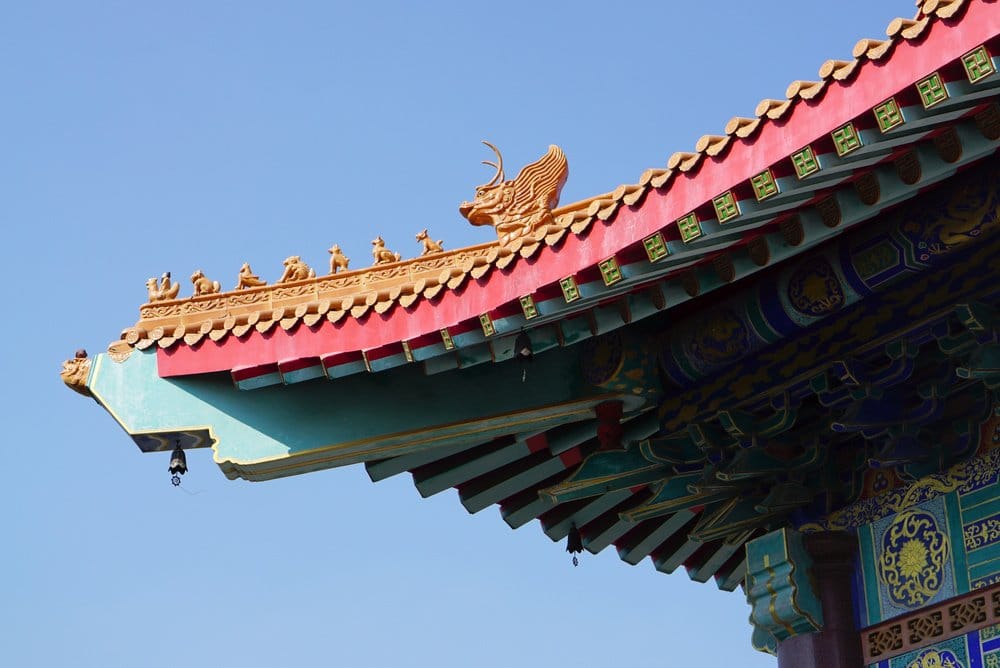
In traditional Chinese architecture, Chaofeng appears as the zǒushòu (走兽, "walking beasts") that line the sloping ridges of palace and temple roofs. These small sculpted figures march in single file along the eaves, led by a figure of an immortal riding a phoenix, followed by a procession of mythical creatures: dragon, phoenix, lion, heavenly horse, sea horse, suanni, fish, xiezhi (justice beast), douniu, and xingshi. Only the Hall of Supreme Harmony (太和殿) in the Forbidden City — the most important building in the empire — is permitted to display all ten figures. Lesser buildings may have fewer, with the number indicating the building's rank.
Chaofeng's placement at the highest, most exposed points of a building serves both symbolic and practical purposes. Symbolically, he represents vigilance, auspiciousness, and the power to ward off evil spirits and disasters. Practically, the roof-ridge figures help secure the tiles and joints at the most vulnerable points of the roof, where leaks and damage are most likely to occur.
Cultural significance: Chaofeng represents courage and the human aspiration to reach beyond safety. His presence on rooftops transforms the highest, most dangerous part of a building into a position of power and protection.
4. Pulao (蒲牢) — The Fourth Son, Voice of Thunder
Pinyin: pú láo | Rank: Fourth | Parentage: Dragon and Sea Creature (or Toad)
Pulao is the most paradoxical of the dragon's sons. Despite being a dragon's offspring, he is famously timid — specifically, he is terrified of whales. When a whale attacks or even approaches, Pulao screams in terror, and his cries are said to echo across the ocean.
This fear, however, became his gift. The third-century scholar Xue Zong, in his commentary on the Xījīng Fù (西京赋), recorded: "In the sea there is a great fish called the whale, and by the shore there is a beast named Pulao. Pulao has always feared the whale. When the whale strikes Pulao, he lets out a great roar." Ancient Chinese artisans turned this mythological quirk into a brilliant piece of functional design.
When casting large bronze bells — instruments whose primary purpose was to produce a sound loud enough to be heard across great distances — craftsmen shaped the bell's top loop (the zhōngniǔ, 钟钮) into the form of Pulao, and carved the striking beam (the zhōngchuí, 钟锤) into the shape of a whale. When the whale-shaped striker hit the Pulao-shaped bell knob, the bell would ring with extraordinary volume and resonance, as if the terrified dragon son were screaming in fear. The result was described as "xiǎng rù yún xiāo" (响入云霄, "resounding to the heavens") and "zhuān shēng dú yuǎn" (专声独远, "the sound carrying uniquely far").
So closely was Pulao associated with bells that his name became a literary synonym for the instrument itself. You can still see Pulao's image on temple bells across China, Korea, and Vietnam — a small dragon clutching the top of the bell, mouth open in a perpetual roar.
Cultural significance: Pulao teaches that what appears to be a weakness — fear — can be transformed into a source of power. His presence on bells transforms an ordinary object into a mythological event: every strike of the bell re-enacts the primordial confrontation between the small and the vast, and the small one's voice wins.
5. Suanni (狻猊) — The Fifth Son, Guardian of the Incense
Pinyin: suān ní | Rank: Fifth | Parentage: Dragon and Lion
Suanni is the most contemplative of the dragon's sons. Born of the dragon and a lion, he has the form of a lion but the temperament of a monk. He is described as xǐ jìng bù xǐ dòng (喜静不喜动) — fond of stillness and averse to movement. His greatest pleasure is to sit motionless for hours, watching the curling smoke of burning incense rise toward the heavens.
The name suān ní is actually one of the oldest Chinese words for "lion," predating the modern term shīzi (狮子). Lions were not native to China; they were introduced through trade and diplomacy from Central Asia and the Indian subcontinent, arriving alongside Buddhism during the Han Dynasty (206 BCE–220 CE). The lion thus carried dual associations — as a fierce guardian in Chinese tradition and as a sacred attendant in Buddhist iconography. Suanni inherited both roles.
In Chinese art and architecture, Suanni appears in two primary contexts. First, he is sculpted onto the legs and rims of xiānglú (香炉, incense burners) in Buddhist temples, where he sits surrounded by curling wisps of fragrant smoke — exactly as the legends describe. Second, he decorates the thrones and pedestals of Buddhist statues, particularly those of Manjushri (文殊菩萨), the bodhisattva of wisdom, whose traditional mount is a lion. The Wutai Mountain (五台山) in Shanxi, the sacred site associated with Manjushri, has a famous temple called the "Five Lords Temple" (五爷庙) where Suanni is venerated.
During the Ming and Qing dynasties, Suanni's image also appeared on the ornamental collars of the stone or bronze guardian lions that flank the entrances of important buildings — a subtle dragon element added to an already powerful symbol.
Cultural significance: Suanni represents the ideal of contemplative strength. He is not passive; rather, he embodies the power that comes from stillness, discipline, and spiritual focus. His association with both incense (communication with the divine) and the lion (protection and authority) makes him a bridge between the sacred and the secular.
6. Baxia / Bixi (霸下/赑屃) — The Sixth Son, Bearer of Eternal Burdens
Pinyin: bà xià / bì xì | Rank: Sixth | Parentage: Dragon and Turtle
Baxia — also known as Bixi — is perhaps the most visible of all the dragon's sons, and the one with the most dramatic backstory. He has the body of a turtle with the head of a dragon, and he possesses immense strength. His passion is carrying heavy loads, and his image is found beneath stone monuments throughout China, Korea, Vietnam, and the broader East Asian cultural sphere.
According to legend, in ancient times Baxia was a destructive force. He would carry mountains on his back and cause devastating floods by thrashing through rivers and seas. The hero Yu the Great (大禹), who was tasked with taming the Great Flood that plagued ancient China, recognized Baxia's incredible strength and managed to subdue him. Under Yu's command, Baxia used his power constructively — pushing mountains aside, digging channels, and dredging riverbeds to direct floodwaters to the sea. He became one of the most important allies in China's most famous engineering feat.
After the flood was controlled, Yu the Great worried that Baxia might return to his destructive ways. So he commissioned a massive stone stele, inscribed with the record of Baxia's contributions to the flood-control project, and placed it on Baxia's back. The weight of the stele — both physical and symbolic — kept Baxia in place. He could not wander off and cause trouble, for he was forever bound to carry the record of his own deeds.
This story explains why, throughout China, you will find stone steles mounted on the backs of dragon-headed turtles. The largest known example is the giant Bixi at Kaiyuan Temple in Zhengding, Hebei Province, which weighs many tons. In the Forbidden City, the bronze turtles in front of the Hall of Supreme Harmony also reflect Baxia's form — though they are technically guī (turtles) with dragon heads, the visual lineage is clear.
It is worth noting that Baxia and true turtles are distinguished by several features: Baxia has teeth (turtles do not), and the arrangement and shape of the shell plates differ. These details were important to traditional scholars who understood the creature as a hybrid, not merely a decorative turtle.
Cultural significance: Baxia represents the transformation of destructive power into constructive service. He also embodies the Chinese concept of gōngdé (功德, merit and virtue) — the idea that great deeds should be permanently recorded and publicly displayed. Every stone stele carried by Baxia is a testament to the belief that physical monuments preserve moral and historical truths for future generations.
7. Bi'an (狴犴) — The Seventh Son, Champion of Justice
Pinyin: bì àn | Rank: Seventh | Parentage: Dragon and Tiger
Bi'an is the dragon's most principled son. Born of the dragon and a tiger, he combines the authority of both parents: the celestial power of the dragon and the earthly ferocity of the tiger. His name is sometimes written as Xiànzhāng (宪章), and his defining traits are jí gōng hǎo yì (急公好义, eager for justice and public-spirited) and míng biàn shì fēi (明辨是非, able to distinguish right from wrong).
Bi'an is depicted as a tiger-like creature, sometimes with a single horn on his head, projecting an aura of absolute authority and unflinching vigilance. He does not merely enforce the law — he understands it. He can sense guilt and innocence, and he will not be swayed by wealth, rank, or intimidation.
Historically, Bi'an's image was carved above the gates of prisons, earning those prisons the colloquial name "hǔtóu láo" (虎头牢, "tiger-head prison"). His fearsome visage served as both warning and promise: warning to the guilty that justice awaited them, and promise to the innocent that they would be protected. Bi'an also appeared in the courthouses and government offices, where his likeness adorned the "Sùjìng" (肃静, "Silence") and "Huíbì" (回避, "Keep Away") signs carried before magistrates, as well as the ceremonial tablets of government officials. With his tiger eyes watching from every corner of the courtroom, Bi'an ensured that proceedings were conducted with solemnity and fairness.
The Neixiang County Magistrate's Office (内乡县衙) in Henan Province — one of the best-preserved ancient government offices in China — still retains Bi'an carvings on its prison gates, offering a tangible connection to this tradition.
Cultural significance: Bi'an represents the ideal of impartial justice. In a society where the legal system was often subject to corruption and the influence of the powerful, Bi'an served as a mythological counterweight — a reminder that true authority derives from fairness, not force. His presence in courthouses was not merely decorative; it was a moral statement that the space itself was under supernatural supervision.
8. Fuxi (负屃) — The Eighth Son, Patron of Literature
Pinyin: fù xì | Rank: Eighth | Parentage: Dragon and Azure Dragon
Fuxi is the dragon's most refined son, and in many ways, the one most like his father. Born of the dragon and an Azure Dragon — making him the most "pure-blooded" of the nine sons — Fuxi has a fully dragon-like form. He is elegant, scholarly, and deeply devoted to literature and the arts of writing.
His name means "carrying xì" (屃, a character associated with strength and bearing), but his character is anything but burdensome. He is described as yǎ hào sī wén (雅好斯文, "elegantly fond of culture and refinement"). His great passion is the written word — particularly the inscriptions carved into stone steles, which in ancient China were the highest form of literary and historical preservation.
In Chinese art, Fuxi is depicted as a sinuous dragon coiled around the top of stone steles, his body intertwined with the carved calligraphy. He does not merely sit on the stele — he embraces it, wrapping himself around the text as if to protect and adorn it. Where Baxia carries the physical weight of the stele from below, Fuxi crowns it from above, creating a visual symphony of form and meaning: the strength of the written word supported by endurance and crowned by reverence.
This pairing of Baxia and Fuxi on a single monument — turtle-dragon below, coiled dragon above — is one of the most recognizable compositions in Chinese stone monument design. You can see it at the Confucius Temple in Qufu, at the Ming Tombs near Beijing, and at countless historic sites across East Asia.
Cultural significance: Fuxi represents the reverence for literary culture that has been a defining feature of Chinese civilization for millennia. In a society where the written word was the primary vehicle of governance, history, philosophy, and art, Fuxi's devotion to inscriptions and calligraphy was not a mere hobby — it was a sacred duty. His presence on steles declares that the text beneath him is worthy of eternal preservation and celestial protection.
9. Chiwen (螭吻) — The Ninth Son, Guardian Against Fire
Pinyin: chī wěn | Rank: Ninth (Youngest) | Parentage: Dragon and Great Fish
Chiwen — also known as Chiwei (鸱尾), Chīwěn (鸱吻), or Àoyú (鳌鱼, "ao fish") — is the dragon's youngest and perhaps most practically important son. Born of the dragon and a great fish, he has the head of a dragon and the body of a fish, giving him a striking appearance that is both fearsome and aquatic.
Chiwen has two defining characteristics: he loves to swallow things, and he has the power to summon rain and extinguish fire. These traits made him the ideal guardian for China's wooden buildings, which were perpetually vulnerable to fire — the greatest threat to traditional architecture.
According to the Tàipíng Yùlǎn (太平御览), which quotes the Táng Huìyào (唐会要): "After the Xiangliang Palace of the Han Dynasty burned down, a shaman from Yue said that in the sea there is a fish-dragon whose tail resembles that of a hawk, and by churning waves it can summon rain. So its image was placed on roof-ridges to suppress fire disasters." This is the earliest recorded reason for placing Chiwen on roofs, dating the practice to at least the Han Dynasty (206 BCE–220 CE).
On traditional Chinese buildings, Chiwen is positioned at the two ends of the main roof ridge, facing inward with his mouth wide open, apparently swallowing the ridge itself. His body faces outward, and on his back, a sword is driven into his spine. The sword has its own mythology: some say it was placed by the Taoist immortal Xu Xun (许逊) to prevent Chiwen from running away; others say it wards off evil spirits. Regardless of the explanation, the sword pins Chiwen permanently to his post — he is a guardian who can never abandon his duty.
Chiwen's role was not purely symbolic. The ridge ends of a Chinese roof are the most structurally vulnerable points, where the main horizontal ridge meets the descending slopes. By placing a large, heavy Chiwen ornament at these junctions, builders reinforced the weakest points of the roof and protected against water infiltration. The glazed ceramics and metal components of Chiwen ornaments also served as primitive lightning conductors — the Ming Dynasty records note that Chiwen on the Forbidden City was struck by lightning at least six times, absorbing strikes that might otherwise have ignited the wooden structure below.
The rank of the building determined the form of Chiwen: imperial palaces featured dragon-headed Chiwen, government offices used beast-headed versions, and common residences were permitted only simple fish-tail shapes. This hierarchy made Chiwen not just a fire guardian but also a marker of social status.
Cultural significance: Chiwen represents the pragmatic wisdom of Chinese architecture and the deep interconnection between myth and daily life. His presence on millions of buildings across East Asia is a testament to the Chinese genius for embedding spiritual meaning into functional design.
Conclusion: The Living Legacy of the Dragon's Sons
The nine sons of the dragon are remarkable not because they are powerful, fearsome, or magical — though some of them are all three. They are remarkable because they chose to serve. Each son, instead of pursuing his father's celestial destiny, found a niche in the human world and filled it with dedication and purpose. The musician guards the instrument. The warrior guards the blade. The judge guards the courtroom. The writer guards the text. The fire-fighter guards the home.
This is why the nine sons are still visible today — not in museums behind glass, but on the roofs of active temples, the handles of ringing bells, and the bases of stone monuments in public parks. They are functional mythology: stories that earn their keep by doing real work in the physical world.
The legend also carries a deeper cultural message. The proverb "lóng shēng jiǔ zǐ, gè yǒu suǒ hǎo" is not merely an observation about diversity — it is a celebration of it. In a culture that sometimes emphasized conformity and filial obedience, the nine sons offered a counter-narrative: that a father (even a dragon) can take pride in children who follow utterly different paths. None of the nine became a dragon, and that is precisely the point. Their greatness lies not in replicating their father's glory but in discovering and pursuing their own callings.
For visitors to China — whether exploring the Forbidden City in Beijing, the ancient temples of Hangzhou, or the stone stele forests of Xi'an — learning to recognize the nine sons transforms a sightseeing walk into a treasure hunt. Suddenly, the roof is alive with Chaofeng and Chiwen. The courtyard bell whispers of Pulao. The turtle beneath the stele is not a turtle at all, but Baxia, still carrying the record of Yu the Great's triumph over the flood. And somewhere, on the head of a forgotten huqin in a dusty corner of a temple, Qiuniu is still listening to the music.