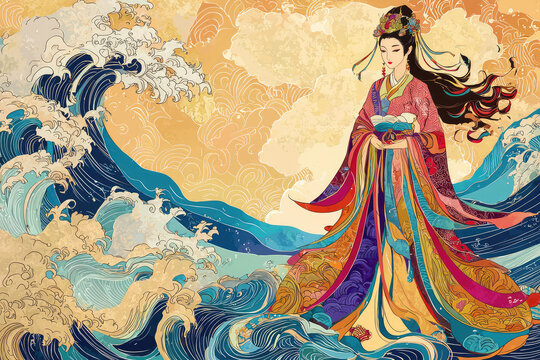
The Girl Who Wouldn't Marry
Lin Moniang was born on Meizhou Island, off the coast of Fujian, in 960 CE — the first year of the Song dynasty. From the start, she was different. She didn't cry as a baby (her name Moniang means "silent girl"). She refused to marry, which in 10th-century coastal China was roughly equivalent to refusing to exist. She spent her time praying to Guanyin and weaving at her loom.
Then came the storm. Her father and brothers were out at sea when a typhoon hit. Moniang fell into a trance at her loom — eyes closed, arms outstretched, gripping her brothers and father in a spiritual embrace. Her mother, seeing her like this, shook her awake. Moniang cried out — and one of her brothers slipped from her spiritual grip and drowned. When the survivors returned, they confirmed Moniang's vision down to the last detail.
This is the founding miracle of Mazu. Not a show of power, not a divine birth, but a desperate act of maternal love performed by a girl who refused to become a mother. The paradox is the whole point.
Death and Deification
Moniang died at 28. The Daoist version says she climbed a mountain, found the Tao, and ascended to heaven. The more popular version says she swam out to search for her father's body after another storm and died of exhaustion. Either way, fishermen along the Fujian coast started reporting sightings: a woman in red, hovering above the waves, guiding ships to safety.
Deification in Chinese folk religion is pragmatic. You worship a god because the god works. Fishermen who prayed to Mazu came home alive. Merchants who lit incense to her survived typhoons. The evidence was empirical. By the 12th century, the Song imperial court had given her an official title: "Celestial Consort." By the 13th century, she was "Empress of Heaven." By the Qing dynasty, she held more imperial titles than most human officials.
The 1123 Miracle
The event that put Mazu on the imperial radar happened in 1123, when a Song dynasty envoy named Lu Yundao was sailing to Korea. A storm nearly sank his fleet. Lu prayed to Mazu, and the seas calmed. When he returned safely, he reported the miracle to the emperor, who granted Mazu her first official temple title.
There's a painting from the 18th century, now in the Rijksmuseum in Amsterdam, depicting this rescue. Mazu floats on a cloud above the ship's mast, dressed in red, while terrified sailors cling to the rigging below. It's one of the few Chinese mythological paintings in a major European museum — a testament to how far Mazu's cult spread along maritime trade routes.
Qianliyan and Shunfeng'er
Mazu is never alone. Her two constant companions are demons she defeated and converted: Qianliyan (Thousand-Mile Eye), a red demon who can see anything across any distance, and Shunfeng'er (Wind-Following Ear), a green demon who can hear every whisper on the wind. In some versions, they were rivals who both wanted to marry her; she defeated them both and put them to work.
These two guardians turn Mazu from a passive savior into an active surveillance network. She doesn't just wait for prayers — she sees trouble coming and hears distress calls before they're even voiced. Thousand-Mile Eye and Wind-Following Ear are her early warning system, and they make her the most responsive deity in the Chinese pantheon.
A Goddess for the Diaspora
Mazu traveled wherever Chinese sailors went. There are Mazu temples in Malaysia, Singapore, Vietnam, Japan, the Philippines, and the United States. The oldest Chinese temple in San Francisco, dating to 1852, was dedicated to Tin Hau — the Cantonese name for Mazu. When Chinese immigrants built new lives abroad, they brought her along as proof that the sea could be survived.
In Taiwan, Mazu worship reaches a pitch found nowhere else. The annual Dajia Mazu Pilgrimage — a nine-day, 271-mile procession carrying the goddess's statue across the island — draws millions of participants. The statue is carried in an ornate sedan chair, day and night, through cities and rice paddies, and the faithful line the roads to touch it, be touched by it, and be reminded that someone is watching over them.
What Mazu Means
Mazu occupies a unique position in Chinese religion precisely because she started as a human. She's not a cosmic principle or a metaphysical concept. She was a girl who lost a brother and spent her life trying to make sure no one else suffered the same loss. Her divinity isn't about power — it's about empathy. And in a world where the ocean still kills, that empathy remains the most valuable currency a god can offer.