Ten Suns in the Sky
In ancient times, the world was blessed — or cursed — with not one sun but ten. These ten suns were the children of Di Jun, the Lord of the Eastern Heaven, and his wife Xihe. According to the cosmic arrangement, the ten suns took turns crossing the sky, one appearing each day in a regular rotation. This system worked well for a time, and the world enjoyed a stable climate with reliable cycles of warmth and light. But eventually, the ten suns grew bored with their solitary routines and decided that it would be far more fun to appear in the sky all at once.
The consequences were catastrophic. When all ten suns appeared simultaneously, the earth was subjected to unbearable heat. Rivers and lakes dried up, crops withered in the fields, and forests burst into flame. The ground cracked and split under the relentless solar assault, and people and animals suffered terribly. Some sought shelter in caves and underground, but even there the heat was oppressive. The ten suns, oblivious to the suffering below, cavorted in the sky, proud of their brightness and power. Something had to be done, or all life on earth would be destroyed.
The Emperor\'s Plea
Yao, the legendary emperor who ruled the earth, was desperate. He consulted his advisors and performed rituals to plead with the suns to return to their proper rotation, but they ignored him. He prayed to Di Jun, begging the Lord of Heaven to control his children, but even the father of the suns could not — or would not — compel them to behave. Finally, in a last resort, Yao turned to Hou Yi, the greatest archer the world had ever known. Hou Yi was a mortal hero of extraordinary skill, a man whose aim was so precise that he could shoot a blade of grass from a hundred paces and split a falling hair with a single arrow.
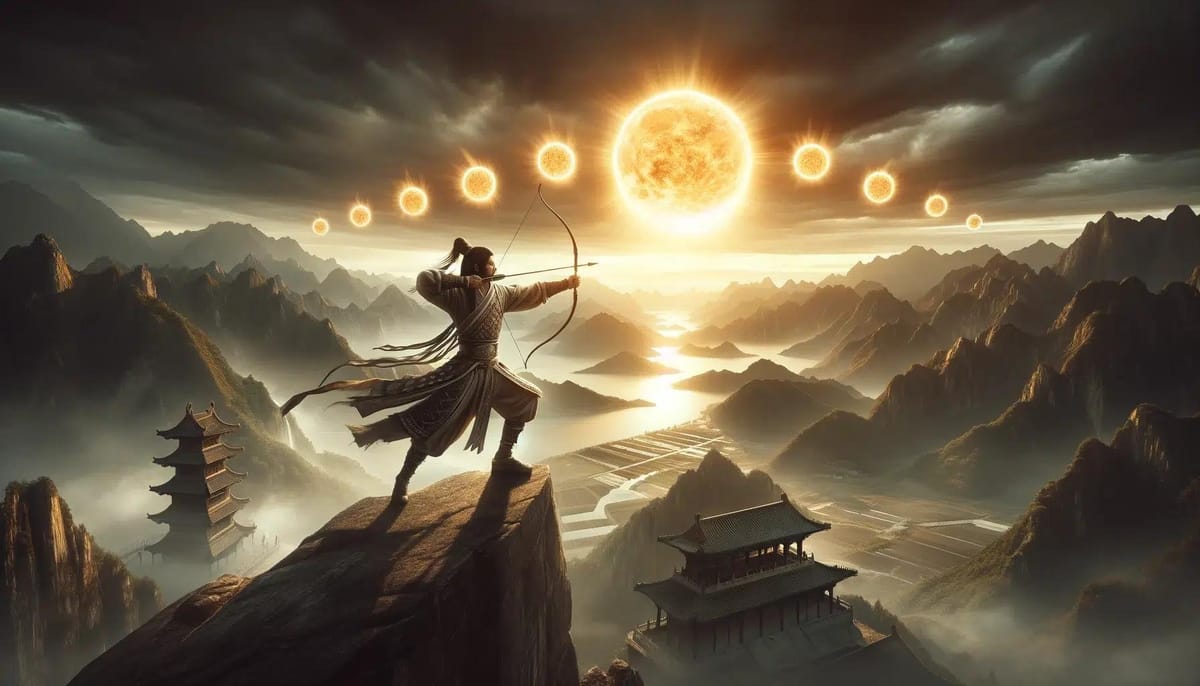
Di Jun, ashamed of his children's behavior but unwilling to destroy them, gave Hou Yi a magical red bow and a quiver of white arrows, instructing him to frighten the suns into submission. But Hou Yi, seeing the suffering of the people and the devastation of the land, decided that mere intimidation would not suffice. He would teach the suns a lesson they would never forget. Taking his stand on a mountaintop, Hou Yi nocked an arrow, drew the bow to its fullest extent, and fired. The arrow streaked across the sky and struck one of the suns, which shattered into pieces and fell to earth in the form of a great three-legged crow — the true form of the sun spirit.
Nine Arrows, Nine Suns
One by one, Hou Yi shot down the suns. Each arrow found its mark with unerring accuracy, and each sun fell from the sky as a dead three-legged crow. The people below watched in awe and gratitude as the unbearable heat gradually diminished with each sun that was destroyed. Hou Yi shot the second sun, then the third, then the fourth. The fifth, sixth, and seventh followed in rapid succession. He reached for the eighth arrow and destroyed the eighth sun, then the ninth. By now, only one sun remained in the sky, and the temperature had returned to a tolerable level.
It was at this moment that Emperor Yao intervened. Realizing that if Hou Yi shot down the last sun, the world would be plunged into eternal darkness and cold, Yao secretly sent a servant to steal one of Hou Yi's arrows. With only nine arrows remaining and the tenth safely hidden, Hou Yi was unable to destroy the final sun, and the world was saved. This detail adds a layer of wisdom to the myth — even when combating a terrible threat, one must not destroy it entirely, for even the most destructive forces serve a necessary purpose. The remaining sun continued to provide warmth and light, and the world found its balance once more.
The Price of Heroism
Hou Yi's heroic act saved the world, but it came at a terrible personal cost. By killing nine of Di Jun's children, Hou Yi had earned the wrath of the Lord of Heaven. As punishment, Di Jun stripped Hou Yi and his wife Chang'e of their divine status and banished them to live as mortals on earth. This was a devastating blow, especially for Chang'e, who had been a beautiful celestial being and was now condemned to age and die like any ordinary human. Hou Yi was consumed by guilt for having brought this fate upon his beloved wife.
Determined to restore their immortality, Hou Yi embarked on a perilous journey to find the Elixir of Immortality. He traveled to the Kunlun Mountains, where the Queen Mother of the West resided, and begged her for the precious potion. Moved by his devotion and his heroic deeds, the Queen Mother agreed to give him enough elixir for two people. Hou Yi returned home with the elixir, but the story did not end happily. Chang'e, whether out of impatience, curiosity, or a desire to protect the elixir from a thief, drank both portions herself and floated up to the moon, where she became the Moon Goddess. Hou Yi was left alone on earth, a hero who had saved the world but lost everything he loved.
A Timeless Legend
The story of Hou Yi shooting the suns remains one of the most powerful and beloved myths in Chinese culture. It is a story about the courage to confront seemingly insurmountable threats, the wisdom of knowing when to stop, and the tragic cost that heroism can exact. Hou Yi's sacrifice — saving the world at the price of his own happiness — has made him a symbol of noble selflessness in Chinese culture. The myth is also intimately connected to the Mid-Autumn Festival, when Chinese people gaze at the moon and remember Chang'e, the goddess who resides there, and Hou Yi, the hero who remains on earth, forever separated from his beloved. Their story is a reminder that even the greatest victories can carry the heaviest burdens.