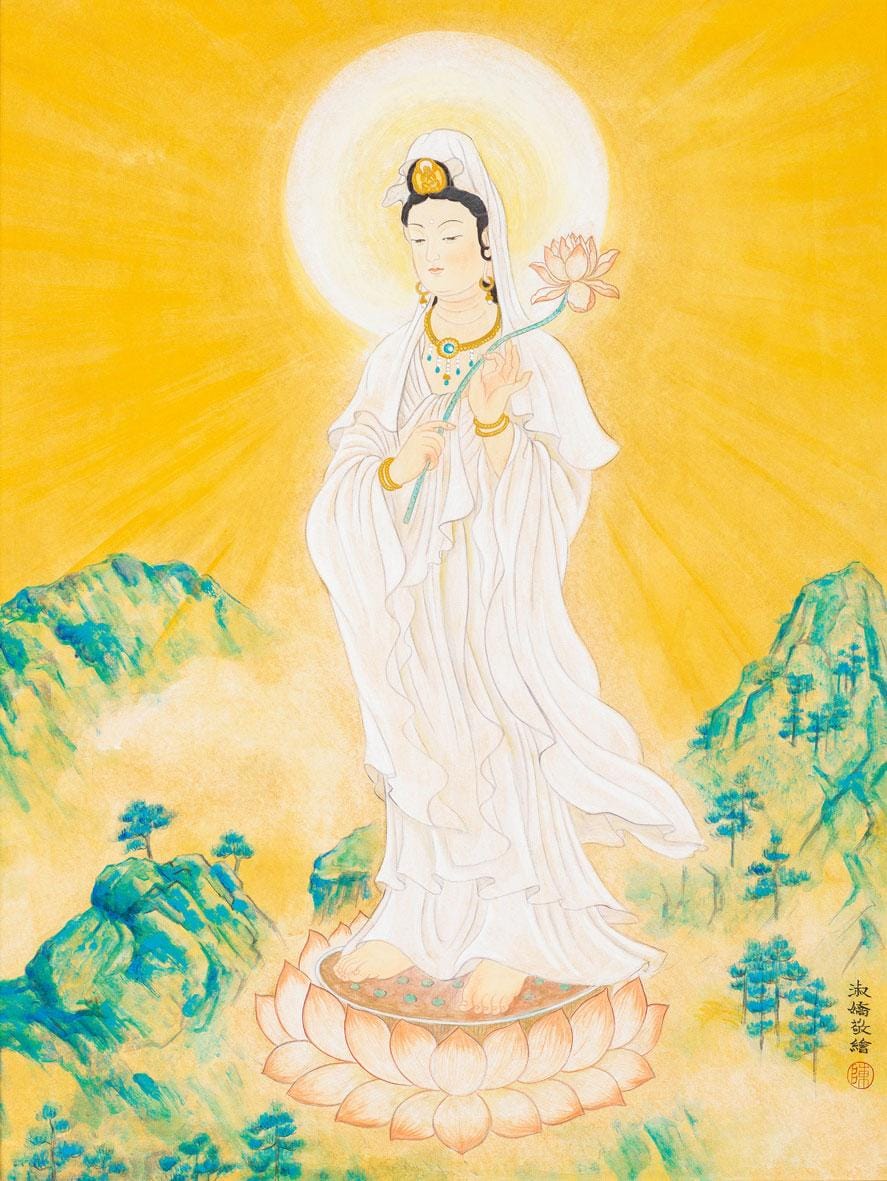
From Indian Prince to Chinese Mother
Guanyin didn't start out Chinese. The deity we know today began as Avalokiteshvara, a male bodhisattva in Indian Buddhism whose name means "the lord who looks down" — down at the suffering of the world, with compassion. But something remarkable happened on the long road from India to China: a male deity transformed into a female one, and a distant cosmic lord became the most beloved mother figure in Chinese religion.
The shift didn't happen overnight. In early Tang dynasty Buddhist art, Guanyin still appears as a mustachioed prince, sometimes with a small Amitabha Buddha in his headdress. By the Song dynasty, the mustache was gone. By the Ming, Guanyin was unmistakably female — white-robed, gentle-faced, holding a vase of pure water and a willow branch, standing on a lotus.
Why the gender change? Scholars have offered dozens of theories. The most convincing one is also the simplest: Chinese culture needed a mother goddess, and Buddhism didn't have one. Confucianism was patriarchal. Daoism had female immortals, but they were remote. The cult of Guanyin filled a gap — a divine figure who would listen, who would care, who would never turn you away.
The Thousand Hands
One of Guanyin's most striking iconographic forms is the Thousand-Armed Guanyin. Each hand holds a different tool or symbol — a sword, a lotus, a wheel, a rope, a water jar — representing her infinite capacity to help in infinite situations. The legend behind this form tells of Guanyin trying to help all suffering beings at once, and her head splitting into pieces from the effort. Amitabha Buddha gathered the fragments and reformed them into eleven heads, with a thousand arms to reach in every direction.
It's a powerful metaphor. Compassion isn't gentle or passive — it's overwhelming. The impulse to help everyone is itself a kind of violence against the limits of a single body. The thousand arms are Guanyin's answer to that violence: if one body isn't enough, have a thousand.
Guanyin and the Fish Basket
One of the most down-to-earth Guanyin stories is the Fish Basket tale. A beautiful woman appeared in a village carrying a fish basket, and announced she would marry whoever could memorize the Lotus Sutra overnight. A young fisherman did it. On their wedding night, the bride died. When the grieving fisherman opened her coffin, the body was gone — and Guanyin appeared in the sky above, revealing the whole thing had been a lesson in impermanence.
The story is typical of how Guanyin operates in Chinese folk religion: she meets you where you are. She doesn't appear as a terrifying cosmic being. She shows up as a beautiful woman, an old man, a child, whatever it takes to get your attention and teach you something. The Lotus Sutra says Avalokiteshvara will appear in whatever form the sufferer needs most. Chinese worshippers took that literally.
Putuoshan and the Pilgrimage
Guanyin's sacred mountain is Putuoshan, an island off the coast of Zhejiang. Since the Tang dynasty, pilgrims have traveled there by the millions. The island is packed with temples, nunneries, and the sound of chanting that echoes off the sea cliffs. The connection to the ocean is deliberate — Guanyin is the protector of sailors and fishermen, a role she inherited from (or shares with) Mazu.
During the Cultural Revolution, most of Putuoshan's temples were destroyed. They were rebuilt in the 1980s and 90s, often with donations from overseas Chinese communities who had kept the faith alive abroad. Today, Putuoshan receives over a million pilgrims a year. The incense smoke is so thick on festival days that you can taste it.
Why Guanyin Still Matters
Guanyin is the most widely worshipped figure in Chinese religion — more than Buddha, more than the Jade Emperor, more than Confucius. She persists because she answers a need that philosophy doesn't: the need to be heard. Not judged, not corrected, not lectured. Just heard. Guanyin listens. That's her whole function. Her name literally means "observer of sounds" — the one who hears the cries of the world.
In a culture that prizes stoicism and self-reliance, Guanyin offers permission to be vulnerable. You don't pray to her for wisdom. You pray because you're hurting, and she's the only deity who seems to care about that more than about whether you've been filial or righteous. That's not a theological position. It's a human one. And it's why, after a thousand years, the white-robed figure with the willow branch still has more temples than anyone else in China.