A Story That Refuses to Settle
Ask a folklorist where the Chinese Zodiac comes from, and you will get a careful answer wrapped in caveats. The truth is, nobody knows for certain. The twelve-animal cycle appears fully formed in Han Dynasty texts from the second century BCE, but the legend that explains it — the Great Race — exists in dozens of competing versions across China, Vietnam, Korea, and Japan. Some feature the Buddha. Others feature the Jade Emperor. A few skip the race entirely and blame the arrangement on the animals' natural sleeping habits. What every version shares, however, is something more durable than a fixed plot: a racetrack full of cunning, kindness, brute force, and cosmic irony that has been told around dinner tables for over two thousand years. This is the most widely known version — and the one that best explains why the rat comes first.
The Jade Emperor's Decree
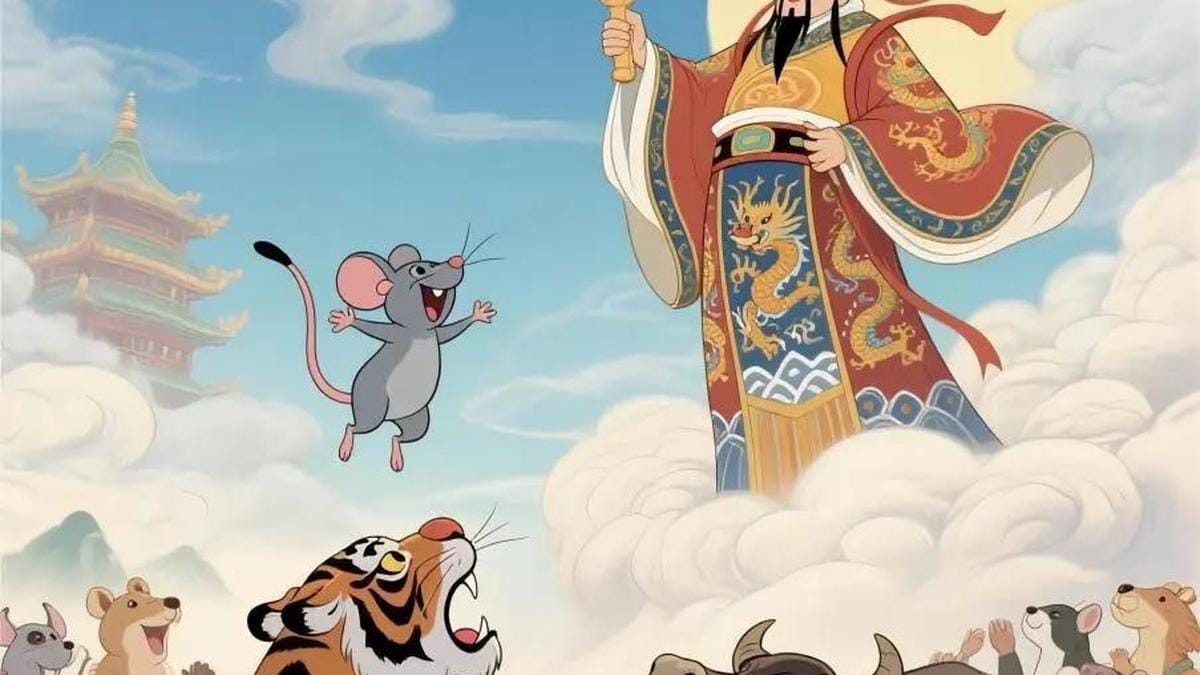
Long ago, before the calendar had names for its years, the Jade Emperor — Yu Huang Shang Di, supreme ruler of Heaven — looked down upon the mortal realm and saw that the people had no way to mark the passage of time. The seasons turned, generations rose and fell, and no one could say with certainty how many years had passed since a great flood or a bountiful harvest. The celestial bureaucracy, with its meticulous ledgers and immortal clerks, could track the ages — but humanity could not.
So the Jade Emperor devised a contest. He would summon all the animals of the world to race across a great river, and the first twelve to reach the opposite bank would each lend their name to a year, creating a twelve-year cycle that would give order to time itself. The announcement echoed across mountains, forests, and seas. Every creature wanted a place in the calendar — not just for the honor, but because a year bearing your name meant you would be remembered for eternity.
The Rat and the Ox: A Masterclass in Opportunism
The Rat arrived at the riverbank and immediately faced a problem. It was small. It could not swim well. The current was swift, and the river was wide. But the Rat possessed something that the larger animals did not: an instinct for leverage. It noticed the Ox — patient, powerful, and impressively unconcerned with strategy — wading into the water. The Rat asked for a ride on the Ox's head, claiming it simply wanted to see the far shore. The Ox, being good-natured, agreed.
They crossed together, the Ox doing all the work and the Rat sitting comfortably atop its broad skull. When they reached the opposite bank and the Jade Emperor waited to record the first finisher, the Rat leaped from the Ox's head and landed on the shore a single instant before the Ox could step onto dry land. First place. The Jade Emperor, amused rather than outraged, gave the Rat the first year. The Ox, who had done the swimming, took second — and learned a lesson about reading the fine print.
The Tiger and the Rabbit: Force Meets Fortune
The Tiger did what tigers do: it fought the river head-on. The currents grabbed at its legs and tried to drag it under, but the Tiger thrashed and clawed its way to the far bank with sheer physical power, arriving third — exhausted, furious, and entirely unapologetic. The Jade Emperor admired the display and gave the Tiger the third year.
The Rabbit's crossing was far less heroic but no less effective. Unable to swim, the Rabbit hopped across a series of stepping stones that jutted from the river's surface, moving with quick, precise leaps. In some tellings, the Rabbit slipped from the last stone and was saved only by a gust of wind that the Dragon sent its way — blowing it safely onto the bank. Whether by skill or by luck, the Rabbit finished fourth, proving that not every victory requires a battle against the current.
The Dragon: Why the Mightiest Creature Finished Fifth
Of all the animals in the race, the Dragon should have won effortlessly. It could fly. It commanded rain and wind. It was, by any rational measure, the most powerful creature in the field. Yet the Dragon arrived fifth — and the reason reveals everything about what the Chinese cultural tradition values.
According to the legend, the Dragon noticed a drought-stricken village along its flight path and paused to summon rain for the dying crops. Then, seeing the Rabbit struggling in the river, it blew a helpful gust of wind to push the small creature to safety. Only after these acts of compassion did the Dragon continue to the finish line. The Jade Emperor smiled and gave the Dragon the fifth year — not as a consolation prize, but as an acknowledgment that true greatness lies not in what you can do for yourself, but in what you choose to do for others. A creature that could have won the race instead chose kindness, and in doing so, it earned a more profound kind of first place.
The Snake, the Horse, and the Wooden Raft
The Snake and the Horse arrived in a moment of mutual surprise. The Snake, no swimmer, had coiled itself around the Horse's leg during the crossing, riding unseen through the river. Just as the Horse was about to claim sixth place, the Snake uncoiled and slithered ahead, startling the Horse so badly that it reared back in fright. The Snake crossed sixth; the stunned Horse took seventh.
Behind them came the most cooperative effort of the entire race. The Goat, the Monkey, and the Rooster — none of them strong swimmers — had found a wooden raft on the near bank and worked together to pilot it across. The Rooster spotted the raft and called the others. The Monkey cleared debris from the path. The Goat steadied the vessel and kept it on course. They arrived together — eighth, ninth, and tenth — and the Jade Emperor honored their teamwork by placing them consecutively in the calendar.
The Dog and the Pig: Distraction and Appetite
The Dog was, by all accounts, an excellent swimmer. It could have finished near the top of the rankings. But the Dog spotted the water — cool, splashy, delightful water — and decided that a quick play session was more important than a cosmic contest. By the time it finished romping in the shallows, eleven animals had already crossed. The Dog padded ashore in eleventh place, dripping and entirely unrepentant.
Then came the Pig. The Pig had started the race with enthusiasm but had been distracted by a field of ripe crops along the way. It stopped to eat. Then it stopped again — this time for a nap, because a full belly and a warm afternoon make a persuasive argument for rest. The Pig eventually wandered across the finish line in twelfth and last place, somehow looking both sheepish and satisfied. The Jade Emperor, who had seen everything, gave the Pig the final year — and with it, a reputation for contentment that has endured for two millennia.
The Cat: The Absent Twelfth
And what of the Cat? In the version of the legend most told in China, the Cat asked the Rat to wake it before the race began. The Rat agreed — then deliberately left the Cat sleeping. When the Cat finally awoke and realized what had happened, it was too late. The twelve positions were filled, and the Cat had been shut out of the zodiac entirely. This, the story explains, is why cats and rats have been enemies ever since: the Cat has never forgiven the Rat for its betrayal. The Vietnamese tell a different version — one where the Cat replaces the Rabbit entirely — but the core emotion remains the same: a grudge so ancient it has become instinct.
Not One Story, but Many
The Great Race is not a single narrative but a family of narratives, and the differences between them are as revealing as the similarities. In the Buddhist variant — which spread through China as the religion took root — it is the Buddha, not the Jade Emperor, who summons the animals to a farewell gathering before his departure from the mortal world. The order of arrival is the same, but the framing shifts: the animals come not to compete but to pay respects, and their order reflects the sequence of their devotion rather than the outcome of a race.
In Vietnam, the Rabbit is replaced by the Cat, a substitution that scholars attribute to linguistic drift: the Chinese word for Rabbit (卯, mǎo) sounds similar to the Vietnamese word for Cat (mèo). In Thailand, the Elephant occasionally appears in place of the Pig. The Korean version closely mirrors the Chinese, while the Japanese zodiac — which adopted the system during the Tang Dynasty — retains the same twelve animals but occasionally swaps the Pig for the Wild Boar.
These variations are not errors or corruptions. They are evidence that the zodiac has always been a living tradition — a story that adapts to the culture that tells it, absorbing local values and local creatures while preserving the essential structure that makes it recognizable across borders.
What the Archaeologists Found
The historical record tells a quieter story than the legend, but no less fascinating. The twelve-animal cycle was formalized during the Han Dynasty (202 BCE – 220 CE) as part of the ganzhi (干支) sexagenary calendar system, which paired ten heavenly stems with twelve earthly branches to create a 60-year cycle. The animals were assigned to the twelve branches as mnemonic devices — a way to make an abstract numbering system memorable and culturally resonant.
But the animals may be older than the system that formalized them. The Shuihudi Qinjian (睡虎地秦简) — bamboo slips excavated from a Qin Dynasty tomb in 1975 — contain references to the twelve animals in divination texts dating to around 217 BCE, predating the Han Dynasty by decades. Even earlier, fragments of animal-based timekeeping appear in Zhou Dynasty oracle bones. The evidence suggests that the animals were woven into the calendar not as a single act of imperial decree but through centuries of popular practice that the Han bureaucracy eventually codified. The Great Race, in other words, may be the myth that a folk tradition needed to explain a system that had grown organically and incrementally over generations.
The Race as Moral Philosophy
Read carefully, the Great Race is not really about a race at all. It is a parable about values — and the finishing order is a ranking of principles, not speed. The Rat wins through intelligence, proving that cleverness can outmatch strength. The Dragon places fifth not because it is slow but because it prioritizes compassion over victory. The Goat, Monkey, and Rooster succeed through cooperation, demonstrating that collaboration can achieve what individual effort cannot. The Dog and the Pig finish last not because they are incapable but because they chose pleasure over ambition — and the zodiac honors them anyway, suggesting that a life well-lived need not be a life spent striving.
The animals that finish at the top are not the strongest. The animals that finish at the bottom are not the weakest. The ordering encodes a distinctly Chinese worldview: that wisdom outweighs force, that kindness is not weakness, that cooperation trumps individual brilliance, and that contentment has its own kind of victory. Every placement in the zodiac carries this philosophical weight, which is why the story has survived not as a fairy tale but as a cultural text — read and reread by every generation that inherits it.
Why the Race Still Runs
Two thousand years after it was first told, the Great Race remains one of the most widely known stories in East Asia. It is retold in children's books, animated films, Lunar New Year celebrations, and family conversations. It persists not because it is historically accurate — it is not — but because it does something that dry calendrical systems cannot: it makes the passage of time feel like a story. Every twelve years, when your zodiac animal comes around again, you are reminded that you are part of a cycle older than any nation, and that the values encoded in that cycle — cleverness, kindness, cooperation, contentment — are the same values that the Jade Emperor was testing for all along.
The race is still running. It runs every time someone checks their zodiac sign, every time a grandparent explains why the Rat comes first, every time a child asks why the Cat is not on the list. And the answer, always, is the same: because the story is bigger than any single telling, and its meaning deepens every time it is told again.
Want to know what your zodiac animal says about you? Check out our Complete Guide to the Chinese Zodiac on our Zodiac site.