A Design Problem at the Dawn of Time
Imagine you are the first ruler of a world that has just been shaped by Pangu and populated by Nuwa. The land exists. The people exist. But nothing works. There are no rules for marriage, no system for hunting, no way to record thoughts, no calendar to track seasons. Humanity stumbles through existence like a crowd locked inside an unfinished building — walls but no doors, floors but no stairs.
This was the design problem Fuxi (伏羲) inherited. And his solutions — the eight trigrams, the fishing net, the calendar, the institution of marriage — read less like mythological miracles and more like a master architect walking through a half-built city, sketching blueprints on every surface.
Fuxi is the second of the Three Sovereigns in the tradition that includes Suiren, Fuxi, and Shennong. His name combines fu (伏, "to subdue" or "to lie hidden") and xi (羲, an ancient term related to the sun and sacrificial rituals). Some scholars trace the name to a proto-Chinese word for "shaman" or "priest-king," reflecting his role as humanity's first cultural inventor.
The Dragon-Horse and the River Diagram
The founding moment of Fuxi's legend takes place at the Yellow River. According to the Yijing (Book of Changes) commentaries and later texts like the Guanzi, a creature emerged from the muddy waters — a dragon-horse (longma 龙马), bearing on its back a pattern of dots arranged in a specific numerical configuration. This was the Hetu (河图), the Yellow River Diagram.
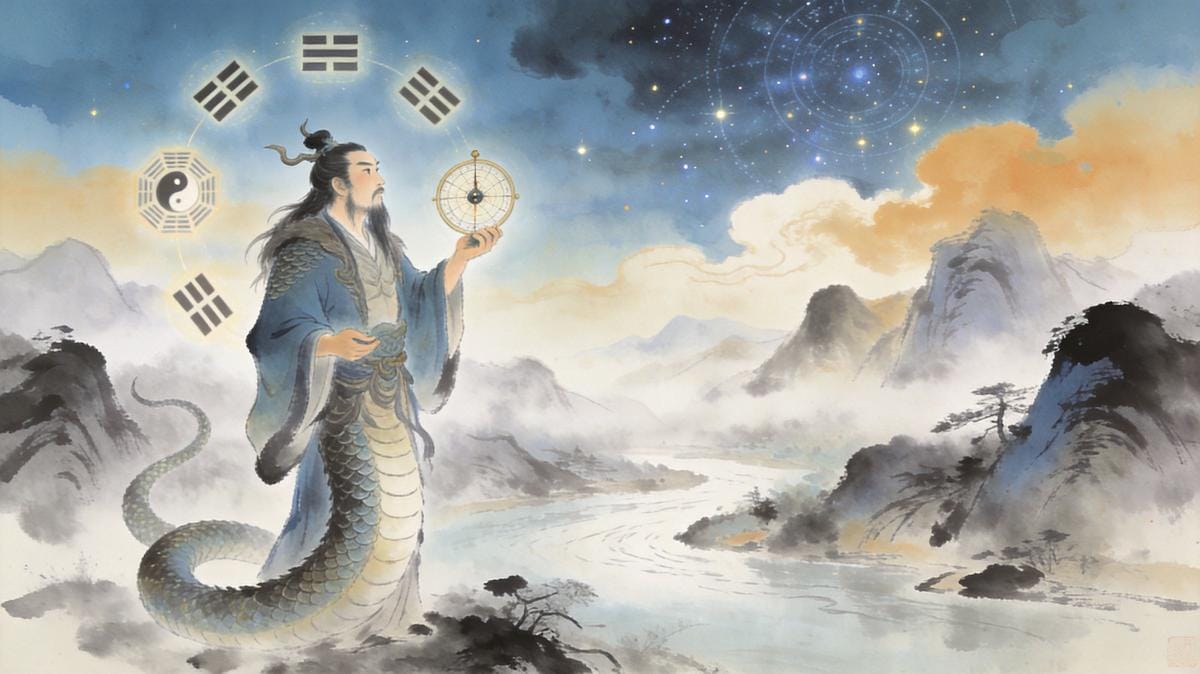
Fuxi studied the pattern. He meditated on it. And from it, he derived the bagua (八卦) — the Eight Trigrams, a system of broken and unbroken lines that could represent every phenomenon in the universe. Heaven and earth. Water and fire. Mountain and lake. Wind and thunder. Eight symbols, endlessly recombinable, forming the DNA of Chinese cosmological thought.
The Shu Jing (Book of Documents) references this moment cryptically: "When the River yielded its diagram, the sage took it and established the trigrams." The Shi Ji by Sima Qian adds that Fuxi "created the eight trigrams to communicate with the divine and to classify the virtues of all things."
What makes the bagua remarkable is its elegance. Three lines, each either solid (yang) or broken (yin), arranged in eight possible combinations — and from those eight combinations, you can model weather patterns, agricultural cycles, human relationships, political dynamics, even the progression of disease. It is a binary system, predating Leibniz by roughly four thousand years. The German mathematician himself recognized this when he encountered the Yijing in the 18th century.
The Net, the Calendar, and the Wedding
The bagua was Fuxi's philosophical masterpiece, but his practical inventions were equally transformative. The Yi Jing Xici (系辞, the Appended Remarks of the Book of Changes) records: "Fuxi knotted cords into nets and taught the people to hunt and fish." Before Fuxi, people chased individual animals with their bare hands. After Fuxi, they could catch dozens at once.
He established the first calendar, dividing the year into seasons and assigning names to the months — a system later refined by the Yellow Emperor and the Xia dynasty. Without a calendar, agriculture is impossible. You cannot plant crops if you do not know when spring arrives.
And he created the institution of marriage. The Fengsu Tongyi (风俗通义) states: "Fuxi established the pairing of men and women, ordering that each man take one woman and each woman take one man, and that they present animal skins as betrothal gifts." Before this, the text implies, sexual relations were unregulated and children did not know their fathers. Fuxi's solution was radical: pair-bonding, gift exchange, public ceremony. The pi (皮) — a pair of deer skins — became the first engagement ring.
The Snake-Bodied Sovereign
Almost every ancient depiction of Fuxi shows him with a human upper body and a snake or dragon tail below. He is nearly always paired with Nuwa, their tails intertwined — a visual motif that appears on Han dynasty tomb bricks from Shandong to Sichuan. The Tianwen section of the Huainanzi describes him as having a snake body and a human head.
This hybrid form is not random. Snakes shed their skins — a symbol of transformation and renewal. Dragons control water and weather. In pairing Fuxi with Nuwa as twin serpent-bodied beings, ancient Chinese artists were encoding a cosmological claim: these are not humans who achieved divinity, but primordial forces that assumed human shape to teach civilization.
The Diben (帝本) tradition identifies Fuxi as the son of a woman named Huaxu (华胥), who stepped into a giant footprint in a swamp called Leize (雷泽) and became pregnant. The footprint belonged to the Thunder God. This birth story — woman steps in divine footprint, conceives culture hero — parallels origin myths across the ancient world, from the Greek Danae to the Korean Dangun.
Fuxi as the First Emperor
Multiple texts agree that Fuxi was the first to hold the title of emperor (di 帝). The Shiji by Sima Qian begins its chronological tables with Fuxi, and the Diwang Shiji (帝王世纪) by Huangfu Mi records his reign at 110 years (some say 197). His capital was at Chen (陈), modern-day Huaiyang in Henan Province, where the Taihao Mausoleum (太昊陵) still draws pilgrims each spring.
The title Taihao (太昊) — "Great Brilliance" — was posthumously conferred. It positions Fuxi as the embodiment of the eastern direction, the element of wood, and the season of spring. In the Five Elements cycle, wood is the element of beginnings, which is fitting for a sovereign whose entire legacy is about starting things.
The Trigrams That Built a Culture
The bagua became the foundation of the Yijing (Book of Changes), arguably the most influential text in East Asian intellectual history. King Wen of Zhou expanded the eight trigrams into sixty-four hexagrams. Confucius reportedly studied the Yijing so intensively that he wore out three copies of the bamboo slips. The system influenced Daoist alchemy, Buddhist metaphysics, military strategy, traditional medicine, feng shui, and Korean and Japanese divination traditions.
Every time a traditional Chinese doctor takes a pulse and maps it to the five phases, every time a feng shui master positions a building according to the eight directions, every time someone consults the Yijing for guidance — they are using a system that traces back to Fuxi watching dots on a dragon-horse's back.
Compare this to the Greek myth of Prometheus, who stole fire from the gods. Fuxi didn't steal anything. He observed, deduced, and constructed. His was not a gift from above but a discovery from within — a fundamentally different model of how knowledge enters the human world.
Connections Across the Mythological Landscape
Fuxi's story interlocks with nearly every other major figure in Chinese mythology. He is paired with Nuwa as both sibling and spouse — the two of them repopulating the world after a great flood, much like Deucalion and Pyrrha in Greek myth. Some traditions place him as Suiren's son, creating a direct lineage from fire to civilization. And his trigram system provided the intellectual infrastructure that the Yellow Emperor would later use to organize the state, that Shennong would use to classify herbs, and that Yu the Great would use to channel the floodwaters.
Fuxi did not just invent things. He built the operating system that every subsequent Chinese culture hero would run on.