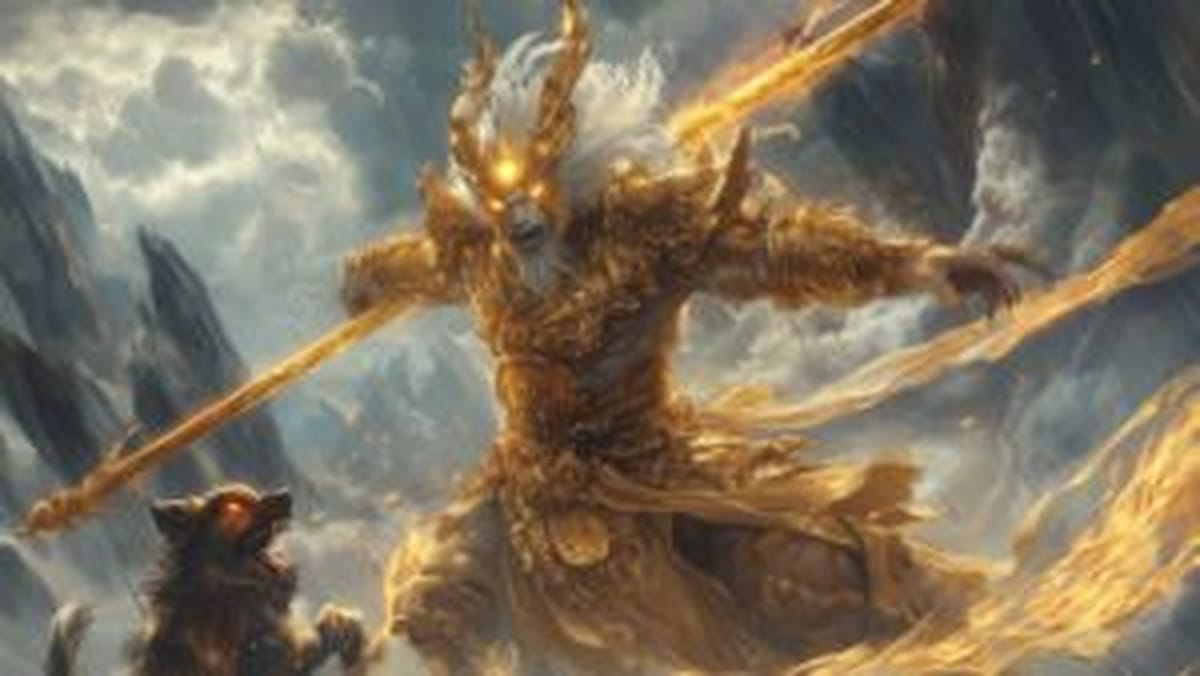
The God With Three Eyes
If the Jade Emperor had a problem too big for his regular army, he sent Erlang Shen. If demons were terrorizing the countryside, Erlang Shen showed up with his hound and his three-pointed double-edged lance, and the demons suddenly had much bigger problems. And if you asked Erlang Shen how he felt about working for the Jade Emperor, he'd probably say something rude and then do the job anyway, because that's who he is.
Erlang Shen — Yang Jian by birth — has a third eye in the middle of his forehead. Not a decorative one. This eye sees through every illusion, every disguise, every transformation. When Sun Wukong turned himself into a temple to hide, Erlang's third eye spotted the tail Wukong forgot to conceal. When demons take human form, Erlang sees the monster underneath. In a mythological world built on deception, he's the one guy you can't fool.
A Family Dysfunctional Enough for Greek Tragedy
Yang Jian's mother was the Jade Emperor's sister, Yaoji. She fell in love with a mortal scholar named Yang Tianyou. The Jade Emperor considered this a mortal sin — literally — and punished Yaoji by sealing her under Peach Mountain. Different versions give different reasons: some say it was the mixed marriage itself, others that she used her divine powers to help mortals flood the land.
Yang Jian grew up knowing his mother was imprisoned. He trained under a Daoist master, became impossibly powerful, and then did what any son would do: he split Peach Mountain open with his lance and freed her. The Jade Emperor responded by sending his other nephew to kill Yaoji. Yang Jian, depending on the version, either couldn't save her a second time or was too late. Either way, he never forgave his uncle.
This is the core of Erlang Shen's character. He fights for heaven, but he doesn't respect it. He does his duty while carrying a grudge that would fuel a dozen family dramas.
The Battle Against Wukong
When Sun Wukong was wreaking havoc in heaven, Erlang Shen was the one who finally caught him. Their fight is one of the most spectacular passages in Journey to the West — a shape-shifting duel where each transformation is countered by another. Wukong becomes a fish, Erlang becomes a fish-eating bird. Wukong becomes a snake, Erlang becomes a crane. On and on it went, until Wukong made his fatal mistake: he turned into a temple, but his tail stuck out the back like a flagpole.
Erlang's third eye caught the deception immediately. Even then, capturing Wukong required Laozi's diamond snare from above. Erlang Shen was the only fighter in heaven who could match the Monkey King blow for blow, trick for trick.
Who's the Good Boy?
Erlang Shen never goes anywhere without his Xiaotian Quan — the Howling Celestial Hound. This isn't a pet. It's a divine beast that can track anything, bite through anything, and fight alongside its master with terrifying coordination. In some versions of the myth, the hound was the one who actually bit Wukong during their battle, giving Erlang the opening he needed.
The six brothers of Mount Plum — six mountain deities who serve as Erlang's sworn companions — round out his retinue. Erlang doesn't command the celestial armies. He leads a small, tight crew. That tells you something about how he operates.
The Reluctant Loyalist
Here's what makes Erlang Shen fascinating: he could overthrow the Jade Emperor. He has the power, the skill, and the motivation. His mother was killed by the very system he serves. But he doesn't rebel. He shows up when heaven calls, fights harder than anyone, and then retreats back to his mountain without demanding promotion or praise.
Some read this as weakness. Others see it as the deepest form of integrity — doing the right thing even when the people ordering you around don't deserve your loyalty. Erlang Shen protects the world, not the emperor. The fact that those two things sometimes overlap is incidental.
In Chinese folk religion, Erlang Shen is worshipped as a water god, a warrior god, and a protector of the innocent. His temples are especially common in Sichuan, where the real historical Yang Jian (if he existed) was said to have served as a hydraulic engineer, taming the Min River. Maybe that's the most telling detail of all: the god who could fight heaven chose instead to manage floods. He preferred building to destroying.