The Ruler Who Gave It Away
Of all the revolutionary acts in Chinese mythology — Suiren making fire, Fuxi decoding the cosmos, the Yellow Emperor defeating Chiyou — the most radical was performed by a man who simply stepped aside. Emperor Yao (尧) looked at the most powerful position in the known world, looked at his own son, and decided that neither he nor his bloodline deserved to keep it. He gave the throne to a stranger.
This is the shanrang (禅让, "ceding the throne") — the abdication of power to the most worthy person rather than the most related one. It is the founding myth of meritocratic governance in Chinese culture, and Yao is its chief architect. Every subsequent debate about whether leaders should be chosen by birth or by ability traces back to this single decision.
The Shiji by Sima Qian begins its account of Yao with a description that reads like an impossible ideal: "His benevolence was like heaven, his wisdom like the gods. Approaching him, one felt like the sun; looking up to him, one felt like a cloud." But the real measure of Yao is not his virtue — it is what he did with it.
The Man Behind the Throne
Yao's personal name was Fangxun (放勋), and he was the son of Di Ku and his wife Qingdu. The Shiji records that his half-brother Zhi ruled briefly before him but proved incompetent, and the people turned to Yao instead. This detail is significant: Yao did not seize the throne. He was chosen. His authority derived from consent, not conquest.
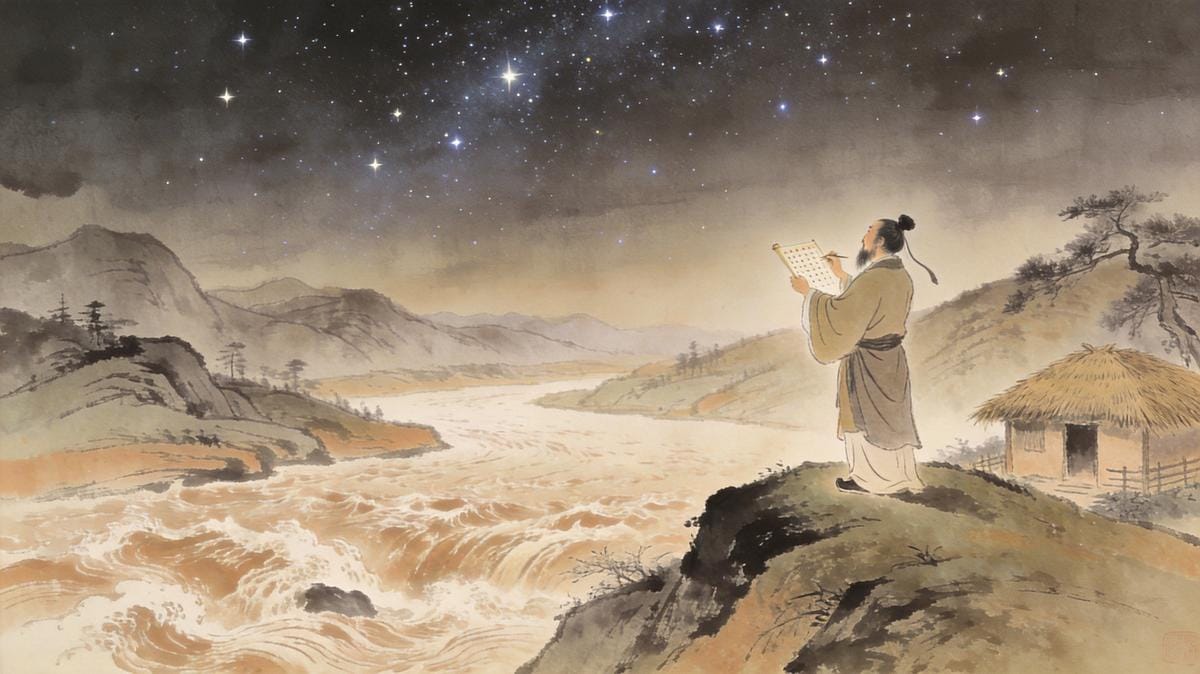
The Shangshu (尚书, Book of Documents) opens with the "Yao Dian" (尧典, Canon of Yao), one of the oldest texts in the Chinese literary tradition. It describes Yao as aligning his governance with the movements of the sun, moon, and stars — appointing the Xi and He brothers to observe the heavens and create an accurate calendar. "He separately commissioned Xi Zhong to reside in Yanggu and respectfully receive the rising sun," the text reads. "He ordered the Xi brothers and the He brothers to reverently observe the heavens and calculate the calendar."
This is not just astronomy. By grounding his rule in the movements of celestial bodies, Yao was claiming that political order must reflect cosmic order — a principle that would dominate Chinese political theory for three thousand years.
The Flood
Yao's reign was disrupted by a catastrophe. The Shangshu records: "The waters of the flood warned heaven, vastly encircling the mountains and overwhelming the highlands. The people of the lowlands were distressed." This was the Great Flood — the same deluge that Yu the Great would eventually tame, but during Yao's reign, it was an unsolved crisis.
Yao consulted his ministers about who could control the waters. They recommended Gun (鲧), Yu's father. Yao was skeptical — "Gun is contrary and destructive; he will ruin the work" — but he yielded to the consensus. Gun was given nine years to control the flood. He failed. He tried to build ever-higher dikes, but the water simply rose higher. The Shan Hai Jing says that Gun stole the xi rang (息壤, self-expanding earth) from heaven to build his dikes — an act of cosmic theft that angered the gods and led to his execution on Feather Mountain.
The flood narrative is crucial to understanding Yao. He was a ruler who faced a problem too large for any individual to solve, who delegated authority to the recommended candidate, who watched that candidate fail, and who bore the consequences without abdicating responsibility. The flood was not his fault, but it was his problem — and the eventual solution (through Yu) would come from the next reign.
The Great Question: Who Should Rule?
As Yao aged, the question of succession became urgent. He had a son, Danzhu (丹朱), but Yao judged him unsuitable. The Shangshu records the deliberation:
Yao asked: "Who can follow and carry out my work?" The minister Fangqi said: "Your son, Danzhu, is intelligent and open." Yao replied: "Ah, he is obstinate and quarrelsome. Can he?"
Yao then asked his ministers to recommend someone else. They suggested Shun (舜), an obscure commoner known for his extraordinary filial piety — a man who had endured abuse from his family with patience and virtue. Yao decided to test him.
He gave Shun his two daughters, Ehuang (娥皇) and Nüying (女英), as wives — not as gifts, but as observers. "I will test him," Yao said. He also gave Shun responsibilities in government: managing the education of the nobles, overseeing diplomatic relations with foreign tribes, and navigating the wilderness. The Shiji records that Shun succeeded at every task. "The various ministers were all convinced of his virtue."
For twenty years, Shun served under Yao's observation. Only after two decades of proven competence did Yao formally cede the throne. The Shangshu describes the moment: "Yao aged and ordered Shun to take the role of acting emperor... After twenty-eight years, Yao died. The people mourned as if they had lost a parent."
The Philosophy of Abdication
The shanrang narrative has been debated, celebrated, and weaponized throughout Chinese history. The Confucian tradition treats it as the gold standard of governance — proof that the best ruler is the one who places the welfare of the people above dynastic interest. Mencius argued that Yao's decision was correct because "Heaven sees as the people see; Heaven hears as the people hear." The Mandate of Heaven, in this reading, flows not through bloodlines but through popular approval.
The Legalist tradition was skeptical. Han Feizi argued that the shanrang was either fiction or foolishness — no ruler would voluntarily surrender power, and any ruler who did was abandoning the state to chaos. The Mohists, meanwhile, used the story to argue that merit, not birth, should determine leadership — a position that put them at odds with both hereditary aristocrats and Confucian ritualists who emphasized proper lineage.
The historical question is equally contested. Some scholars argue that the shanrang reflects a real pre-dynastic practice of chieftain selection by council. Others see it as a Zhou dynasty invention, designed to legitimize the Zhou overthrow of the Shang by creating a mythological precedent for non-hereditary succession. If Yao could give the throne to Shun, then the Zhou could take it from the Shang — provided they were more virtuous.
Yao and the Art of Ruling Less
A tradition preserved in the Zhuangzi captures Yao at his most philosophical. In the "Xiaoyaoyou" (逍遥游, Free and Easy Wandering) chapter, Yao visits a Daoist sage named Xu You (许由) and offers him the empire. "When the sun and moon are already shining," Yao says, "why continue to light a torch? When the seasonal rains are already falling, why keep watering the crops? If you were on the throne, the empire would be well governed. I am merely occupying the position. Please take it."
Xu You refuses. "You govern the empire, and the empire is well governed. If I were to take your place, would I be doing it for the name? The name is just the guest of the reality. Would I be doing it for the reality? The wren builds its nest in the deep forest, using no more than a single branch. The mole drinks from the river, taking no more than a bellyful. Go home, my lord. I have no use for the empire."
This exchange is a philosophical dialog about the nature of power and desire. Yao, the virtuous ruler, still craves validation — he wants someone better to confirm that the world is in good hands. Xu You, the Daoist sage, sees through the craving. The empire is fine as it is. The best ruler is the one who rules least — and the one who can walk away from power entirely has surpassed even the best ruler.
Yao's Enduring Question
Yao died, and Shun mourned him for three years. The people refused to acknowledge Danzhu and followed Shun instead — a detail that reinforces the meritocratic thesis. The people chose the better man, not the blood heir.
Yao is buried at Chengyang, in modern Shandong Province, and he is remembered as the model of the philosopher-king — a ruler who governed through virtue, who endured catastrophe without complaint, who tested his successor for two decades before trusting him with power, and who ultimately defined the meaning of leadership as the willingness to let go of it.
His question — "Who can follow and carry out my work?" — remains the fundamental question of governance. Not "Who is my heir?" but "Who can do the job?" The fact that a mythological ruler asked it four thousand years ago, and that Chinese culture has argued about the answer ever since, tells you something about the power of the question.