The Family From Hell
Before he was an emperor, Shun (舜) was a farmhand with a target on his back. His father, Gusou (瞽叟, "Blind Old Man"), wanted him dead. His stepmother wanted him gone. His half-brother, Xiang (象), wanted his share of the inheritance — and was perfectly willing to help kill him to get it. Together, they formed the most dysfunctional family in Chinese mythology, and they spent years trying to murder the man who would become the most virtuous emperor in the tradition.
Shun's story is the original rags-to-throne narrative in Chinese culture. Born into poverty, abused by his own family, he never fought back. He endured, he worked, and he remained filial — and his refusal to break is exactly what made him worthy of the empire.
The name Shun means "obedient" or "compliant," but the character 舜 also refers to a type of hibiscus flower. The Shiji gives his personal name as Chonghua (重华, "Double Brilliance") — a name that hints at the inner light that his family tried so hard to extinguish.
Genealogy: The Bloodline That Should Have Meant Nothing
The Shiji traces Shun's ancestry back to the Yellow Emperor through seven generations: Huangdi, Changyi, Zhuanxu, Qiongchan, Jingkang, Gusou, and finally Shun. By the time Shun was born, the family had fallen so far from imperial glory that they were common peasants. Six generations of decline — from the grandson of heaven to a blind farmer in a mud hut.
This genealogy is significant. Shun was not a nobody. He was a fallen aristocrat — someone with the blood of the Yellow Emperor in his veins but none of the privileges. His rise to the throne was therefore both a meritocratic triumph and a restoration of the legitimate line. The myth has it both ways: Shun earned the throne through virtue, but he also deserved it through ancestry. The tension between these two claims is never fully resolved.
The Murder Attempts
The Shiji and the Mencius describe three specific attempts on Shun's life, each more brazen than the last.
The first: Gusou asked Shun to repair the roof of the family granary. While Shun was up on the roof, Gusou and Xiang removed the ladder and set the building on fire. Shun, according to the Liezi, used two bamboo hats as wings and glided to safety. The Shiji is more restrained: "Shun descended using his hat as a shield." Either way, he survived.
The second: Gusou asked Shun to dig a well. When Shun was deep underground, Gusou and Xiang shoved earth and stones into the well, attempting to bury him alive. But Shun had anticipated treachery and dug a side tunnel. He emerged elsewhere, alive and unharmed.
The third, recorded in later tradition: Gusou and Xiang invited Shun to drink, planning to intoxicate and then kill him. Shun's wife, Ehuang (one of Yao's daughters), gave him a medicinal bath beforehand that made him resistant to alcohol. He drank without effect and left unharmed.
After each attempt, Shun returned to his family as if nothing had happened. He continued to serve his father with respect and to treat his brother with kindness. The Mencius explains: "When his father and brother tried to kill him, he could not abandon them. When they were not trying to kill him, he was always there for them."
The Commoner Who Outshone Everyone
Word of Shun's extraordinary character spread. The Shangshu records that when Yao asked his ministers for a successor, they said: "There is a common man among the lower people named Shun." Not a noble. Not a warrior. A common man whose only credential was his moral character.
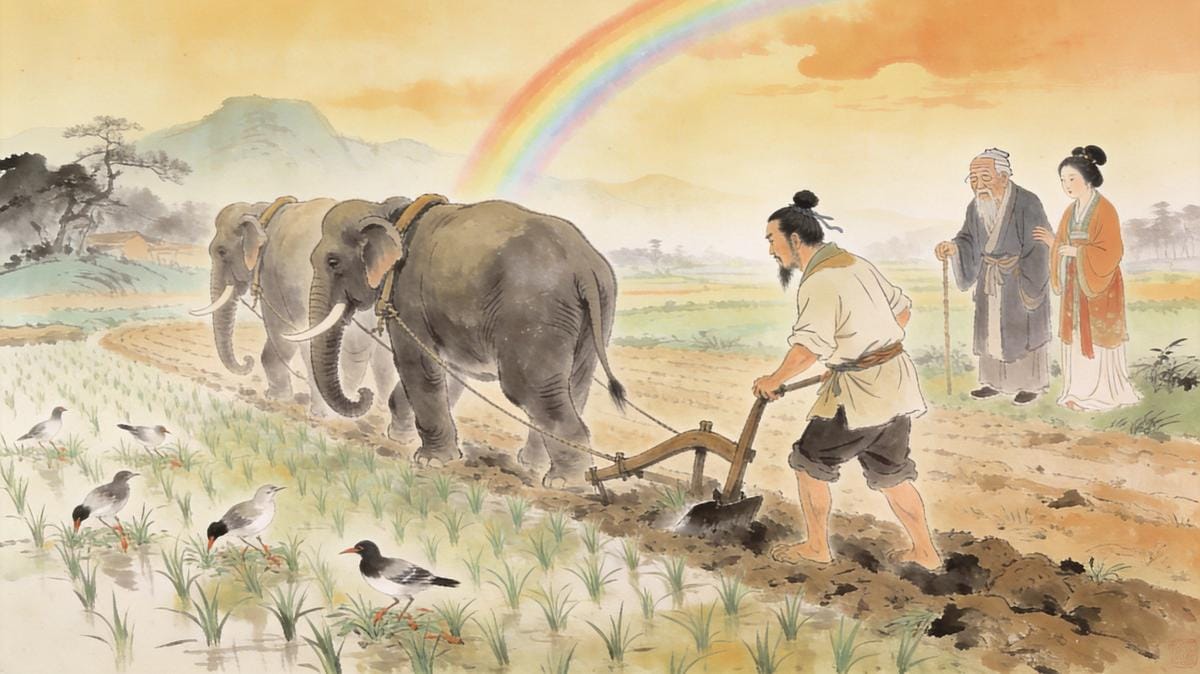
The Mencius adds detail: "Shun plowed at Mount Li, made pottery by the Yellow River, and fished at Thunder Marsh." He was a laborer — a man who worked with his hands and earned his bread through sweat. His reputation was not built on achievement but on patience. The people of Mount Li stopped disputing over land boundaries after they saw how Shun yielded his own. The potters by the Yellow River stopped producing shoddy goods after they saw Shun's meticulous craftsmanship. The fishermen at Thunder Marsh stopped fighting over the best spots after they saw Shun offering the prime positions to others.
His influence was magnetic. Wherever he went, people became better — not because he lectured them, but because his example was impossible to ignore.
The Twenty-Year Test
Yao gave Shun his two daughters as wives — Ehuang and Nüying — to observe his character from the inside. He gave him government responsibilities. He sent him into the wilderness, into the mountains, into storms. The Shiji records: "Shun entered the great forests of the mountains. He encountered fierce winds and thunderstorms but was never disoriented or afraid." This was not a symbolic test. The wilderness was genuinely dangerous, and Shun navigated it with a calm that convinced everyone — including the gods — that he was made of different stuff.
After twenty years of testing, Yao formally abdicated. Shun became emperor. And then he did something unexpected: he continued to visit his father, Gusou, with the same respect he had always shown. The Liji (Book of Rites) records that Shun "carried the shield and axe to the court of Gusou, dancing with reverence and delight." The new emperor — the most powerful man in the world — still performed the rites of a filial son before a father who had tried to murder him. Multiple times.
Shun's Reign: Institutional Builder
Once on the throne, Shun proved to be a skilled administrator. The Shangshu records his institutional reforms in detail. He divided the empire into twelve provinces, each with appointed officials. He established regular inspection tours to monitor the performance of local governors. He created the system of imperial audiences, where officials presented reports on the state of their territories.
He appointed Yu (禹) to continue the flood control work that Gun had failed at — a decision that would lead to Yu the Great's legendary taming of the waters. He appointed Gao Yao (皋陶) as minister of justice, establishing the principles of criminal law. He appointed Qi (弃, also called Hou Ji) as minister of agriculture, ensuring food security for the growing population.
He also dealt decisively with troublemakers. The Shangshu records that Shun punished the "Four Perils" — four monstrous officials who had abused their power. He exiled Hundun (浑沌), Qiongqi (穷奇), Taowu (梼杌), and Taotie (饕餮) to the four extremities of the earth, "to keep the harmful creatures of the wilderness at bay." Each of these names became a byword for a different type of wickedness: Hundun for chaos, Qiongqi for treachery, Taowu for stubborn malice, Taotie for insatiable greed.
The Second Abdication
At the end of his reign, Shun replicated Yao's precedent. He had a son, Shangjun (商均), but judged him unworthy. Instead, he designated Yu the Great — the man who had solved the flood crisis — as his successor. The Shanhai Jing tradition says that Shun abdicated and traveled south, dying at Cangwu (苍梧) during a tour of inspection. His two wives, Ehuang and Nüying, rushed to his side but were blocked by the Xiang River. They wept by the riverbank, their tears staining the bamboo with permanent spots — the origin of the xiangfei zhu (湘妃竹, "Concubine Xiang Bamboo"), also known as mottled bamboo, which still grows along the Xiang River in Hunan.
The women drowned themselves in the river and became its goddesses — the Xiang River Deities, worshipped for centuries. The poet Qu Yuan wrote the "Xiang Jun" and "Xiang Furen" odes in their honor, part of the Chu Ci (Songs of Chu), one of the greatest works of Chinese literature.
Shun and the Problem of Filial Piety
Shun's story raises one of the most difficult questions in Chinese ethics: what do you do when filial piety conflicts with justice? Your father tries to kill you. Your brother helps. Do you fight back? Do you report them? Do you leave?
Shun's answer was to do none of these things — and to do all of them, in a way. He did not fight back physically, but he escaped each murder attempt through cleverness. He did not report his family to the authorities, but he did not allow himself to be killed. He did not leave permanently, but he established enough distance to survive. The Mencius frames this as the highest form of filial piety: Shun honored his parents by never giving up on the relationship, while simultaneously refusing to let their wickedness destroy him.
Later Confucians debated this endlessly. Was Shun truly filial, or was he enabling abuse? The question has no clean answer, which is precisely why Shun's story remains relevant. Every generation must decide how to balance loyalty to family with loyalty to self — and Shun's impossible balance is the standard against which all solutions are measured.
The Bamboo Still Grows
Shun is buried at Jiuyi Mountain (九疑山) in Hunan Province, and his tomb remains a pilgrimage site. The Xiangfei bamboo still grows along the river where his wives wept. The spots on its stalks — said to be the stain of their tears — are visible to this day, a botanical monument to grief that refuses to fade.
Of all the Three Sovereigns and Five Emperors, Shun is the most human. He did not invent fire or decode the cosmos or sever heaven from earth. He just survived a terrible family and refused to become terrible himself. That is not a small thing. In a mythological tradition full of cosmic battles and divine inventions, Shun's achievement — remaining good in a world that gave him every reason not to be — might be the most miraculous of all.