The Ruler Who Did Nothing Wrong
Most mythological rulers are remembered for their spectacular acts — wars fought, monsters slain, inventions created. Di Ku (帝喾) is remembered for something far more difficult: being good at the job without making it about himself.
Di Ku, also known as Gaoxin (高辛), is the fourth of the Five Emperors in the traditional sequence: Huangdi, Zhuanxu, Di Ku, Yao, Shun. His name is the most unassuming of the group. Di means "emperor." Ku (喾) means "to inform" or "to instruct" — a name that suggests a ruler whose primary function was communication, not conquest. He instructed the people in the ways of proper governance, and he listened when they spoke back.
This makes Di Ku the odd one out. The Yellow Emperor is a warrior-king. Zhuanxu is a cosmic reformer. Yao is a philosopher. Shun is a moral hero. Di Ku is... a competent administrator. And in the political mythology of ancient China, that was enough to make him one of the greatest sovereigns who ever lived.
Genealogy and Birth
The Shiji traces Di Ku's lineage directly to the Yellow Emperor. He was the great-grandson of Huangdi: the Yellow Emperor begot Xuanxiao, Xuanxiao begot Jiaoji, and Jiaoji begot Di Ku. But the Diwang Shiji adds that he was also the nephew of Zhuanxu, making him both a descendant and a relative of his predecessor.
His birth name was Jun (俊), and he was also called Gaoxin after the fiefdom he was initially granted. The Shiji notes that he was born speaking his own name — a detail that appears in several emperor birth stories, marking the child as supernaturally self-aware.
The Shan Hai Jing refers to a figure called Di Jun (帝俊) who is sometimes identified with Di Ku. This Di Jun is described as the husband of two sun-goddesses, Xihe (羲和) and Changxi (常羲), who bore him ten suns and twelve moons respectively. Whether Di Jun and Di Ku are the same figure remains debated, but the solar and lunar connections reinforce the cosmological significance of his reign.
The Virtues of Equilibrium
The Shiji's description of Di Ku is a masterclass in how ancient Chinese political thought understood good governance. Sima Qian writes: "He was benevolent but not unyielding, virtuous but not boastful. His wealth was distributed rather than hoarded. He listened to the concerns of the distant and observed the needs of the near. He followed the way of heaven and understood the desires of the people. He was respectful and frugal, and he was sincere and trustworthy."
Notice what is absent from this list. No military campaigns. No divine revelations. No supernatural feats. Just a set of personal qualities — benevolence, humility, generosity, attentiveness, frugality, trustworthiness — applied consistently to the business of ruling. Di Ku's greatness lies not in what he did but in how he did it.
The Shiji adds that "the sun and moon were always on time, and the winds and rain arrived in their proper seasons" during his reign. This is a cosmological compliment of the highest order: when the ruler is virtuous, nature itself falls into harmony. The converse — that natural disasters indicate the ruler's moral failure — became a foundational concept in Chinese political philosophy.
The Four Sons and the Shape of History
Di Ku's most significant contribution to the mythological narrative is his children. Through his four wives, he fathered the founders of China's most important dynasties — a genealogical feat that makes him the single most important ancestor in Chinese royal lineage.
His principal wife, Jiang Yuan (姜嫄), gave birth to Hou Ji (后稷), the ancestor of the Zhou dynasty. According to the Shi Jing (Book of Odes), Jiang Yuan stepped in the footprint of a giant and became pregnant — the same conception motif found in Fuxi's birth story. Hou Ji became the god of agriculture and the progenitor of the house that would rule China for nearly eight hundred years.
His second wife, Jiandi (简狄), swallowed an egg dropped by a dark bird (xuanniao 玄鸟) and gave birth to Qi (契), the ancestor of the Shang dynasty. The Shi Jing records this myth in the "Shang Song" section: "Heaven commanded the dark bird to descend and give birth to the Shang." This egg-conception motif parallels world-egg creation myths and positions the Shang as divinely ordained.
His third wife, Qingdu (庆都), gave birth to Yao (尧), who would become the next of the Five Emperors and the archetype of the virtuous ruler. And his fourth wife, Changyi (常仪), gave birth to Zhi (挚), who briefly ruled before yielding to Yao.
Three of these sons — Hou Ji, Qi, and Yao — became founders or ancestors of dynasties that shaped Chinese civilization. Di Ku did not just rule well. He populated the future.
Government as Listening
The Kongzi Jiayu (孔子家语, School Sayings of Confucius) records a passage in which Confucius describes Di Ku's governing method: "He appointed officials according to their abilities and did not favor his relatives. He examined the affairs of the people without growing weary. He was restrained in his desires and sincere in his commitments."
This description reads like a manual for good governance: merit-based appointments, diligence, self-restraint, honesty. No magic required. The subtext is clear — Di Ku's success proves that virtue, not force, is the foundation of lasting power. This is the central argument of the Confucian political tradition, and Di Ku is its Exhibit A.
The Da Dai Liji (大戴礼记) adds that Di Ku "clothed himself in plain garments and ate simple food. He did not indulge in luxuries." The emphasis on frugality is deliberate. In a mythological tradition full of gods who ride dragons and wield cosmic power, Di Ku stands out for his deliberate ordinariness. His restraint is not weakness — it is discipline.
The Music of Governance
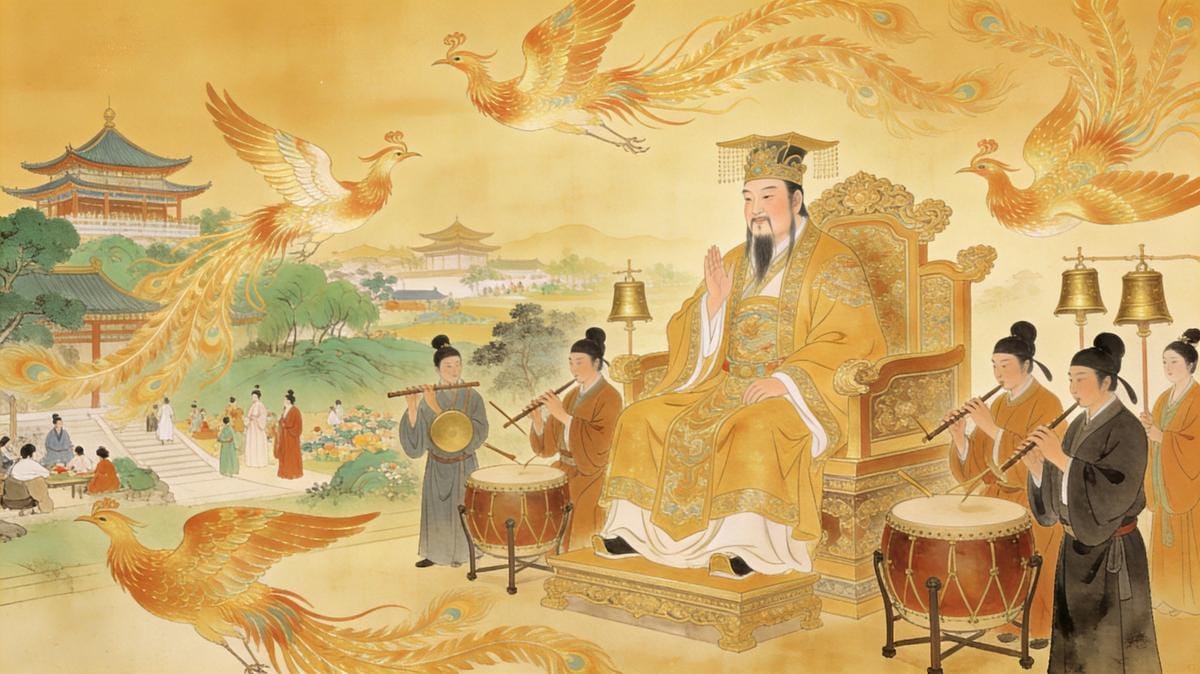
One of the few creative acts attributed to Di Ku is musical. The Lüshi Chunqiu (吕氏春秋) records that Di Ku ordered his musician, Xianhei (咸黑), to compose the jiushao (九招, Nine Invitations) — a set of ritual songs and dances. He also had musicians perform the liuhe (六列, Six Ranks) dance.
Music in ancient China was not entertainment. It was a technology of governance. The correct performance of ritual music was believed to harmonize the state with the cosmic order, ensuring timely rains, abundant harvests, and social stability. By commissioning ritual music, Di Ku was doing the administrative work of aligning human society with the rhythm of the universe — a subtler but no less important form of governance than the Yellow Emperor's wars or Zhuanxu's cosmic surgery.
The Political Fable of Moderation
Di Ku's myth is a political fable dressed as biography. Every detail — his humility, his frugality, his merit-based appointments, his harmonious reign — serves an argumentative purpose. The argument is this: the best ruler is not the most powerful, the most charismatic, or the most divinely favored. The best ruler is the one who governs with restraint, who listens more than speaks, and who leaves the world slightly better than he found it without making a spectacle of the improvement.
This was a radical idea in a world where kings derived legitimacy from military conquest and divine ancestry. Di Ku had both — he was a descendant of the Yellow Emperor and was born with supernatural signs. But his myth deliberately downplays these advantages in favor of personal virtue. The message to future rulers is unmistakable: your bloodline and your military victories mean nothing if you do not govern well.
It is no coincidence that Confucius and his followers revered Di Ku. He was the proof that their political philosophy worked — that a ruler could maintain order and prosperity through virtue alone, without resorting to force or spectacle.
In the genealogy of Chinese myth, Di Ku bridges the gap between the cosmic age of Huangdi and Zhuanxu and the moral age of Yao and Shun. He takes the raw power of his predecessors and channels it into the ethical framework that his successors will perfect. He is the hinge between might and right — and his quiet competence is what makes the turn possible.