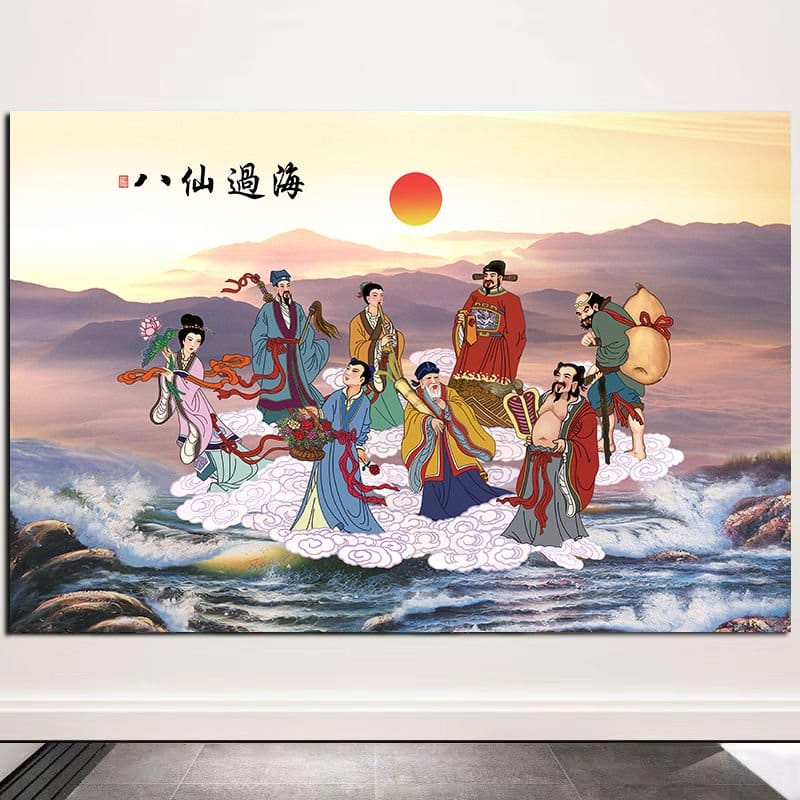
The Invitation to the Feast
The story of the Eight Immortals Crossing the Sea begins with a grand celebration. The Queen Mother of the West, Xiwangmu, had invited all the gods and immortals to a magnificent banquet at her Jade Pool in the Kunlun Mountains to celebrate the ripening of the sacred peaches of immortality. These peaches, which took three thousand years to bloom, three thousand years to bear fruit, and three thousand years to ripen, conferred eternal life upon anyone who ate them, and the Queen Mother's peach banquet was the most prestigious social event in the celestial calendar.
The Eight Immortals were, of course, among the guests. They attended the banquet in high spirits, enjoying the celestial music, the divine food, and the rare wine that flowed freely. Li Tieguai drank deeply from his gourd, Lu Dongbin engaged in philosophical debates with the other guests, and He Xiangu admired the magical flowers that bloomed in the Queen Mother's garden. The celebration lasted for days, and by the time it was over, the Eight Immortals were in an expansive and adventurous mood. Rather than returning to their usual haunts by the conventional route, they decided to take a more interesting path home — across the Eastern Sea.
The Challenge
When the Eight Immortals reached the shore of the Eastern Sea, they paused to consider how they would cross. The sea was vast and turbulent, stretching to the horizon and beyond. Lu Dongbin, ever the strategist, suggested that they could simply fly across, as immortals are not bound by earthly limitations. But Zhongli Quan, the leader of the group, proposed a more interesting challenge: each of them should cross the sea using only their own unique powers and treasures, without relying on the ability to fly or any other common method. This way, they could demonstrate their individual mastery and have some fun in the process.
The others agreed enthusiastically. After all, what was the point of being immortal if you could not show off a little? The challenge was set, and each immortal prepared to cross the sea in their own distinctive way. This moment — the decision to cross the sea by individual means rather than by a shared method — gave rise to one of the most famous idioms in the Chinese language: "Eight Immortals cross the sea, each reveals their divine power." The phrase is used to describe any situation where a group of talented individuals each uses their own unique abilities to accomplish a common goal.
Eight Methods, Eight Miracles
Li Tieguai threw his iron crutch onto the water and stood on it, using his gourd as a sail, riding the waves like a surfer. Zhongli Quan placed his palm-leaf fan on the water and stood upon it, the fan expanding to become a raft that carried him smoothly across the surface. Lu Dongbin stepped onto his sword, which floated on the water like a boat, and crossed with the calm precision of a master. Zhang Guolao rode his magical white donkey across the surface of the sea as if it were solid ground, the animal's hooves barely touching the water. He Xiangu set her lotus flower upon the waves and stood upon it, the flower growing to support her weight, its petals glowing with a soft, otherworldly light.
Han Xiangzi threw his jade flute into the water and rode upon it, the instrument expanding to become a vessel that carried him across. Cao Guojiu placed his castanets on the water and stood on them, the wooden clappers becoming a stable platform. And Lan Caihe tossed a flower basket into the sea and climbed inside, the basket carrying the androgynous immortal across the waves with the ease of a boat. Each method was unique, each was spectacular, and each demonstrated the individual character and powers of its immortal. The scene of the Eight Immortals crossing the sea, each in their distinctive way, has become one of the most frequently depicted scenes in Chinese art, appearing on porcelain, silk, jade, and virtually every medium of decorative art.
The Dragon King\'s Anger
The crossing was not without incident, however. As the Eight Immortals crossed the sea, their magical displays disturbed the underwater kingdom of the Dragon King of the Eastern Sea. The vibrations from Li Tieguai's crutch striking the water, the light from He Xiangu's lotus, and the energy from Lu Dongbin's sword all caused disruptions in the dragon palace below. The Dragon King, enraged by this disturbance, sent his dragon sons and aquatic soldiers to attack the Immortals. A great battle ensued, with the Dragon King's forces using water magic and the Immortals using their various treasures and powers.
The conflict escalated when the Dragon King's forces managed to capture He Xiangu and take her to the underwater palace. The other Immortals were furious and launched a full-scale assault on the Dragon King's domain. Lu Dongbin used his sword to part the waters, while Zhongli Quan fanned the sea into towering waves. The battle raged until other celestial beings intervened to mediate, and the Dragon King was forced to release He Xiangu. This conflict between the Eight Immortals and the Dragon King serves as a reminder that even immortals are not above conflict, and that the exercise of power — even divine power — can have unintended consequences for others.
The Symbolism of the Crossing
The story of the Eight Immortals crossing the sea is far more than an entertaining adventure tale. It is a rich allegory for the Daoist path of spiritual cultivation. The sea represents the turbulent ocean of worldly existence, full of dangers and obstacles. The Eight Immortals, each using their own unique method to cross, represent the Daoist teaching that there are many paths to enlightenment — not one single method that all must follow. Whether you are a scholar like Lu Dongbin, a warrior like Zhongli Quan, a healer like Li Tieguai, or an artist like Han Xiangzi, you can achieve transcendence through the cultivation of your own unique gifts and abilities. This message of pluralism and individualism, embedded within one of China's most beloved folk tales, continues to inspire and encourage people of all backgrounds to seek their own path to fulfillment.