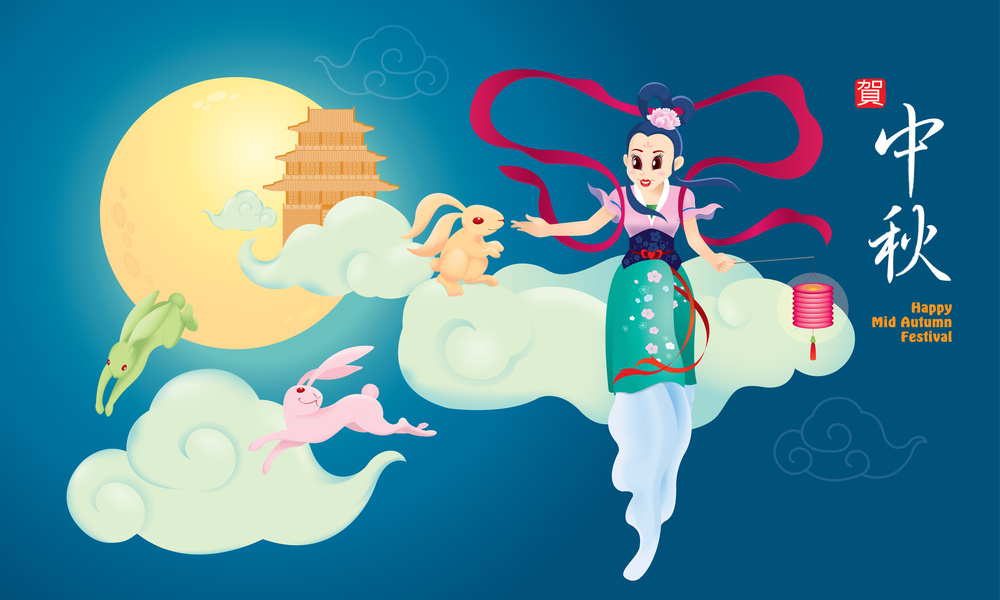
The Beautiful Chang\'e
Chang'e, originally known as Heng'e, was one of the most beautiful women in all of Chinese mythology. She was the wife of Hou Yi, the legendary archer who had shot down nine of the ten suns that were scorching the earth, and together they were the most celebrated couple in the world. But their happiness was shadowed by a terrible fate: as punishment for killing the suns, the Lord of Heaven had stripped both Hou Yi and Chang'e of their divine status and condemned them to live as mortals. For Chang'e, who had once danced among the stars, the prospect of aging and dying on earth was unbearable.
Despite their mortal condition, Hou Yi and Chang'e loved each other deeply, and they did their best to build a happy life together. Hou Yi continued to use his extraordinary archery skills to protect the people from monsters and demons, while Chang'e kept their home and dreamed of returning to the heavens. Their relationship, however, was increasingly strained by Chang'e's longing for immortality and Hou Yi's growing fame, which attracted the attention of admirers, rivals, and enemies. The tension between their love for each other and their different desires would ultimately lead to one of the most famous separations in all of mythology.
The Elixir of Immortality
Determined to restore their immortality, Hou Yi traveled to the Kunlun Mountains and obtained the Elixir of Immortality from the Queen Mother of the West. The Queen Mother, moved by Hou Yi's devotion and his heroic deeds, gave him exactly enough elixir for two people — one dose for himself and one for Chang'e. The elixir was incredibly precious, the distillation of thousands of years of cosmic essence, and the Queen Mother warned Hou Yi to guard it carefully and to consume it during the full moon, when its power would be greatest.
Hou Yi returned home and gave the elixir to Chang'e for safekeeping, telling her to guard it until the proper time. But the existence of the elixir did not remain a secret for long. Feng Meng, one of Hou Yi's apprentices, learned of the precious potion and conceived a plan to steal it. While Hou Yi was away on a hunting expedition, Feng Meng broke into their home and demanded the elixir at swordpoint. Chang'e, refusing to let such a treasure fall into the hands of a wicked man, made a fateful decision — rather than surrender the elixir, she drank both doses herself.
Ascending to the Moon
The effect of the double dose of immortality elixir was immediate and overwhelming. Chang'e felt her body becoming lighter and lighter, as if the very essence of gravity were releasing its hold on her. She began to float upward, rising through the roof of her home and into the night sky. Below her, the earth grew smaller and smaller, and the moon grew larger and larger. She drifted toward the moon as if drawn by an invisible force, her robes billowing in the celestial wind, her hair streaming behind her like a banner of silk.
When Chang'e reached the moon, she found it a cold but beautiful place, with vast plains of silver and mountains of pale jade. The only other inhabitant was the Jade Rabbit, also known as the Moon Rabbit, who was eternally pounding medicines in a mortar and pestle. Chang'e made her home in the Guanghan Palace, the Cold Palace of the Moon, where she would reside for all eternity. But despite the beauty of her lunar kingdom, Chang'e was desperately lonely. She had achieved immortality, but at the cost of everything she loved. She was forever separated from Hou Yi, forever trapped between heaven and earth, forever gazing down at a world she could no longer touch.
Hou Yi\'s Grief
When Hou Yi returned home and discovered what had happened, he was devastated. He rushed outside and saw his wife floating toward the moon, growing smaller and smaller in the night sky. He called out to her, but his voice could not reach her. In his grief and frustration, he reached for his bow and arrows, tempted to shoot the moon down and bring Chang'e back. But he stayed his hand — he could not destroy the moon, for the world needed its light just as it needed the sun's warmth. Instead, he arranged their favorite fruits and cakes on a table in the garden and looked up at the moon, hoping that Chang'e could see him and know that he still loved her.
This act of offering food and gazing at the moon is said to be the origin of the Mid-Autumn Festival, one of the most important holidays in the Chinese calendar. Every year, on the fifteenth day of the eighth lunar month, Chinese families gather to share mooncakes, admire the full moon, and remember the story of Chang'e and Hou Yi. The round shape of the mooncake symbolizes completeness and reunion, an ironic counterpoint to the story of separation that inspired the tradition. The festival is both a celebration of the beauty of the moon and a poignant reminder of the bittersweet nature of love and longing.
The Moon Goddess Today
Chang'e remains one of the most important and beloved figures in Chinese culture, and her name has taken on new significance in the modern era. China's lunar exploration program is named after her — the Chang'e missions have successfully orbited, landed on, and returned samples from the moon, making Chang'e's ancient journey a reality in a way that the mythmakers could never have imagined. The first lunar rover was named Yutu, the Jade Rabbit, after Chang'e's lunar companion. This naming choice connects China's cutting-edge space program to its ancient mythological heritage, suggesting that the impulse to explore the moon is not merely scientific but deeply cultural — a modern expression of a dream that has captivated the Chinese imagination for thousands of years.